SpaceX Cratering Below IPO Price, But 1 Wall Street Pro Thinks It Could 8X From Here
SpaceX's post-IPO collapse left nearly every early buyer underwater, yet one Wall Street firm just slapped an $800 price target on a stock trading near $113. Here is what the bulls see that the market is choosing to ignore.

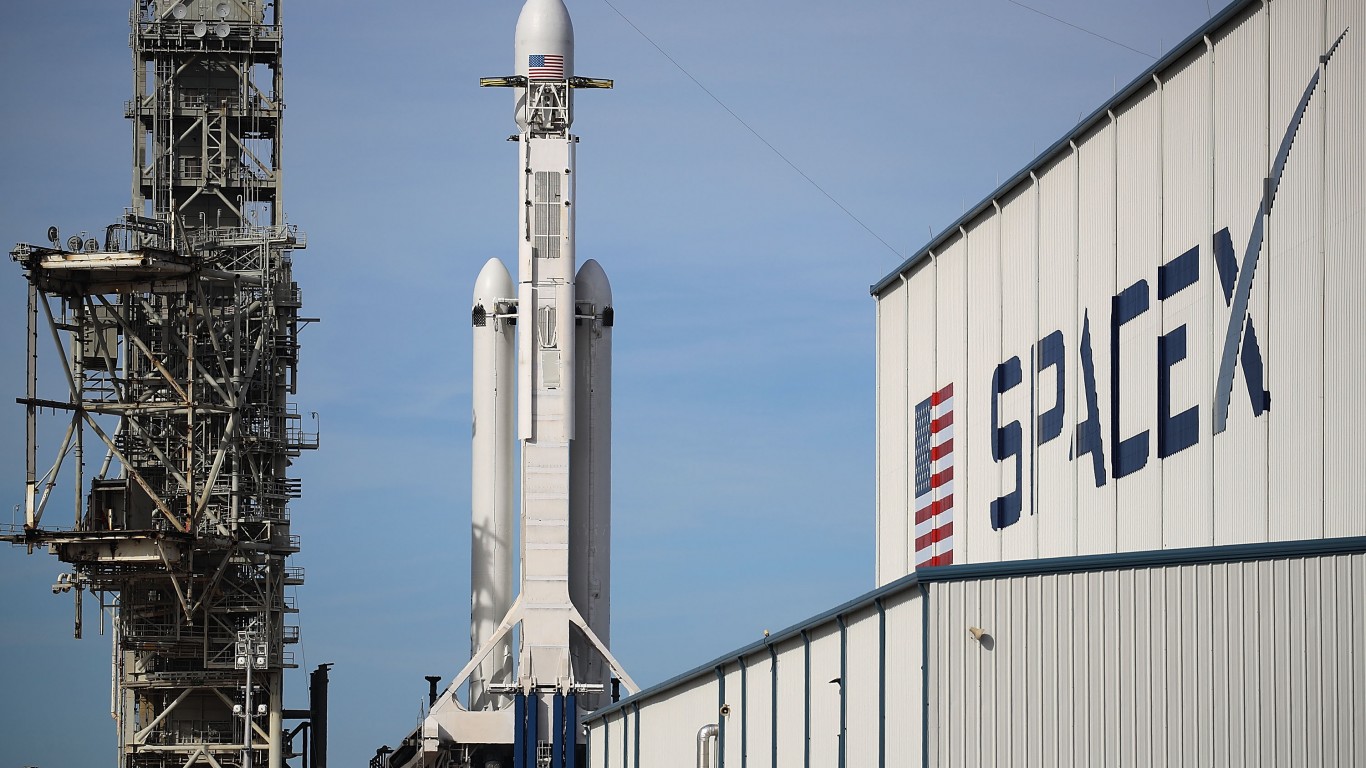
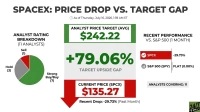
SpaceX (NASDAQ:SPCX | SPCX Price Prediction) currently trades at $113.50, well below the consensus Wall Street price target of $236.71, an implied upside of 108.56%.
Space Exploration Technologies just completed the record $75 billion IPO in mid-June 2026 at a $1.77 trillion valuation and landed with a thud in the weeks that followed. Wall Street sees a company bridging launch, connectivity, and AI infrastructure through Falcon reusability, Starlink’s roughly 9,600 satellites and the newly acquired xAI unit.
One outlier stands apart. Raymond James has staked out an $800 price target, framing SpaceX as a future multi-trillion-dollar monopoly across launch, broadband, and orbital compute.
A Post-IPO Slide That Left Nearly Every Buyer Underwater
Gravity took hold almost immediately. SPCX priced at $135, spiked over $225 in the first days of trading, and has since collapsed from its June 15 high of $192.50, the stock is down 41.04%, sliding 29.48% since its June 12 debut.
Two forces did the damage. A looming unlock described on r/wallstreetbets as “bigger than the entire IPO float” handed short sellers $15.5 billion in profits. Nasdaq-100 inclusion was met with more selling than buying, reinforcing the “ran too far, too fast” narrative. Weekly Reddit sentiment sits at 20.6, firmly bearish.
Fundamentals added pressure. Polymarket cites lack of demonstrated profitability as the reason it prices S&P 500 inclusion this year at just 3.15%.
Why Analysts Refuse to Cut Their Targets
With implied upside of 108.56% to consensus and far more to Raymond James’ number, the bull case demands real space. Coverage is stacked toward the bulls: 7 Buy, 3 Hold, and 1 Sell across 11 analysts, with recent updates leaning toward reiterations rather than downgrades.
Defiance ETFs CIO Sylvia Jablonski frames the disconnect directly: “SpaceX Investors Missing The Bigger Picture”. Her thesis is that the market is pricing SpaceX like an aerospace company instead of “a multi-platform infrastructure company involved in launch, communications, defense, and AI connectivity”. Starlink already serves customers in 164 countries, with direct-to-cell coverage in roughly 30.
The Raymond James $800 case models Starship pushing payload cost-per-kilogram below any commercial or sovereign competitor, Starlink dominating direct-to-cellular and mobile backhaul, and Starship deploying orbital compute infrastructure at scale. The $1.25 billion per month Anthropic deal for roughly 300 megawatts of Colossus capacity is treated as the first proof point of that model. This is a multi-year thesis measured in years, not quarters.
How Rocket Lab and AST SpaceMobile Are Faring in the Same Downdraft
The peer group sold off with SPCX, though not as violently. This looks like a sector-wide reset compounded by a company-specific unlock.
Rocket Lab (NASDAQ:RKLB) trades at $66.94, down 20.82% over the past month but still up 41.13% over the past year. Its consensus target of $114.33 implies 70.79% upside, with 14 Buy and 3 Hold ratings. Neutron’s debut launch is the swing factor.
AST SpaceMobile (NASDAQ:ASTS) trades at $58.29, down 18.42% over the past month and 19.74% year to date. Its consensus target of $83.32 implies 42.94% upside, though the mix of 2 Buy, 7 Hold, and 2 Sell reads more cautious than either RKLB or SPCX.
The largest analyst-implied upside in the group sits with SpaceX. Consensus alone points 108.56% higher, and Raymond James stretches that well beyond. SPCX is where the widest gap lives.
What the Numbers Actually Show
SPCX trades at $113.50 against a consensus target of $236.71, implying 108.56% upside across the 11-analyst panel. The rating split:
- Buy: 7
- Hold: 3
- Sell: 1
SPCX is down 29.48% since listing, 25.93% over the past month, and 5.3% over the past week. The S&P 500 is up 8.38% year to date, a wide gulf versus SPCX’s IPO-to-date return.
Prediction markets stay skeptical near-term. Polymarket assigns only a 22.0% probability that SPCX closes above $120 by month-end, and just 3.15% to S&P 500 inclusion in 2026.
Where I Actually Land on SpaceX at $113
The bull case at $113 rests on Starship’s reusability curve holding and Starlink’s direct-to-cell rollout converting telecom carriers into recurring revenue. That is the concrete path back toward the consensus $236.71. Orbital compute is the wildcard that could take you toward Raymond James’ $800 over a multi-year horizon.
The bear case builds if lock-up expiries keep resetting the float, xAI integration bleeds capital faster than launch cadence produces margin, and profitability remains theoretical rather than sustained. Any of those flips this into a value trap dressed as a mega-cap growth story.
On balance, I lean cautiously constructive. The base case stands on its own without the moonshot, and the peer group confirms this was a sector-wide reset. The setup favors patient accumulation over chasing, and suits investors comfortable holding through more air pockets.
Contact [email protected] for any questions or corrections.
Alex Sirois is a financial writer with experience spanning both retail and institutional investing. He has written for InvestorPlace and held roles at BNY Mellon and Bernstein, giving him a perspective that bridges Main Street portfolios and Wall Street analysis.
Alex holds an MBA from George Washington University and has built his career across multiple industries, including e-commerce, education, and translation — a breadth of experience that informs how he breaks down complex financial topics for everyday investors. His writing is conversational, actionable, and grounded in long-term, buy-and-hold investing principles.
At 247 Wall St., Alex focuses on delivering analysis that is both accessible and useful, with a clear emphasis on helping readers make more informed decisions with their money.