Micron Revenues Could Triple Again By 2030. Here’s the Math.
Micron just posted the most dominant quarter in memory chip history, yet the stock is down nearly 28% in a month. The math behind a $2,000 price target depends on three things breaking right simultaneously.

This post may contain links from our sponsors and affiliates, and Flywheel Publishing may receive compensation for actions taken through them.

Micron Technology (NASDAQ:MU | MU Price Prediction) just did something no memory company has done before. It reported $41.46 billion in a single quarter, up 345.72% year over year, with GAAP gross margins running at 84.6%.
CEO Sanjay Mehrotra called memory a “defining strategic asset in the AI era.” Shares are up 187.67% year to date. The question: can Micron hit $2,000 per share by 2030 if revenue really does triple again?

Why Micron Shares Are Stuck Despite Blowout Numbers
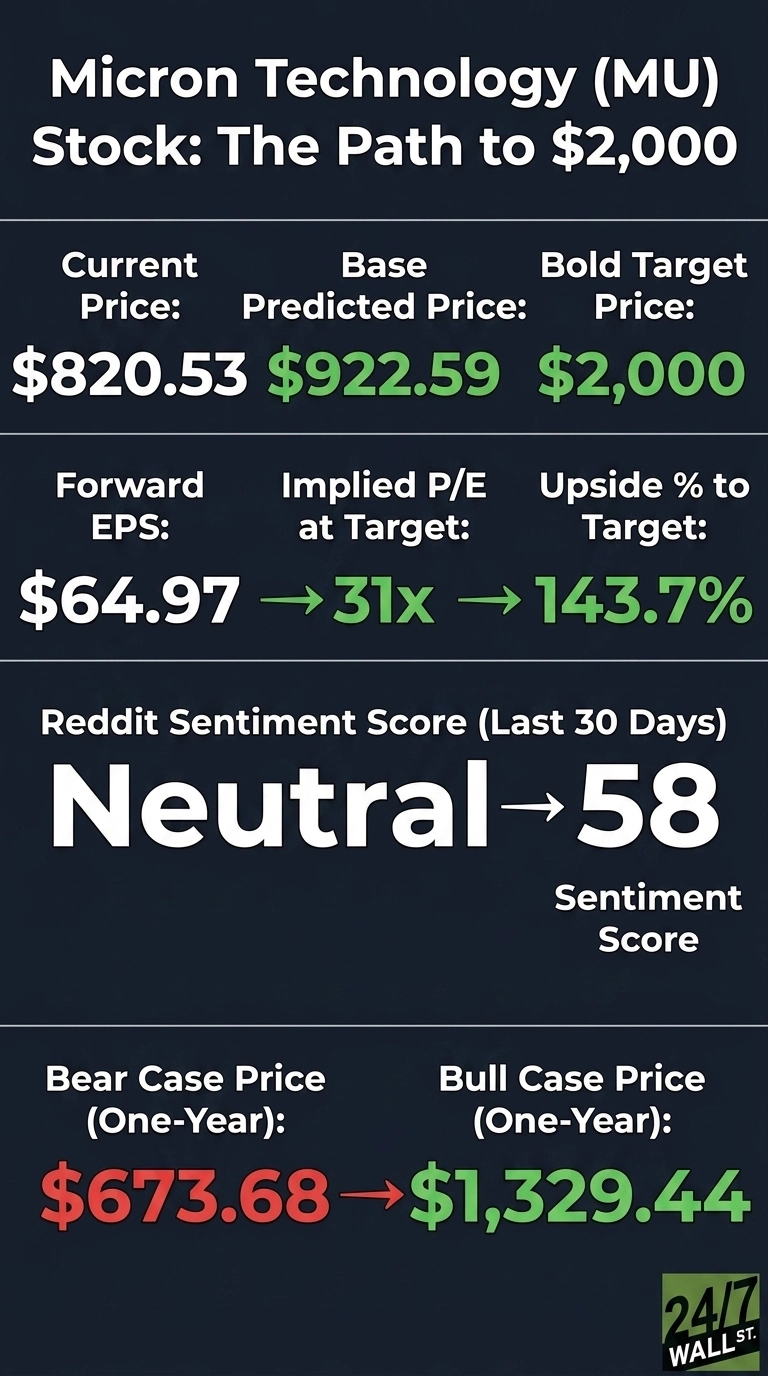
Despite the record earnings report, Micron is down 15.48% over the past week and 27.53% over the past month, sliding from over $1,132 to $820.53.
The trigger was Chinese DRAM maker CXMT’s 466% Shanghai debut, which pushed its market cap past Intel. Investors dumped everything memory. SanDisk fell 9%, Western Digital fell 8%, and Micron fell 7% in the sector sell-off.
Morgan Stanley’s Mike Wilson noted the correction in semiconductor and storage stocks is “pretty well advanced”. With a beta of 2.14, MU amplifies every macro shudder. CXMT competes in commodity DDR5, not HBM, but the market is painting all memory names with the same brush.
Wall Street Sees 84% Upside. My Model Says More
The Wall Street consensus target is $1,507.38, backed by 9 Strong Buys, 31 Buys, 4 Holds, and just 1 Strong Sell. That is 89% bullish. Our internal base case is $922.59 (12.44% upside) with a one-year bull case of $1,329.44 and confidence rated 90%.

Wall Street models Micron’s revenue peaking near $269 billion in 2029 and declining to $240 billion by 2030. Nomura’s DRAM forecast tells the opposite story: DRAM revenue growing 63% from $1.261 trillion in 2027 to $2.06 trillion in 2030. If Nomura is right, consensus is modeling the wrong cycle shape.
The Path to $2,000 Per Share
Reaching $2,000 from today’s price of $820.53 would require a gain of 143.7%. With forward EPS of $64.97, a $2,000 price implies a forward P/E of 31x. Our base case of $922.59 already implies 18x, meaning the bold target needs roughly 13x of additional multiple expansion, or continued EPS growth that compresses that ratio naturally.
Micron’s Q4 guidance calls for $50 billion in revenue and $31 non-GAAP EPS. Mehrotra said Micron’s “multi-year Strategic Customer Agreements will significantly enhance the durability and predictability of Micron’s strong financial performance.”
The company can fulfill only 50% to two-thirds of key customer demand. HBM4 is in volume shipment for NVIDIA Vera Rubin, and HBM4E ramps in calendar 2027.
The primary risk: a rerun of the 2023 memory trough, when revenue collapsed to $15.5 billion and gross margin went negative.
Where Micron Trades Today vs Its Earnings Power
At $820.53 against forward EPS of $64.97, MU trades at roughly 13x forward earnings. For a company posting 345.72% revenue growth with 84.6% gross margins, that is a value multiple.
The stock sits 20% below its 52-week high of $1,254.81 and miles above the 52-week low of $103.21. The 10-year total return of 6,025.12% proves this stock can compound when the cycle turns in its favor.
Is $2,000 Realistic? My Verdict
Hitting $2,000 requires a 143.7% gain. That is a stretch, but not a fantasy.
Three things need to break right: HBM4E must ramp cleanly through 2027, Strategic Customer Agreements must prove they extend the cycle past Wall Street’s 2028 rollover call, and CXMT must stay contained in commodity DDR5. What derails it: a hyperscaler capex reset that punctures memory pricing before HBM4E ships. We’ve outlined the blueprint for how Micron could reach $2,000 in 2030.
Contact [email protected] for any questions or corrections.
Vandita Jadeja is a financial publisher with over a decade of experience writing about financial topics, including investment, savings, retirement, insurance and banking. Vandita is a Chartered Accountant who loves to debunk financial concepts for readers.
Her work has appeared on sites that include The Motley Fool, InvestorPlace, and Benzinga. She covers investing and focuses on stock picks and price prediction for 24/7 Wall St.
When not looking for the next stock investment opportunity, she can be found traveling, reading, chasing sunsets and enjoying her iced latte.