Pepsi vs Coca-Cola: The Better Buy For The Second Half of 2026
Coke just raised guidance twice this year while Pepsi watches its biggest snack unit stumble, yet one of these stocks may be a far more compelling buy heading into the second half of 2026.

This post may contain links from our sponsors and affiliates, and Flywheel Publishing may receive compensation for actions taken through them.
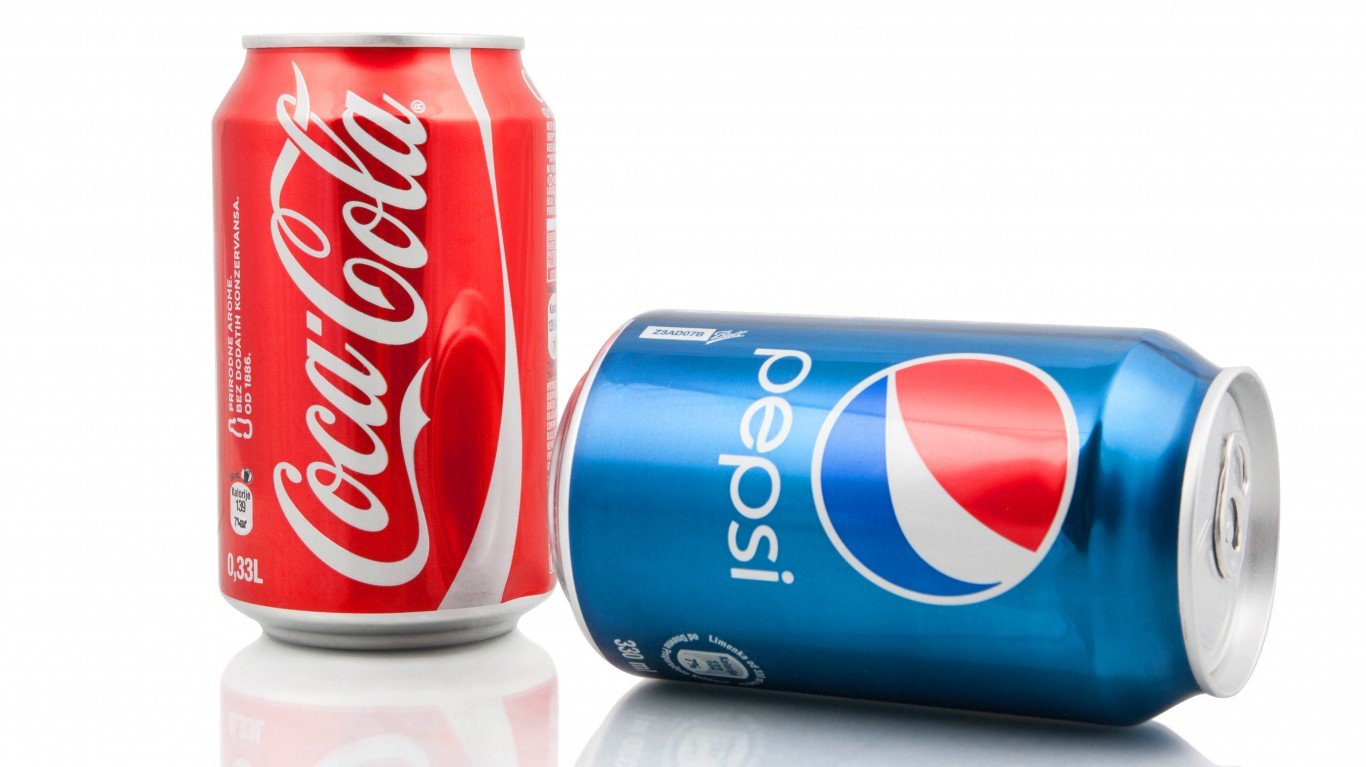
Coca-Cola (NYSE: KO | KO Price Prediction) and PepsiCo (NASDAQ: PEP) both closed the books on Q2 2026 with beats, yet the businesses look further apart than ever.
Coke leaned on Zero Sugar, a FIFA World Cup blitz, and pricing power to raise guidance twice this year. Pepsi leaned on international snacks and functional beverages to offset a softer North America food unit. Two consumer defensives, two very different quarters.
Zero Sugar Powers Coke. International Snacks Save Pepsi.
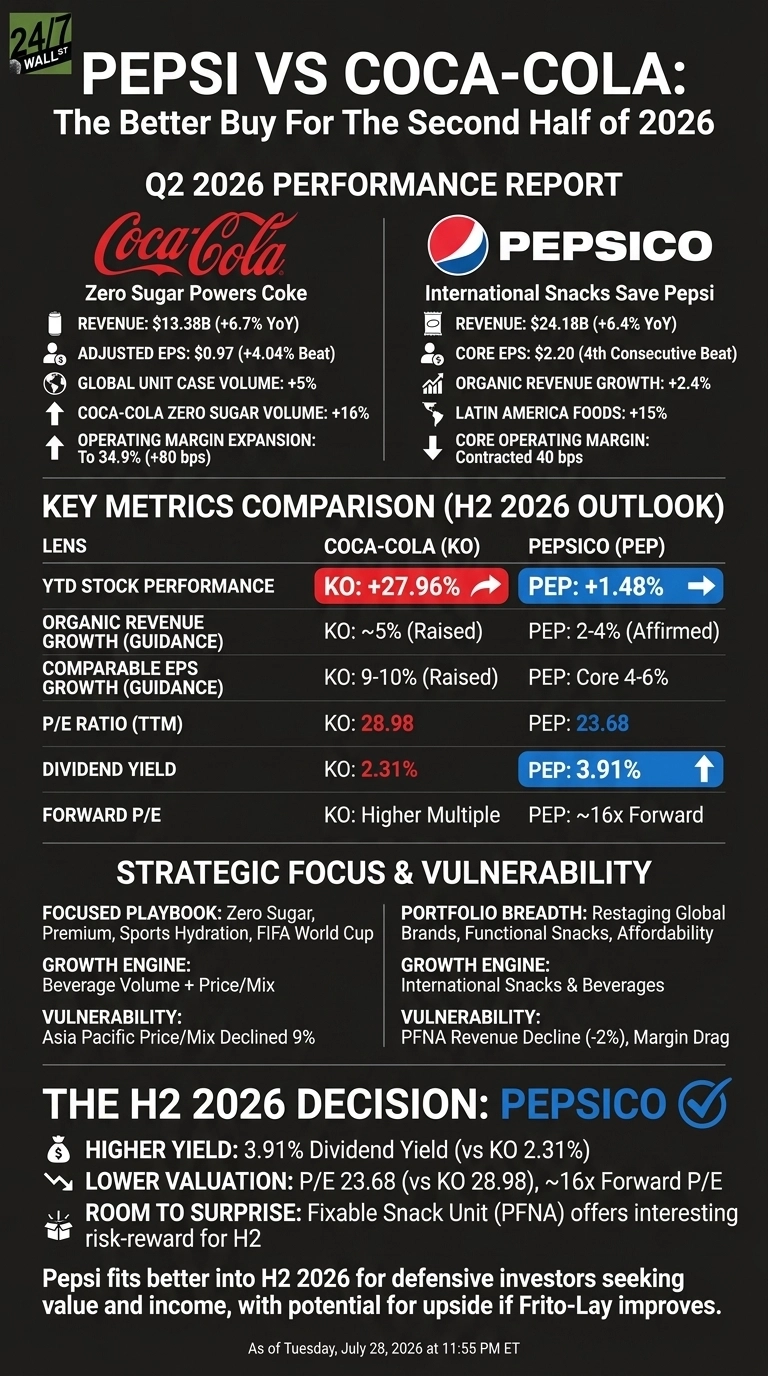
Coca-Cola posted adjusted EPS of $0.97 on $13.38 billion in revenue, with global unit case volume up 5% and Coca-Cola Zero Sugar volumes up 16% across every region. That is a rare thing in packaged goods: broad-based volume growth alongside operating margin expansion to 34.9% from 34.1%.
Latin America revenue jumped 16%, and the FIFA World Cup campaign drove 60 billion digital impressions. New CEO Henrique Braun sounded confident but measured: “We leveraged our powerful brands and system to gain value share, delivering revenue, profit and earnings growth while also investing for the long term.”

PepsiCo delivered core EPS of $2.20 on $24.18 billion in revenue, its fourth straight EPS beat. The story split cleanly by geography and category. Frito-Lay parent PFNA slipped 2%, while Latin America Foods grew 15% and EMEA rose 10%.
Ramon Laguarta pointed to functional formats: “portion control varieties, diverse ingredients, functional benefits such as hydration, protein and fiber, energy and zero sugar beverage varieties.” Organic revenue growth of 2.4% is respectable, but core operating margin still contracted 40 basis points.

Premium Bet vs. Portfolio Balancer
| Lens | Coca-Cola | PepsiCo |
| Core Bet | Zero Sugar, premium packaging, sports hydration | Restaging global brands, functional snacks, affordability |
| Growth Engine | Beverage volume plus price/mix | International snacks and beverages |
| Key Vulnerability | Asia Pacific price/mix down 9% | PFNA revenue decline, margin drag |
| Forward P/E | Higher multiple | 16x forward |
| Dividend Yield | 2.31% | 3.91% |
Coke is running a focused playbook. Pepsi is running a wider one that must fix its Frito-Lay pricing problem while its international engine hums. The share prices reflect that gap: KO is up 27.96% year to date, while PEP has managed just 1.48%.
The Next Test Is Whether Pepsi Fixes Frito-Lay
I will be watching Coke’s raised 2026 outlook of roughly 5% organic revenue growth and 9% to 10% comparable EPS growth, plus the BODYARMOR FIT rollout and the pending African bottling sale.

For Pepsi, the real catalyst is PFNA. If affordability packs and brand restaging pull volumes back into positive territory in H2, the $155.91 analyst target starts looking earned. If not, the 2% to 4% organic revenue growth guide gets tested.

Why I Lean Pepsi for the Second Half of 2026
Coke is the higher-quality business right now. I would not argue otherwise. Yet the stock has already priced much of that in after a 33.33% one-year run, and it trades at a P/E of 26 against analyst targets that are essentially flat to today’s price. For a defensive investor who wants durable execution and does not mind paying up, Coke is the cleaner pick.
For me, PepsiCo fits better into H2 2026. The 3.91% yield, forward P/E near 16, insider buying, and a fixable snack unit give it more room to surprise. I would change my view if Frito-Lay volumes stay negative into Q4. Until then, Pepsi looks like the more interesting risk-reward.
Contact [email protected] for any questions or corrections.
Vandita Jadeja is a financial publisher with over a decade of experience writing about financial topics, including investment, savings, retirement, insurance and banking. Vandita is a Chartered Accountant who loves to debunk financial concepts for readers.
Her work has appeared on sites that include The Motley Fool, InvestorPlace, and Benzinga. She covers investing and focuses on stock picks and price prediction for 24/7 Wall St.
When not looking for the next stock investment opportunity, she can be found traveling, reading, chasing sunsets and enjoying her iced latte.