Top Tech Analyst Says Hyperscalers Are the Clear AI Winners, but Beaten-Down Software Offers Value
Ray Wang sees the AI market splitting megacaps into two very different investment stories, and the beaten-down names Wall Street has abandoned may be hiding the more compelling opportunity.

Constellation Research Chairman Ray Wang went on CNBC Monday morning to argue that the AI capital cycle has split the megacaps into two camps: hyperscalers with a clear line of sight to AI monetization, and enterprise software names that have been sold off despite growing cash flows.
Both could be good investments today.
“The House Always Wins:” Hyperscalers Own the Hardware
Wang’s core view is that infrastructure owners capture value regardless of which model or application ultimately dominates. “The market sees a clear path to AI dominance in those markets,” he said, adding, “The house always wins. It’s kind of like Las Vegas. You’re basically hosting the compute. You don’t care which models win. You’re just running the hardware.“
Amazon (NASDAQ:AMZN | AMZN Price Prediction) reported Q2 revenue of $200.61B, with AWS growing 37% year-over-year, its fastest in 18 quarters. AMZN posted a 17% one-week gain heading into the interview.
Microsoft (NASDAQ:MSFT) reported $90 billion in quarterly revenue and 43% Azure growth, with Azure crossing $100B in annual revenue for the first time. Alphabet delivered $119.8 billion in Q2 revenue, up 24% year-over-year, with Google Cloud accelerating to 82% growth.
Why Microsoft and Google Are “Playing Both Games”
Wang singled out two names as best positioned: “Google and Microsoft are actually in a good place because they’re playing both games.“ Both own the pipes and ship frontier models, giving them exposure to compute margins and application-layer economics.
The trade-off, Wang noted, is cash. Hyperscalers show double-digit cloud growth driven by AI spending but are approaching negative free cash flow due to capex investments.
Wall Street May Be Overlooking These 3 Software Leaders
The other side of Wang’s tale is the punished software cohort. Software/SaaS companies are down 24-35% in the AI rotation.
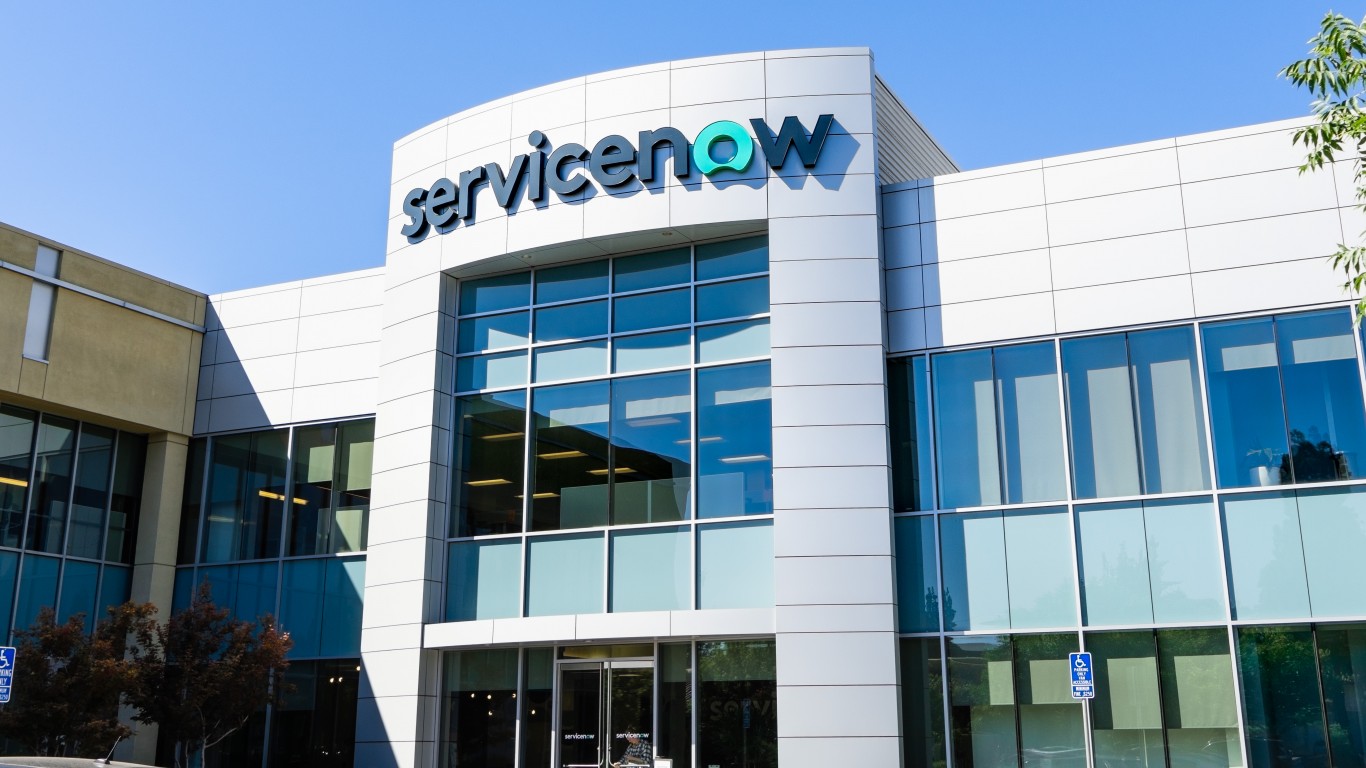
“I’d look at Salesforce. I look at ServiceNow. I’d also look at Adobe. These are companies that are down, but their free cash flows [are] up,” Wang said.
ServiceNow (NYSE:NOW) is down 27.39% year-to-date and 41.03% over one year. Salesforce (NYSE:CRM) is off 30.17% YTD, and Adobe (NASDAQ:ADBE) is down 28.45% YTD.
Yet the fundamentals Wang points to are clearly there. Salesforce’s Q1 FY27 report showed Agentforce and Data 360 combined ARR of nearly $3.40 billion, up over 200% year-over-year, and free cash flow of $6.556 billion. Adobe generated $2.109 billion in Q2 free cash flow on record revenue of $6.62 billion, with AI-first ARR exceeding $500 million.
Wang saved his sharpest praise for ServiceNow’s operating model: “ServiceNow is at 24.5% growth. It’s Rule of 50, Rule of 60 over at ServiceNow.” Bill McDermott echoed the point on the Q2 call, noting “operating to the Rule of 56, well on our way to the Rule of 60” with agentic deployments up ninefold in nine months. ADBE trades at a forward P/E of 10 and CRM at 14, with both companies trading at a compressed multiple relative to their AI-era revenue growth.
Key Takeaways
Wang’s thesis stands in direct contrast to Jim Cramer’s earlier warning that software investors fear their holdings could become “the next victim of Anthropic or OpenAI.” Wang instead sees improving free cash flow and rapidly expanding AI-related revenue at Salesforce, ServiceNow, and Adobe, even as their share prices fall.
Salesforce’s upcoming second-quarter fiscal 2027 earnings report will provide the next major test, with management guiding for revenue between $11.27-$11.35 billion. Investors should watch two variables: how quickly hyperscaler capex consumes free cash flow and whether AI-related ARR at legacy software companies like Salesforce, ServiceNow, and Adobe grows fast enough to drive a valuation reset.
Contact [email protected] for any questions or corrections.
Thomas Richmond is a financial writer and content strategist with 5+ years of experience covering stocks and financial markets. He has published over 500 articles focused on individual stock analysis, helping investors better understand business fundamentals, stock valuations, and long-term opportunities.
Thomas previously served as a Content Lead at TIKR, a stock research platform, where he helped scale the company’s blog to hundreds of articles per month and contributed to a weekly newsletter reaching more than 100,000 investors.
Outside of work, Thomas enjoys weight lifting and soccer.