CVX, OXY & XOM: The Next Big Move in Oil Could Be Just Getting Started
Brent crude has swung from $138 to the high $60s and back again in 2026, and three U.S. oil majors are riding that chaos to gains Wall Street did not see coming. The real question is whether the move that…


Oil has come alive again in 2026. Brent crude spiked to $138 per barrel on April 7 during the Strait of Hormuz disruption, retraced to the high $60s in early July, and now sits near $89. That volatility has fueled the U.S. majors.
Chevron (NYSE:CVX | CVX Price Prediction) is up 24.73% year-to-date, Exxon Mobil (NYSE:XOM) has advanced 28.88%, and Occidental Petroleum (NYSE:OXY) leads the group at 37.26%. Here is the path to CVX at $225, XOM at $180, and OXY at $75 in the year ahead.
Why Wall Street Is Warming Up to Oil Majors
All three companies are beating expectations. Chevron posted seven consecutive quarterly EPS beats, with Q2 2026 adjusted EPS of $6.06 on revenue of $67.20 billion (+51.4% YoY). CEO Mike Wirth credited “disciplined investment and strong execution that drove record U.S. upstream production, record crude throughput in our U.S. refineries, and exceptional reliability across key assets.”
Exxon has strung together 4 consecutive EPS beats, and CEO Darren Woods says the company is “fundamentally stronger” after growing advantaged volumes in Guyana and the Permian. Occidental claims five straight beats, capped by a 29.8% Q2 EPS surprise at $2.40.

The Path to $225, $180, and $75
Chevron at $186.56 needs roughly 21% to hit $225. Exxon at $153.04 needs about 18% to reach $180. Occidental at $55.91 requires roughly 34% to $75.
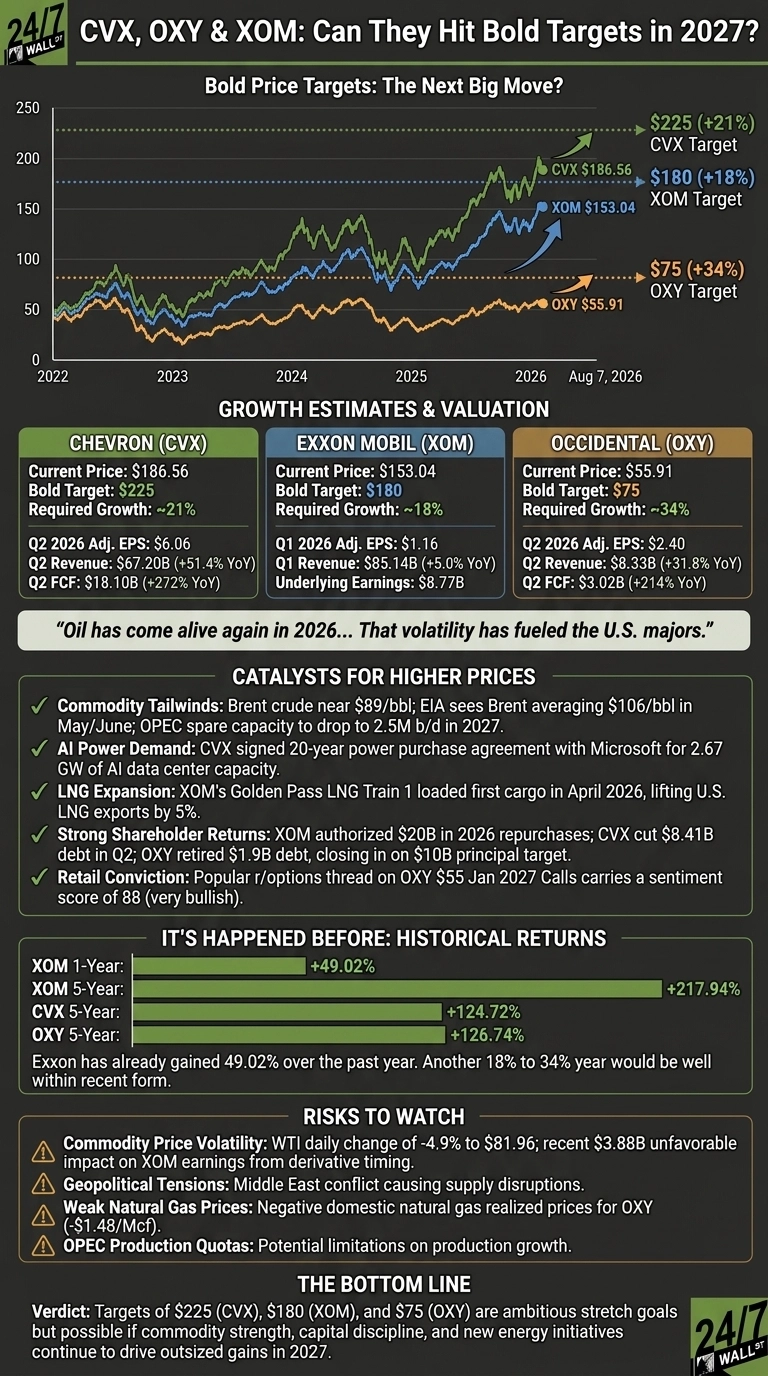
At $180, Exxon would trade near 27x its full-year 2025 EPS of $6.70, close to the S&P 500 average, before factoring in 2026 growth. Occidental at $75 would sit near 15x its forward EPS of $4.85, hardly demanding given the deleveraging story. Chevron’s Q2 run-rate annualizes above $24 in EPS, keeping $225 in normal multiple territory.

What Could Push These Stocks Higher
- Commodity tailwinds. The EIA sees Brent averaging $106 per barrel in May and June and warns OPEC spare capacity will drop to 2.5 million b/d in 2027 after the UAE’s departure.
- AI power demand. Chevron signed a 20-year power purchase agreement with Microsoft (NASDAQ:MSFT) for 2.67 GW of dedicated capacity in West Texas.
- LNG expansion. Exxon’s Golden Pass LNG Train 1 loaded its first cargo in April 2026, lifting U.S. LNG exports by 5%.
- Buybacks and deleveraging. Exxon authorized $20 billion in 2026 repurchases. Chevron cut $8.41 billion of debt in a single quarter. Occidental retired $1.9 billion and is closing in on its $10 billion principal target.
- Retail conviction. One popular r/options thread, “Oil is going to $150+ OXY $55 Jan 15th 2027 Calls,” carries a sentiment score of 88 (very bullish).

History Says These Moves Are Possible
Exxon has already gained 49.02% over the past year and 217.94% over five years. Chevron is up 124.72% over five years, and Occidental has climbed 126.74% in the same span. Another 18% to 34% year would be well within recent form.
The Bottom Line on the Bull Case
Chevron’s $18.10 billion in Q2 free cash flow, Exxon’s $15.60 billion in structural cost savings since 2019, and Occidental’s aggressive deleveraging support higher multiples.
Risks remain (OPEC quotas, weak U.S. natural gas prices, and Middle East supply shocks), but with Brent structurally supported and buybacks running hot, $225 for CVX, $180 for XOM, and $75 for OXY are stretch goals worth watching. Returns at this level should not be expected every year, but we have outlined the blueprint for how this trio could see outsized gains in 2027.
Contact [email protected] for any questions or corrections.
Vandita Jadeja is a financial publisher with over a decade of experience writing about financial topics, including investment, savings, retirement, insurance and banking. Vandita is a Chartered Accountant who loves to debunk financial concepts for readers.
Her work has appeared on sites that include The Motley Fool, InvestorPlace, and Benzinga. She covers investing and focuses on stock picks and price prediction for 24/7 Wall St.
When not looking for the next stock investment opportunity, she can be found traveling, reading, chasing sunsets and enjoying her iced latte.