Why One Prominent Analyst Expects 85% Returns for ON Semiconductor Despite Current Turmoil
ON Semiconductor just posted a clean earnings beat, yet its stock sits nearly 40% below its 52-week high while one top analyst sees a radically different story unfolding in the quarters ahead.


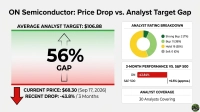
ON Semiconductor (NASDAQ:ON | ON Price Prediction) currently trades at $81.17, while the Wall Street consensus price target sits at $108.88, leaving roughly 34% of implied upside. The Street-high target of Susquehanna Financial Group’s Christopher Rolland carries a $150 target points to roughly 85% of upside from here.
The Arizona-based chipmaker builds power management, analog and sensing silicon for electric vehicles, industrial automation and AI data center power delivery. Wall Street has been paying attention because AI data center revenue is now expected to more than double in 2026, a mix shift that could redefine the company’s growth algorithm after a punishing cyclical trough.
A Semi Selloff Erased the Spring Rally
ON shares have fallen 13.46% over the past month and now trade nearly 40% below the 52-week high of $134.92 set in early June, unwinding a monster rally off the 2025 lows.
A broader semiconductor selloff hit the analog and power complex in late July. Concerns included increased competition from China, doubts about the sustainability of AI-related demand, and new U.S. tariffs impacting the supply chain. Skepticism around SiC expansion execution and automotive capacity underutilization layered on top.
The irony: Q2 2026 was a clean beat. Revenue of $1.60 billion grew 9.2% year over year, non-GAAP EPS of $0.74 and free cash flow of $425.4 million grew 300.94% year over year all topped consensus. The market did not care.
Why Susquehanna Sees 85% Upside
Rolland’s bull thesis rests on three pillars the market appears to be discounting:
The first is silicon carbide and Treo dominance, with multi-year content-per-vehicle expansion tied to 800V EV powertrains. The second is AI data center power acceleration, where ON’s PMICs, smart power stages and high-efficiency MOSFETs are designed into next-generation server racks including NVIDIA Blackwell and Rubin platforms. The third is industrial and automotive recovery, where fab utilization and long-term supply agreements should provide operating leverage.
Of the 29 analysts covering ON, 1 rates it Strong Buy, 10 rate it Buy, and 18 rate it Hold, with no Sell ratings. The average $108.88 target implies meaningful upside, but the ratings mix flags conviction fatigue after 2025’s brutal cycle.
Management guides Q3 revenue of $1.65 billion to $1.75 billion and non-GAAP EPS of $0.81 to $0.93 with continued margin expansion. Design wins include the NVIDIA MGX ecosystem, a Great Wall platform deal for EliteSiC and silicon MOSFETs, and the Rivian R2. The planned Synaptics acquisition adds connected compute exposure at accretive margins.
The Peer Group Sold Off Together, But ON Fell Hardest
The analog and power complex fell as a group, but ON took the deepest hit on a one-month basis. Every close peer sits below its consensus target.
NXP Semiconductors (NASDAQ:NXPI) has dropped 15.54% over the past month to $239.71, against a consensus target of $311.10 for roughly 30% implied upside. Coverage is heavily Buy-tilted at 6 Strong Buy, 17 Buy, 6 Hold and 1 Sell.
Microchip Technology (NASDAQ:MCHP) has held up better, down 0.94% over the past month at $84.69 versus a $111.71 consensus target, implying about 32% upside. Ratings skew Buy at 2 Strong Buy, 17 Buy and 6 Hold.
STMicroelectronics (NYSE:STM) has fallen 18.15% over the past month to $56.10, versus a $71.52 target for roughly 27% upside. Ratings are more balanced at 1 Strong Buy, 7 Buy and 7 Hold.
The largest analyst-implied upside in this peer set sits with ON. The market is treating ON as the highest-beta name in a group already trading below fair value, driven by sentiment rather than company-specific damage.
Where the Numbers Land
ON currently trades at $81.17. The consensus target of $108.88 across 29 analysts implies roughly 34% upside; the Susquehanna Street-high of $150 implies roughly 85%.
Year to date, ON is up 49.9%, well ahead of the 13.39% gain in the S&P 500. Over one year, shares are up 70.56%. The 13.46% one-month drop is noise inside the signal.
Shares trade at a forward P/E of 25, elevated for a cyclical semi but reasonable if AI data center revenue truly doubles in 2026.
My Take: Watching the AI Data Center Ramp
The bull case strengthens if AI data center revenue delivers on the doubling guide and SiC content per vehicle expands as EV architectures move to 800V. Gross margins would climb toward 40%-plus, operating leverage compounds, and Rolland’s $150 target starts to look conservative.
The bear case gains traction if this becomes a value trap. China competition could compress SiC pricing, tariffs disrupt supply, automotive underutilization drags margins, and the Synaptics deal creates integration risk. Analog and Mixed-Signal declined 2% year over year in Q2, so recovery is uneven.
On balance, lean bullish. The FCF inflection is real, AI data center wins are named customers rather than pipeline, and the Street-wide dislocation looks more like sentiment than fundamentals. Rolland’s 85% call is aggressive, but the consensus 34% upside strikes me as the more defensible base case for patient investors.
Contact [email protected] for any questions or corrections.
Alex Sirois is a financial writer with experience spanning both retail and institutional investing. He has written for InvestorPlace and held roles at BNY Mellon and Bernstein, giving him a perspective that bridges Main Street portfolios and Wall Street analysis.
Alex holds an MBA from George Washington University and has built his career across multiple industries, including e-commerce, education, and translation — a breadth of experience that informs how he breaks down complex financial topics for everyday investors. His writing is conversational, actionable, and grounded in long-term, buy-and-hold investing principles.
At 247 Wall St., Alex focuses on delivering analysis that is both accessible and useful, with a clear emphasis on helping readers make more informed decisions with their money.