More Analysts Say Hold Than Buy on Tesla. The Price Target Went Up Anyway.
Wall Street analysts lean neutral on Tesla, yet price targets keep climbing higher. Here is why the math behind the contradiction points in a direction most investors are not expecting.


Tesla (NASDAQ:TSLA | TSLA Price Prediction) presents one of the market’s clearest disconnects right now. More analysts rate the stock a hold than a buy, yet the consensus price target keeps drifting higher.
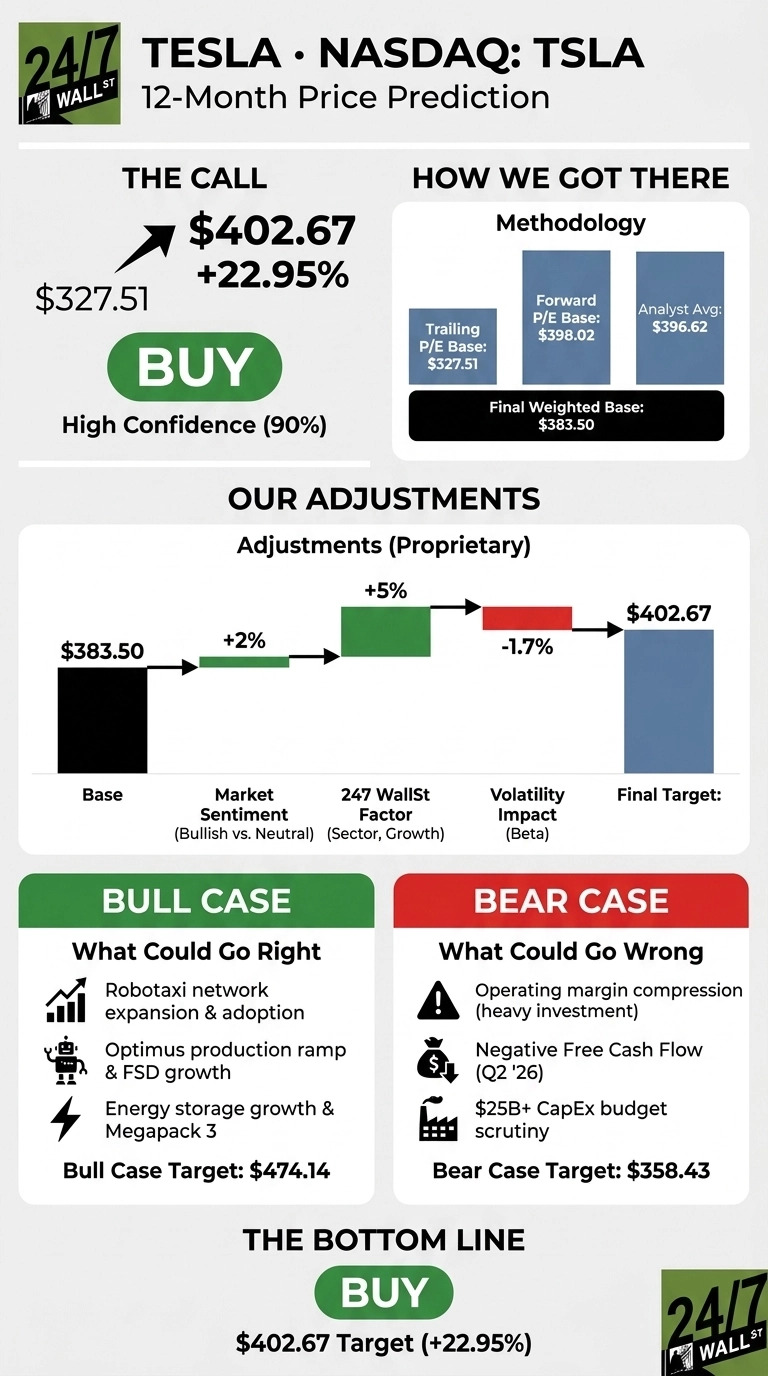
Our 24/7 Wall St. price target for Tesla is $402.67, implying 22.95% upside from the current $327.51 price. That translates to a buy rating with a confidence level of 90%. The model leans positive despite an analyst community that skews neutral.
| Metric | Value |
|---|---|
| Current Price | $327.51 |
| 24/7 Wall St. Price Target | $402.67 |
| Upside | 22.95% |
| Recommendation | BUY |
| Confidence | 90% |
A Rough Summer After a Punishing Earnings Reaction

Tesla is down 27.17% year to date and 17.04% over the past month, though shares have edged up 1.85% in the last week. The stock trades well below its 52-week high of $498.83 and near the low of $297.38. Q2 2026 explains most of the decline.
Tesla posted revenue of $28.24 billion, up 25.52% year over year and beating consensus by 7.10%. Non-GAAP EPS of $0.33 missed the $0.5367 estimate by 38.51% as operating expenses jumped 47% on AI infrastructure, R&D, and the CEO Performance Award.
Deliveries hit a record 480,126 vehicles and FSD subscriptions reached 1.48 million, but free cash flow swung to negative $1.09 billion. Shares fell 14.52% on the report.

The Case for $474 and Higher
In our bull scenario, Tesla reaches $474.14 within twelve months, a 44.77% total return. Robotaxi is the swing factor. The service runs in seven US metros, and Elon Musk said unsupervised miles are growing “more than 10% a week.”
Optimus lines are being installed at Fremont, Megapack 3 is on track for 2026, and Cybercab engineering drives are underway. UBS upgraded the stock earlier this year, citing the long-term AI opportunity balancing near-term demand risk.

What Could Go Wrong
Our bear case takes Tesla to $358.43, still a 9.44% return but well below the base case. CFO Vaibhav Taneja confirmed capex will exceed $25 billion this year and grow for two to three more. Operating margin collapsed to 1.4% in Q2.
Prediction markets assign only a 10.5% probability to an Optimus release by year end. Bulls counter that the OpEx surge reflects AI compute and CEO Performance Award vesting, both non-recurring drags on the reported EPS line.

How Tesla Compares to Rivian and Ford
Rivian (NASDAQ:RIVN) is the closest pure-play EV comparable. Rivian carries a market cap of $23 billion against Tesla’s $1.31 trillion, and posted a Q1 2026 adjusted loss of $0.54 per share. It trades at a negative earnings multiple, which makes Tesla’s 169x forward P/E look expensive on paper but reasonable given actual profitability.
Ford (NYSE:F) offers the legacy contrast. Ford raised full-year 2026 adjusted EBIT guidance to $8.5 billion to $10.5 billion and pays a 5.5% dividend yield. Its Model e segment is still losing $4 billion to $4.5 billion annually. Ford is priced as a mature manufacturer; Tesla is priced on AI, robotics, and autonomy. That framing supports our buy, though it explains why 18 analysts sit on the sidelines.
Tesla Price Prediction 2026-2030
The 24/7 Wall St. model output is buy at $327.51 with a price target of $402.67 and 90% confidence. The bull thesis rests on robotaxi miles compounding as management describes, while the key downside catalyst would be FSD approvals in China and Europe slipping further into 2027.
Extending the model forward, here is where Tesla could trade if the base-case trajectory holds.
| Year | 24/7 Wall St. Price Target |
|---|---|
| 2026 | $402.67 |
| 2027 | $455 |
| 2028 | $510 |
| 2029 | $560 |
| 2030 | $607.17 |
These projections assume Tesla executes on robotaxi scaling and Optimus production. Meaningful upside or downside will hinge on FSD regulatory approvals and the return on that $25 billion annual capex commitment.
Contact [email protected] for any questions or corrections.
Vandita Jadeja is a financial publisher with over a decade of experience writing about financial topics, including investment, savings, retirement, insurance and banking. Vandita is a Chartered Accountant who loves to debunk financial concepts for readers.
Her work has appeared on sites that include The Motley Fool, InvestorPlace, and Benzinga. She covers investing and focuses on stock picks and price prediction for 24/7 Wall St.
When not looking for the next stock investment opportunity, she can be found traveling, reading, chasing sunsets and enjoying her iced latte.