Trump’s 90-Day Inflation Band-Aid: Why His Beef Tariff Pause Won’t Help Consumers
Trump's 90-day beef tariff pause promises relief at the grocery store, but the cattle biology and market forces quietly working against it could make the cure worse than the disease.

Food inflation has become one of those problems that refuses to disappear when politicians declare victory over it. Beef is a perfect example. The average price of ground beef reached $6.89 per pound in July, according to the Federal Reserve Bank of St. Louis, up from $5.55 in January 2025.
President Donald Trump now wants to put a temporary lid on that increase by easing tariffs on imported ground beef. The problem for investors is that the policy attacks the symptom, not the supply shortage — and may simply postpone until after the midterm elections the inflation it is trying to cure.
The Tariff Reversal Is Notable
Trump announced on Truth Social that the U.S. would allow as much as 300,000 metric tons of ground beef imports over the next 90 days without the higher out-of-quota tariff. He also said there is a commitment to sell the imported beef at 25% below current market prices.
Trump blamed Biden-era inflation for today’s beef prices. But his own policy change carries an awkward implication: if removing a tariff can lower prices, imposing that tariff can raise them.
While ground beef rose roughly 39% from the approximately $4-per-pound level early in the Biden administration to $5.55 by January 2025, during Trump’s second term, the average price has climbed another roughly 24% to $6.89.
In other words, Trump’s 90-day tariff pause essentially removes part of the inflationary pressure his administration’s trade policy helped create. That is useful for consumers, but it is hardly a structural solution.
America’s Cattle Problem Can’t Be Fixed in 90 Days
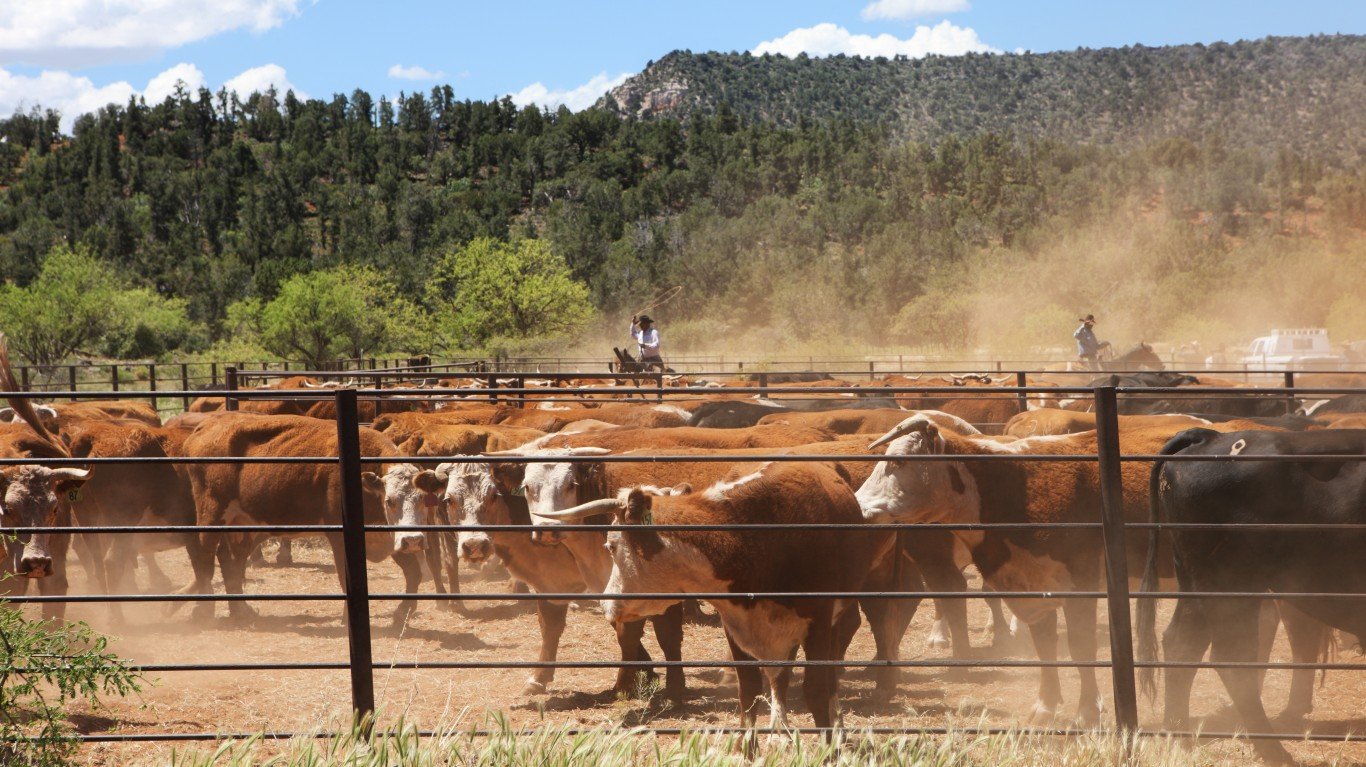
U.S. cattle herds remain constrained. The USDA’s July Cattle report counted 94.2 million cattle and calves, while the beef-cow herd stood at 28.5 million, down 1% from a year earlier. The 2026 calf crop was also projected at 32.5 million, down 2%.
Trump says the import pause will “give space for the Great American Beef Herd to grow again.” But cattle cannot be manufactured like semiconductors.
A beef animal generally requires 18 to 24 months to reach slaughter weight. More importantly, rebuilding the breeding herd creates an even longer lag. A rancher must retain a heifer instead of selling her, breed her, raise her first calf and eventually send that offspring through the beef supply chain. The process can take at least three years.
That creates a nasty incentive problem. Cheap imports may lower prices today, but they also threaten the profitability ranchers need to justify retaining heifers tomorrow. The American Farm Bureau Federation has warned that relying heavily on imports can undermine domestic production incentives.
Granted, the administration has paired its policy with expanded Small Business Administration lending for ranchers and other measures intended to reduce operating friction, including changes involving livestock identification and predator protections. But cheaper feed, more favorable financing and regulatory relief cannot turn a calf into a finished animal overnight.
Investors Should Watch for Winners and Losers
The immediate beneficiaries are companies that buy enormous quantities of beef. Lower wholesale costs can widen margins for restaurant operators such as McDonald’s (NYSE:MCD | MCD Price Prediction), Shake Shack (NYSE:SHAK), and Chipotle Mexican Grill (NYSE:CMG). Broadline distributors including Sysco (NYSE:SYY) and US Foods Holding (NYSE:USFD) also stand to benefit if procurement costs fall.
The opposite pressure falls on domestic processors. Tyson Foods (NYSE:TSN), for example, recently reported a $142 million quarterly loss in its beef segment as cattle costs rose $525 million and volume fell 16%. Tyson also faces a Justice Department criminal antitrust investigation alongside other major meatpackers.
Key Takeaway
In short, investors should treat this as a 90-day price Band-Aid, not a cure for beef inflation. The tariff pause could give consumers and restaurant companies temporary relief, but it does nothing to shorten the cattle-production cycle or reduce the cost of raising livestock.
When tariffs return after the midterm elections while the herd remains constrained, beef inflation can return with them. For shareholders, the better opportunity is to watch companies benefiting from lower input costs — while remembering that today’s cheaper hamburger may simply be borrowing supply from tomorrow.
Contact [email protected] for any questions or corrections.
After two decades of patrolling the dark corners of suburbia as a police officer, Rich Duprey hung up his badge and gun to begin writing full time about stocks and investing. For the past 20 years, he’s been cruising the markets looking for companies to lock up as long-term holdings in a portfolio while writing extensively on the broad sectors of consumer goods, technology, and industrials. Because his experience isn’t from the typical financial analyst track, Rich is able to break down complex topics into understandable and useful action points for the average investor. His writings have appeared on The Motley Fool, InvestorPlace, Yahoo! Finance, Money Morning, and, of course, 24/7 Wall St. He has been featured in both U.S. and international publications, including MarketWatch, Financial Times, Forbes, Fast Company, and USA Today.