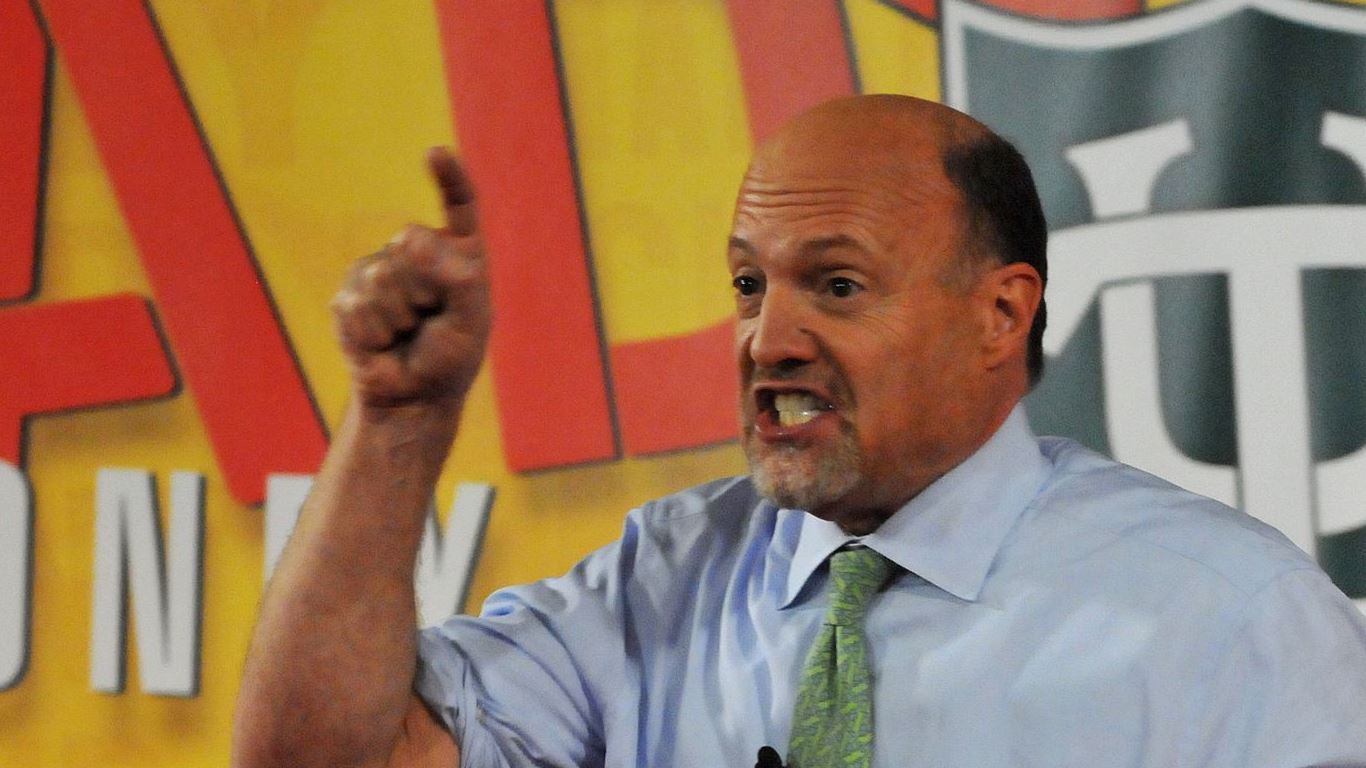
Why Jim Cramer Thinks the Data Center Backlash Could Be a Victory for Big Tech
Jim Cramer just argued that growing political fury over data center construction could hand the biggest cloud giants an unexpected competitive advantage, but he paired that call with a stark warning about the AI trade that investors are probably not…


Jim Cramer used his opening segment on Mad Money to make a counterintuitive call. He said the political backlash brewing against data center construction may end up strengthening the largest hyperscalers rather than derailing them. Hyperscalers are the small group of cloud giants that operate massive data center footprints. Cramer focused on Microsoft (NASDAQ:MSFT | MSFT Price Prediction), Alphabet (NASDAQ:GOOGL), and Amazon (NASDAQ:AMZN).
Two Governors, One Fast Reversal
Cramer opened with a stark shift in political posture. Texas Governor Greg Abbott now wants local approval before builders can break ground and said the companies “basically dug their own grave.” Pennsylvania Governor Josh Shapiro, previously a booster, signed an executive order stating data centers “could harm Pennsylvania’s right to clean air and pure water” and told developers, “If you can’t agree to our strict requirements to get the communities where you want to build to say yes, then you’re not welcome.”
Cramer’s read on the speed of the flip: “Neither governor says no to data centers, but both have gone from boosters to critics in the time it takes to flip a coin. Politicians don’t do that unless they think something’s very, very unpopular.”
Here is how he framed the stakes: “The data center thesis, perhaps the greatest investment theme in a generation, is now under attack and it may never be the same.” He added, “The unbridled build out is most likely over.”
Why Cramer Says the Hyperscalers Win
The turn in his argument centers on competition for finite resources. “The cost of building a data center is being boosted by many companies constructing these things on spec, not just the hyperscalers,” he said. Spec builders are developers who put up data centers without a signed tenant, betting they can lease the shell to a cloud company later. Their bids drive up land, power, labor, and chip costs for everyone.
Remove that layer of demand and the math shifts. “If you get rid of the smaller speculative builders, you get rid of the insane competition that’s pushed up the price of everything from land to construction to labor, electricity, and of course, the inside of a data center like Nvidia,” Cramer said. He argued the incumbents “are the biggest beneficiaries because they can afford to compensate local communities and get their warehouses full of servers built, while the spec builders will indeed get obliterated.” His summary: “This political pushback might be a godsend for the hyperscalers.” Furthermore, “This data center pushback may be a victory for big tech.”
The balance sheets back the framing. Microsoft guided fiscal 2026 capital expenditures to $115.95 billion, with Q4 capex alone at $35.8 billion. Alphabet’s Q2 capex reached $44.92 billion, and management raised roughly $70 billion in combined equity and debt to fund the buildout. Amazon spent $54.21 billion on capex in Q2. CEO Andy Jassy said AWS backlog stands at $496 billion, growing “triple digits year over year.” That spend has to land somewhere: power, cooling, networking, and the physical guts of the buildout. (We mapped seven of those non-chipmaker suppliers in a free report you can grab here.)


A Caveat Investors Should Not Miss
Cramer paired the bullish read with a warning: “I think you sell some. You can’t be as heavily invested in this theme because the price earnings multiples are not going to expand.” He also said, “The AI trade which we’re heavily involved in is currently broken.”
Current valuations illustrate the setup. Microsoft trades at a P/E of 27, Alphabet at 17, and Amazon at 21. Microsoft has climbed 27.7% over the past month, Alphabet 8.9%, and Amazon 12.9% over the same period. Alphabet leads the trio year to date with a gain of 11.2%.
What to Watch Next
The key signal for Cramer’s thesis is whether permitting friction translates into lower input costs for the largest builders. Track whether smaller speculative developers begin failing or selling projects, and whether hyperscaler capex commentary shifts from “Demand continues to exceed available supply” to a firmer tone on unit economics. Microsoft CFO Amy Hood already flagged flexibility on her Q4 call. She said, “The investment into land and data center builds is actually quite flexible” and that “timing can be changed on much of that.” For anyone holding these names through index funds, the near-term question is who gets to keep building on their own terms.
Contact [email protected] for any questions or corrections.
Trey has been an editor and author at 24/7 Wall St. for more than a decade, where he has published thousands of articles analyzing corporate earnings, dividend stocks, short interest, insider buying, private equity, and market trends. His comprehensive coverage spans the full spectrum of financial markets, from blue-chip stalwarts to emerging growth companies.
Beyond 24/7 Wall St., Trey has created and edited financial content for Benzinga and AOL's BloggingStocks, contributing additional hundreds of articles to the investment community.
Trey's editorial expertise extends across multiple publishing environments. He served as production editor at Dearborn Financial Publishing and development editor at Kaplan, where he helped shape financial education materials. Earlier in his career, he worked as a writer-producer at SVE. His freelance editing portfolio includes work for prestigious clients such as Sage Publications, Rand McNally, the Institute for Supply Management, the American Library Association, Eggplant Literary Productions, and Spiegel.
Outside of financial journalism, Trey writes fiction and has been an active member of the writing community for years, moderating workshop sessions at regional conventions.