Disney vs Boeing: Which Turnaround Is Actually Delivering Results?
Disney and Boeing both carry years of turnaround promises, but only one of them has started cashing those promises in while also paying shareholders to wait. Figuring out which one matters a great deal if retirement income is on the…

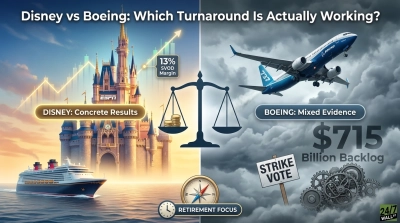
Retirement-focused investors weighing Walt Disney (NYSE:DIS | DIS Price Prediction) against Boeing (NYSE:BA) are really answering one question: which multi-year turnaround has actually produced results, and which is still promising them? Both are iconic American businesses. Both are roughly flat to modestly negative over the past year. Disney is down 5.8% and Boeing down 9.8% over the trailing year as of August 26, 2026. The verdict below focuses on suitability for a reader drawing down a portfolio rather than forecasting relative price performance.
Dimension 1: Is the Turnaround Showing Up in Results?
Disney’s evidence is concrete. Fiscal Q3 revenue rose 7% and segment operating income was up 21% versus prior-year results. Streaming reached a 13% SVOD operating margin, and Experiences posted record fiscal Q3 revenue and segment OI. CEO Josh D’Amaro told analysts the company is “operating from a real position of strength” and reaffirmed double-digit adjusted EPS growth for fiscal 26 and fiscal 27.

Boeing’s evidence is mixed and got harder. Q2 2026 core loss per share of $0.76, missing the $0.34 loss estimate, even as deliveries reached 171 airplanes, the highest quarterly total since 2018, and free cash flow turned positive at $631 million. CEO Kelly Ortberg acknowledged, “We know there’s more work to do and remain clear-eyed about managing the risks in front of us.” FAA certification of the 737-7, 737-10, and 777X models remains an active schedule risk.

Winner: Disney.
Dimension 2: What You Are Paid to Wait
Disney has a trailing P/E of 23 and pays an annualized dividend of $1.50 in two semi-annual installments of $0.75. Boeing’s trailing P/E of 76 is distorted by a one-time $9.67 billion divestiture gain, and the last common dividend had an ex-date of February 13, 2020. Practically, a Disney holder collects something while the turnaround plays out and has an earnings base to anchor valuation against. A Boeing holder is rewarded only if the share price rises. Disney’s yield is modest; the point is that it exists at all.
Winner: Disney.
Dimension 3: What Could Break Each Thesis
Boeing’s near-term risk is on the calendar. According to reporting from Reuters and Seattle-area outlets, Boeing’s engineers and technical workers voted on August 21 and 22, 2026, to reject the company’s “best and final” offer and authorized a strike. Separate reporting indicates a potential work stoppage in early October 2026, while talks are reported to be resuming. Ortberg himself flagged that Boeing was “looking very hard at what we would do should we have a work stoppage.” A whistleblower documentary has added reputational pressure, according to outside reporting. Importantly, demand remains strong: the company holds a record $715 billion order backlog and a commercial pipeline of more than 6,200 airplanes. The challenge is converting that backlog into delivered aircraft on schedule.
Disney’s risks are structural: linear network decline, ESPN sports-rights costs, and consumer sensitivity in Experiences, where park and cruise spending is discretionary. Josh D’Amaro noted “continued international attendance softness” at Shanghai and Hong Kong. These are known, priced-in pressures that the market has already absorbed.
Winner: Disney, on risk profile suitable for a retiree.
Verdict for Retirees
Disney wins clearly for the reader at or near retirement. The turnaround is already visible in reported results, there is an earnings base to value against, and shareholders collect a check while they wait. Boeing may well reward a growth-oriented investor with a long horizon and tolerance for headline risk, but asking a retiree to accept no income, no trailing profitability to anchor valuation, and an unresolved labor confrontation with a date attached is the wrong trade.


Note: Disney is down 37.4% over five years while Boeing is roughly flat at −2.1%, so this verdict addresses suitability rather than relative future performance.
Two checkpoints to monitor. For Boeing: the outcome of the labor vote, and whether the production rate ramp to 47 737s per month and the 777X first delivery in 2027 remain on track. For Disney: whether the 13% SVOD operating margin holds and whether Experiences demand remains resilient into fiscal 2027.


Contact [email protected] for any questions or corrections.
Trey has been an editor and author at 24/7 Wall St. for more than a decade, where he has published thousands of articles analyzing corporate earnings, dividend stocks, short interest, insider buying, private equity, and market trends. His comprehensive coverage spans the full spectrum of financial markets, from blue-chip stalwarts to emerging growth companies.
Beyond 24/7 Wall St., Trey has created and edited financial content for Benzinga and AOL's BloggingStocks, contributing additional hundreds of articles to the investment community.
Trey's editorial expertise extends across multiple publishing environments. He served as production editor at Dearborn Financial Publishing and development editor at Kaplan, where he helped shape financial education materials. Earlier in his career, he worked as a writer-producer at SVE. His freelance editing portfolio includes work for prestigious clients such as Sage Publications, Rand McNally, the Institute for Supply Management, the American Library Association, Eggplant Literary Productions, and Spiegel.
Outside of financial journalism, Trey writes fiction and has been an active member of the writing community for years, moderating workshop sessions at regional conventions.