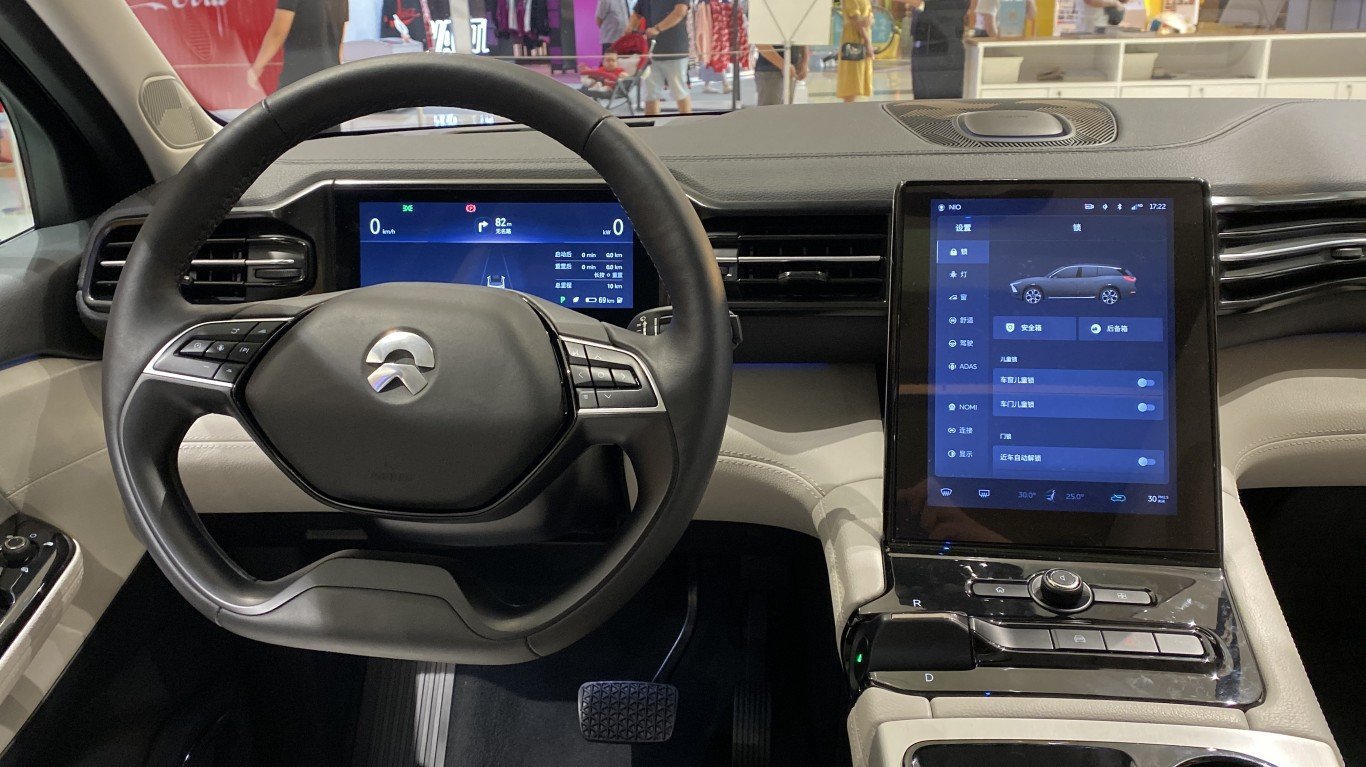
Nio Drops 4% on J.P. Morgan Downgrade and $4.50 Price Target, XPeng and Li Auto Slip
J.P. Morgan just praised Nio's quarter and punished the stock at the same time, and the reason behind that split verdict is reshaping how investors see the entire China EV sector.


Shares of Nio (NYSE:NIO | NIO Price Prediction) are down 4% to $3.92 in early Wednesday trading after J.P. Morgan cut the stock to Neutral from Overweight and lowered its price target to $4.50 from $7.00. The move stands out because the research note credits the company’s execution and blames the market it sells into.
The peer group is lower by a fraction of that move. XPeng (NYSE:XPEV) is down 1% to $11.02, and Li Auto (NASDAQ:LI) is down 1% to $11.78. For contrast, the SPDR S&P 500 ETF Trust (NYSEARCA:SPY) is up 0.1% to $762.48, so the broader market trades essentially flat while the China EV complex leaks lower and Nio drops by several times the peer group’s move.
Nio reported its Q2 2026 results earlier this week, and today’s action is the analyst response to that same report rather than a new disclosure from the company. The downgrade lands after the print, not alongside it, which shapes how the tape is digesting the news.
Rating Cut and $4.50 Target
J.P. Morgan cited sluggish demand in China’s passenger-vehicle market, intensifying price competition, and limited overseas exposure as constraints on Nio’s earnings upside. The firm cut its 2026 and 2027 revenue estimates by 5% and 9%, and its adjusted earnings forecasts by 13% and 52%.

The bank now models an adjusted net loss of 2.34 billion yuan in 2026 and 975 million yuan in 2027, against prior forecasts of a 512 million yuan loss and a 2.52 billion yuan profit. It forecasts 430,000 deliveries in 2026 and 480,000 in 2027, growth of 32% and 12%, and expects China passenger-vehicle demand to be flat to down 5% in 2027.
Among Chinese automakers, the firm said it continues to prefer BYD and Geely on stronger earnings resilience, broader portfolios and greater overseas growth. Xiaomi and Zeekr were named among the rivals crowding the premium segment Nio’s newer models are entering.
Why the Firm Still Praised the Quarter
The pivot in the research note is that J.P. Morgan said Nio’s Q2 results came in moderately ahead of its own estimates, and highlighted sustained profitability, resilient vehicle margins and improving free cash flow. Nio’s vehicle gross margin reached 18.5% in the quarter.
The concern centers on cost pressure heading into the second half. Management forecasts another 2,000 to 3,000 yuan per vehicle increase in costs in the second half, mainly from batteries, memory chips and other materials, and J.P. Morgan flagged that a weak pricing environment could make those costs hard to pass on.
That framing matters for how investors size the risk. A rating cut driven by end-market weakness tends to weigh on the whole sector, while a cut driven by company-specific execution problems tends to concentrate the pain in one name. Today’s action shows the market treating this note as a hybrid, punishing Nio hardest but pulling XPeng and Li Auto down modestly alongside it.
How the Chinese EV Peers Held Up
XPeng stock and Li Auto stock are both easing today rather than dropping, which fits a downgrade aimed at one name rather than at the whole group. J.P. Morgan grouped XPeng and Li Auto among the rivals crowding the premium segment Nio’s newer models are entering, alongside BYD, Geely, Xiaomi and Zeekr.
Year to date through Tuesday’s close, Nio stock was down 20%, XPeng stock was down 45%, and Li Auto stock was down 30%. That is the tension in the story. The least-damaged of the three names this year is the one drawing the rating cut, on an industry call rather than a company call.
What to Watch
The unresolved question for Nio is whether it can hold vehicle margin through the second-half cost increases without cutting price into a flat China market. Vehicle gross margin at 18.5% is the number that has to stand up if the profitability story is going to survive the demand-side headwinds J.P. Morgan flagged.
For investors who own Nio stock, keeping their position sizing modest makes sense while shares digest a downgrade that reset the firm’s multi-year earnings model into loss territory. Watch for management commentary on pricing discipline and any early read on Q3 delivery mix as the ES9 and ES8 continue ramping into the fourth quarter.
Contact [email protected] for any questions or corrections.
David Moadel is financial writer specializing in stocks, ETFs, options, precious metals, and Bitcoin. David has written well over 1,000 articles for leading online publications, helping investors understand markets, income strategies, and risk.His work has appeared in The Motley Fool, InvestorPlace, U.S. News & World Report, TipRanks, ValueWalk, Benzinga, Market Realist, TalkMarkets, Finmasters, 24/7 Wall St., and others.With a master’s degree in education, David has taught at the elementary, high school, and college levels. That teaching background shapes his writing style: clear, educational, and practical. David has also built a loyal social-media audience by providing trustworthy financial content on YouTube, X/Twitter, and StockTwits.