Down 6% in 2026, Uber Is Slashing Another 10% of Its Workforce
Uber just announced its biggest round of layoffs since the pandemic, yet analysts are pointing to targets more than 30% above the current price. Here is what the bulls and bears are each getting right.


At $76.45, Uber Technologies (NYSE:UBER | UBER Price Prediction) looks compelling at current levels. The rideshare and delivery platform is down 6.44% year to date in 2026 and just announced its largest workforce reduction since the pandemic, which sets up a rare disconnect between operating momentum and share-price sentiment.
Uber runs the world’s largest on-demand mobility, delivery, and freight platform, serving 208 million monthly active platform consumers across rides and Eats. The company is now cutting 3,300 jobs, roughly 10% of its 34,000-person global workforce, while reducing management positions by 20%, thinning micro-teams, and forcing most remote staff back into New York and San Francisco offices.
CEO Dara Khosrowshahi framed the move around efficiency, saying “a leaner organisation will mean clearer ownership, faster decisions, and more time spent building rather than coordinating.” The stock has not rewarded the restructuring narrative yet.

Why the Layoffs Could Ignite the Next Leg Higher
Uber is compounding growth at scale. Q2 2026 Gross Bookings hit $58.02 billion, up 24% year over year, marking the fourth consecutive quarter above 20% growth. Trailing 12-month free cash flow crossed $10 billion for the first time, and management said AI coding tools are driving a doubling in code output for engineers, enabling surgical 10% to 20% headcount cuts in select organizations.
Valuation looks reasonable against that backdrop. Uber trades at a trailing P/E of 17 and forward P/E of 17, cheap for a business posting 76.68% net income growth. Q3 guidance calls for Non-GAAP EPS of $0.84 to $0.88, up 28% to 35% year over year, and 21 analysts have revised full-year 2026 EPS estimates upward in the past 30 days.
Why Bears See a Broken Growth Story
The bear case starts with price action. Uber is down 17.63% over the past year and trades well below its 52-week high of $101.99. Mobility revenue grew just 1% in Q2, and business model changes weighed on reported revenue growth by roughly 8 percentage points.
Q2 also delivered a rare miss on both lines, with revenue of $14.19 billion missing the $14.26 billion estimate and EPS of $0.81 falling short of $0.83 expectations. Layoffs of this magnitude, following the biggest cuts since the pandemic, can signal that management sees demand cooling. Autonomous vehicle competition from Waymo and Tesla remains a structural overhang.

Why Patience Has a Case
Uber’s 200-day moving average of $76.56 sits right at the current price, suggesting the market is undecided. The company deployed roughly $4 billion in Q2 to buy Delivery Hero stock, temporarily slowing buybacks. Investors waiting for clarity on AV monetization, mobility reacceleration, and the Delivery Hero integration have a legitimate reason to hold fire until the Q3 report.
What the Numbers Actually Say
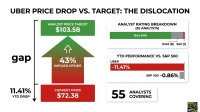
Uber currently trades at $76.45 against a consensus analyst price target of $101.81, implying meaningful upside if consensus proves correct. Analyst targets are one data point, not a promise. Coverage is deep, with 51 analysts split 8 Strong Buy, 35 Buy, 7 Hold, and 1 Sell.

The stock is down 6.44% year to date, badly lagging the S&P 500, which has posted positive returns over the same stretch. Over five years, Uber is still up 89.61%.
Why the Cost Cuts Reframe the Uber Setup
At $76.45, Uber screens attractively. Here is why. The setup pairs accelerating upward EPS revisions with a stock trading 25% below its 52-week high. The 3,300-person workforce reduction represents an AI-driven margin unlock on top of guidance calling for 28% to 35% EPS growth next quarter.
The path to appreciation runs through Q3 execution, restored buyback cadence, and any AV milestone in the 15 cities Uber expects to be live in by year end. A forward multiple of 17 on a business generating over $10 billion of free cash flow leaves room for both multiple expansion and earnings growth.

The thesis breaks if mobility growth stalls further, if AV partners defect, or if regulatory action reclassifies drivers. Watch quarterly Gross Bookings growth staying above 20% and buybacks resuming within months rather than quarters.
At a market cap of $156 billion against consensus pointing 33% higher, Uber offers scarce large-cap growth at a value multiple, and that framing anchors the setup.
Contact [email protected] for any questions or corrections.
After two decades of patrolling the dark corners of suburbia as a police officer, Rich Duprey hung up his badge and gun to begin writing full time about stocks and investing. For the past 20 years, he’s been cruising the markets looking for companies to lock up as long-term holdings in a portfolio while writing extensively on the broad sectors of consumer goods, technology, and industrials. Because his experience isn’t from the typical financial analyst track, Rich is able to break down complex topics into understandable and useful action points for the average investor. His writings have appeared on The Motley Fool, InvestorPlace, Yahoo! Finance, Money Morning, and, of course, 24/7 Wall St. He has been featured in both U.S. and international publications, including MarketWatch, Financial Times, Forbes, Fast Company, and USA Today.