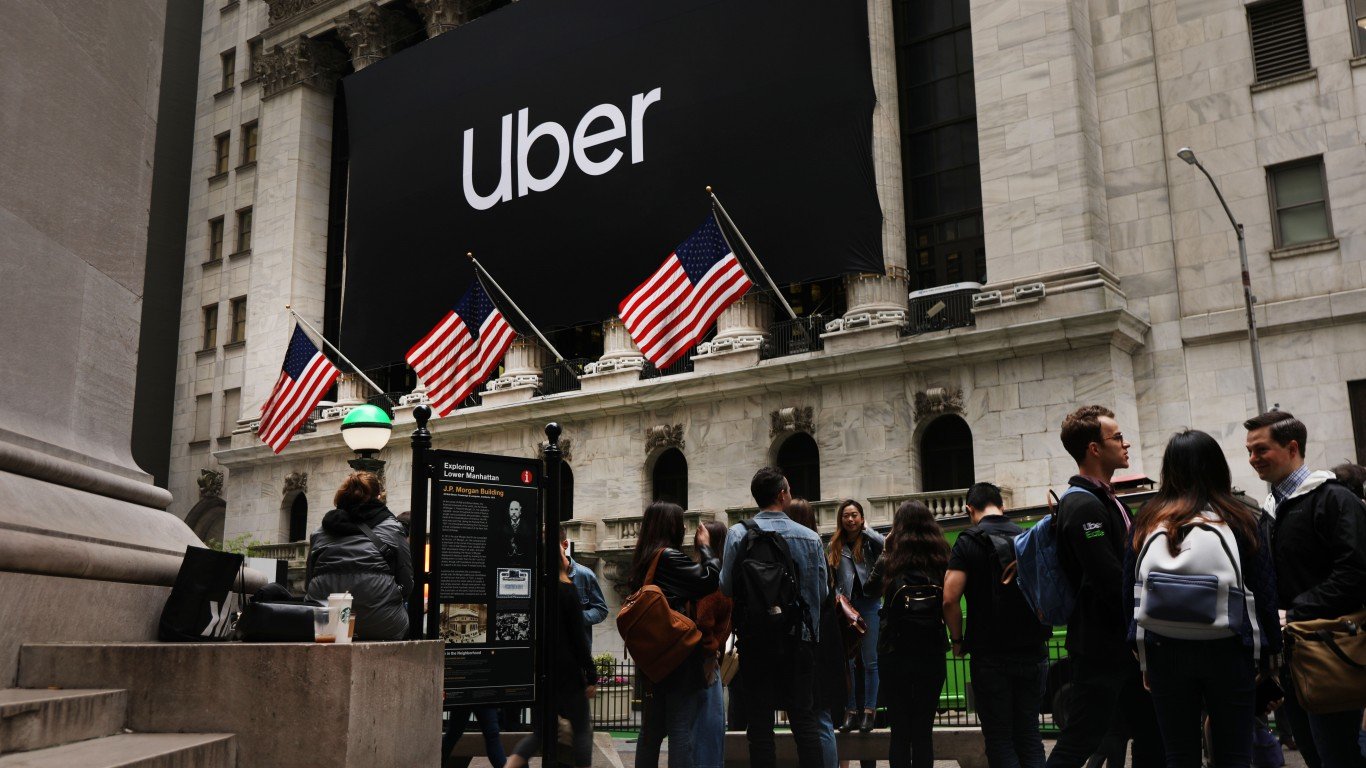
Despite Nearing 52-Week Low, Uber Stock Has More Room to Run
Uber stock sits near a 52-week low while posting record free cash flow and guiding for up to 35% earnings growth, a contradiction that points to a rare mispricing in one of the most widely watched names on Wall Street.

Uber Technologies (NYSE:UBER | UBER Price Prediction) has quietly slid back near the low end of its 12-month range, but our model reads the setback as opportunity. Fundamentals are accelerating, cash generation just hit a company record, and the stock is trading at a mid-teens earnings multiple. That combination is unusual for a business compounding gross bookings at more than 20%.
The 24/7 Wall St. Price Target for Uber
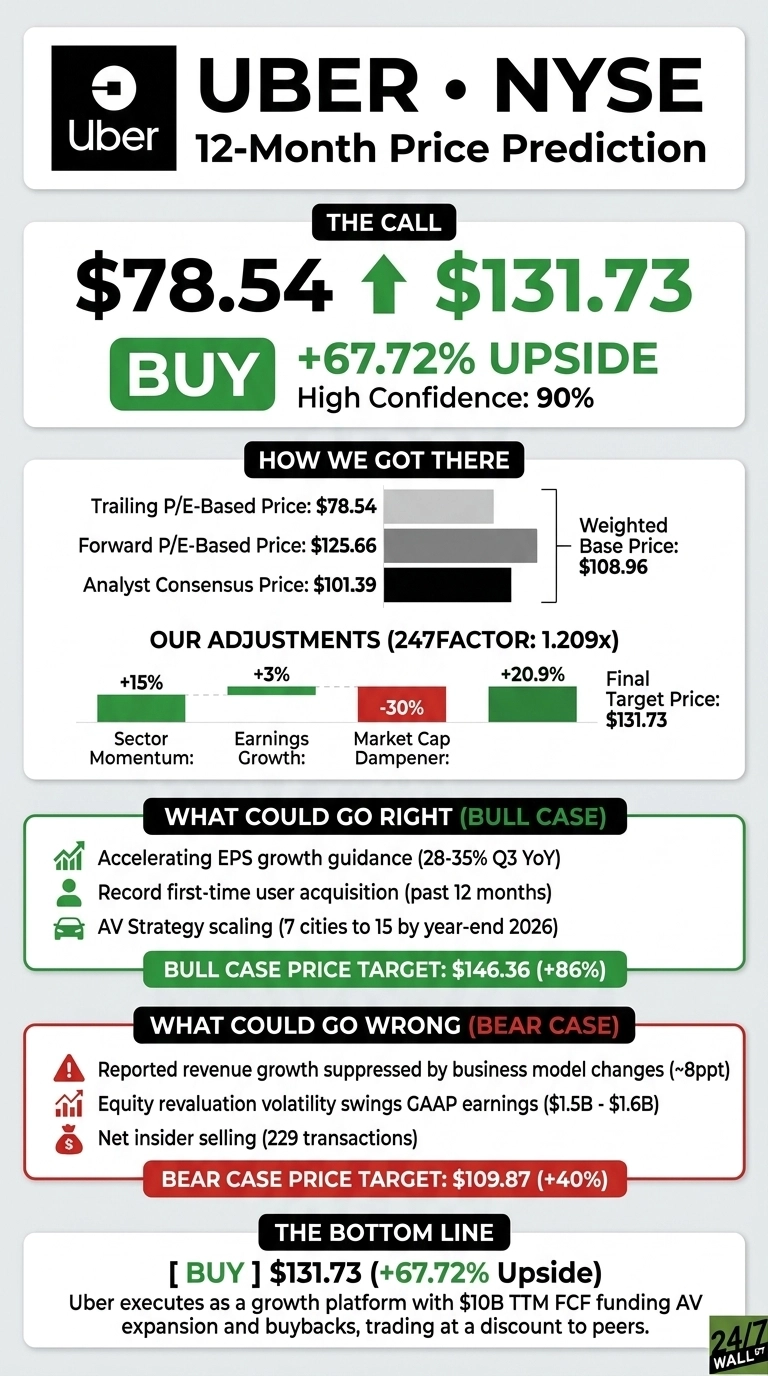
Uber closed the last session at $78.54, still within striking distance of its 52-week low of $65.41. Our 24/7 Wall St. price target for Uber is $131.73 over the next 12 months, implying 67.72% upside. The recommendation is buy, with a high confidence level of 90%.
| Metric | Value |
|---|---|
| Current Price | $78.54 |
| 24/7 Wall St. Price Target | $131.73 |
| Upside | 67.72% |
| Recommendation | BUY |
| Confidence | 90% |
Why Uber Has Been Under Pressure
Uber is down 13.29% over the past year and 3.88% year to date, though shares have bounced 9.1% in the last week.
The Q2 2026 report on August 5 was the flashpoint: EPS of $0.81 missed by 2.76% and revenue of $14.19 billion came in 0.50% light. Gross Bookings still grew 24% to $58.02 billion, and trailing 12-month free cash flow crossed $10 billion for the first time. Retail sentiment on Reddit turned bearish (scores 35 to 38) after the miss.

The Bull Case
Bulls see Q3 guidance of $0.84 to $0.88 in non-GAAP EPS (28% to 35% growth) as proof the platform is compounding. CEO Dara Khosrowshahi said Uber has “added more first-time users over the past twelve months than in any period over the past five years”.
The AV strategy is scaling from 7 cities today to 15 by year-end 2026 and targets 28 cities globally by 2028. Our bull-case scenario points to $146.36, an 86% return.

What Could Go Wrong
Reported revenue growth is suppressed by roughly 8 percentage points from business model changes, and equity revaluations have swung GAAP earnings by $1.5 billion to $1.6 billion in recent quarters. Insider activity shows net selling across 229 transactions.
Those revaluations are non-cash, and Uber repurchased $6.52 billion of stock in 2025 alone. Our bear case still targets $109.87, which is 40% above today’s print.
How Uber Compares to Lyft and DoorDash
Lyft (NASDAQ:LYFT) is the closest US-listed rideshare comp. Lyft grew Q2 revenue 16.1% to $1.84 billion with 30.5 million active riders. Its trailing P/E of 2 is distorted by a prior tax valuation release. Lyft is expanding roughly in line with Uber’s Mobility segment while lacking the delivery and freight optionality.
DoorDash (NASDAQ:DASH) is the delivery comp. DoorDash grew Q2 revenue 35.6% to $4.45 billion but trades at a P/E of 92. Uber’s Delivery segment grew 28% with segment operating income up 38%, meaning investors get DoorDash-like growth at a fraction of the multiple. The peer set makes our price target look conservative.
| Company | P/E | Q2 Revenue Growth |
|---|---|---|
| Uber | 16 | 12.2% |
| Lyft | 2 | 16.1% |
| DoorDash | 92 | 35.6% |
The Setup Into Q3
Our 24/7 Wall St. price target of $131.73 and buy rating rest on a simple thesis: Uber trades like a mature rideshare business but is executing like a growth platform, with $10 billion in trailing FCF funding both AV expansion and buybacks.
The setup into Q3 hinges on whether Uber delivers on the 28% to 35% EPS growth guide. Key risks to watch include Delivery segment growth decelerating below 20% or Mobility take rates continuing to compress.

| Year | 24/7 Wall St. Price Target |
|---|---|
| 2026 | $91 |
| 2027 | $135 |
These projections assume Uber continues scaling AV partnerships and Delivery profitability. Significant upside could come from faster AV commercialization, while worker classification regulation or equity revaluation volatility remain the primary risks.
Contact [email protected] for any questions or corrections.
Vandita Jadeja is a financial publisher with over a decade of experience writing about financial topics, including investment, savings, retirement, insurance and banking. Vandita is a Chartered Accountant who loves to debunk financial concepts for readers.
Her work has appeared on sites that include The Motley Fool, InvestorPlace, and Benzinga. She covers investing and focuses on stock picks and price prediction for 24/7 Wall St.
When not looking for the next stock investment opportunity, she can be found traveling, reading, chasing sunsets and enjoying her iced latte.