Chevron’s Dividend Looks Great at $104 Oil—What Happens When Oil Falls?
Chevron has raised its dividend 39 straight years, but the real test was never a bull market in crude. Find out what the 2020 stress test and two new revenue streams reveal about whether that streak survives the next oil…

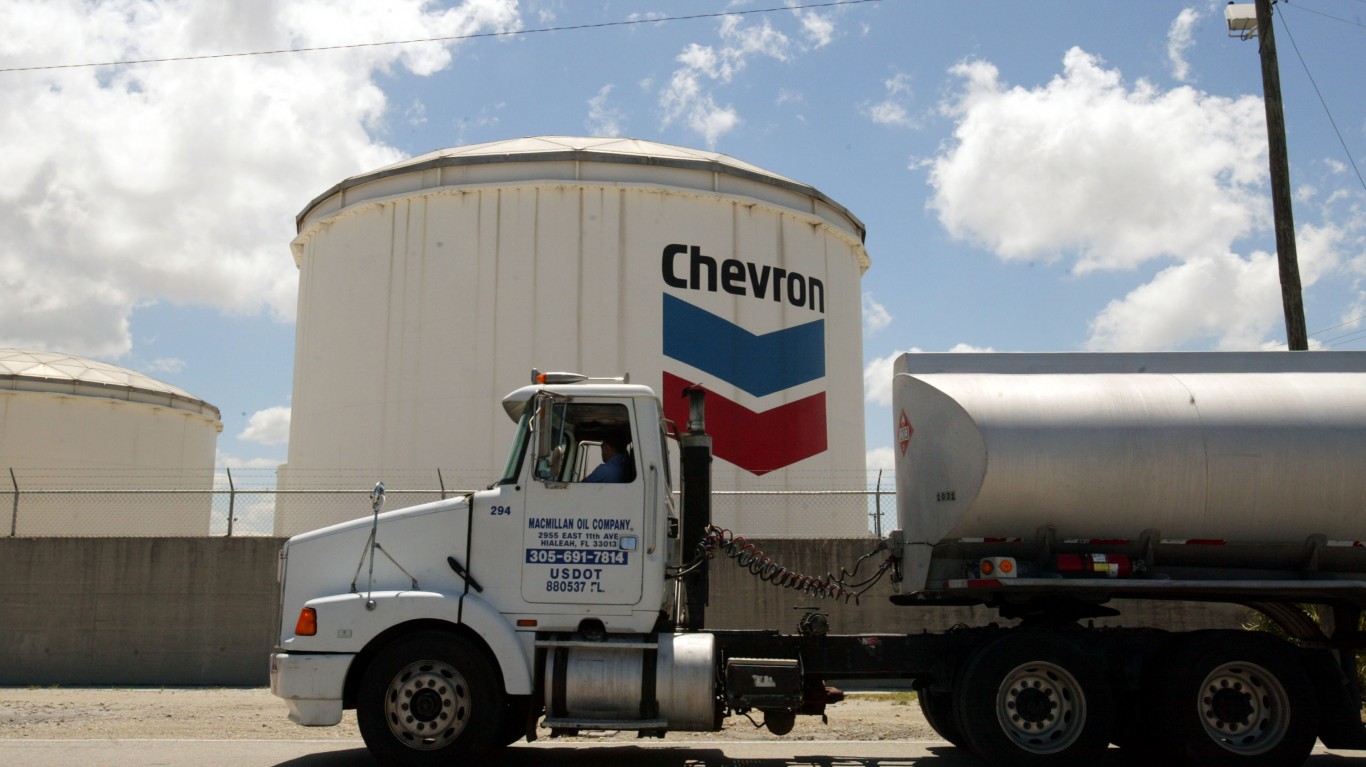
Chevron (NYSE:CVX | CVX Price Prediction) shareholders are set to collect another $1.78 per share quarterly payment on September 10, 2026, extending a streak most oil majors envy. The check is the third at the current rate, which reflects a 4% raise announced at the start of 2026, marking the 39th consecutive annual increase. With shares at $212.21 and up 42.32% year to date, the current yield sits at roughly 3.08%.
For a commodity-linked payer, the check looks easy with Brent at $104. The real question is what happens when crude rolls over. That answer is where Chevron earns its scorecard.
Dividend Scorecard: A Grade, With an Asterisk
Q2 2026 delivered adjusted EPS of $6.06 on revenue of $67.20 billion, up 51.43% year-over-year. Free cash flow hit $18.095 billion against a quarterly dividend outlay near $3.504 billion. Full-year 2025 produced $33.94 billion in operating cash flow versus $12.75 billion in dividend payout. Balance sheet: net debt to cash flow from operations of 0.6 times after more than $8 billion in debt reduction last quarter.

FY2025 EPS came in at $6.63 while the annualized forward dividend runs $7.12. On trailing earnings, that reads over 100%. On free cash flow, it clears comfortably. Grade: A minus. Elite streak, elite coverage in a good tape, but the ratio compresses fast when crude cracks.

2020 Stress Test You Should Actually Care About
When WTI collapsed to $36.97 in November 2020, Chevron generated only $10.6 billion of operating cash flow for the full year and paid out $9.7 billion in dividends. Q2 2020 operating cash flow was just $80 million against a $2.394 billion dividend. Chevron leaned on the balance sheet, protected the payment, and kept the streak alive. That is the resilience the current management team is being paid to replicate.
What Actually Changes the Math This Cycle
The Hess integration delivered $1.5 billion in synergies six months ahead of schedule, and management called Hess free cash flow “roughly double the incremental dividends”. Also, Project Kilby, a 20-year take-or-pay power purchase agreement with Microsoft covering 2.67 gigawatts, is designed to throw off “long duration contracted cash flows that are independent of commodity price cycles.”
Mike Wirth summarized the philosophy plainly: “We’ll always focus on value over growth.” For dividend investors, the read is straightforward. The payment is safer than the ratio suggests, but only because Chevron has, again and again, chosen the check over almost everything else. Streaks like this one are the whole reason we built a free Dividend Kings screen ranking the longest-running raisers by valuation today.
Contact [email protected] for any questions or corrections.
Chris Lange is a financial and geopolitical writer with more than a decade of experience covering a myriad of topics. He has published thousands of articles for 24/7 Wall St., with past coverage focused heavily on stocks, IPOs, healthcare, defense, global affairs, and technology.
His work has been quoted, or referenced by a number of outlets including Business Insider, USA Today, Yahoo Finance, MSN, The Motley Fool, and many other publications. A graduate of Southwestern University, he studied business with a focus on investments and has previous experience in banking and startups.
When not reading or writing the news, he is following his passion for Lacrosse, playing chess, or building solar projects with his dad.