‘Some of These Lasers Were the Size of Buildings’: Now They Need 12 Minerals China Cut Off
China just restricted 12 minerals that defense contractors need to build the next generation of laser weapons, and Raytheon's $289 billion backlog may be sitting on a supply chain fault line nobody wants to talk about.

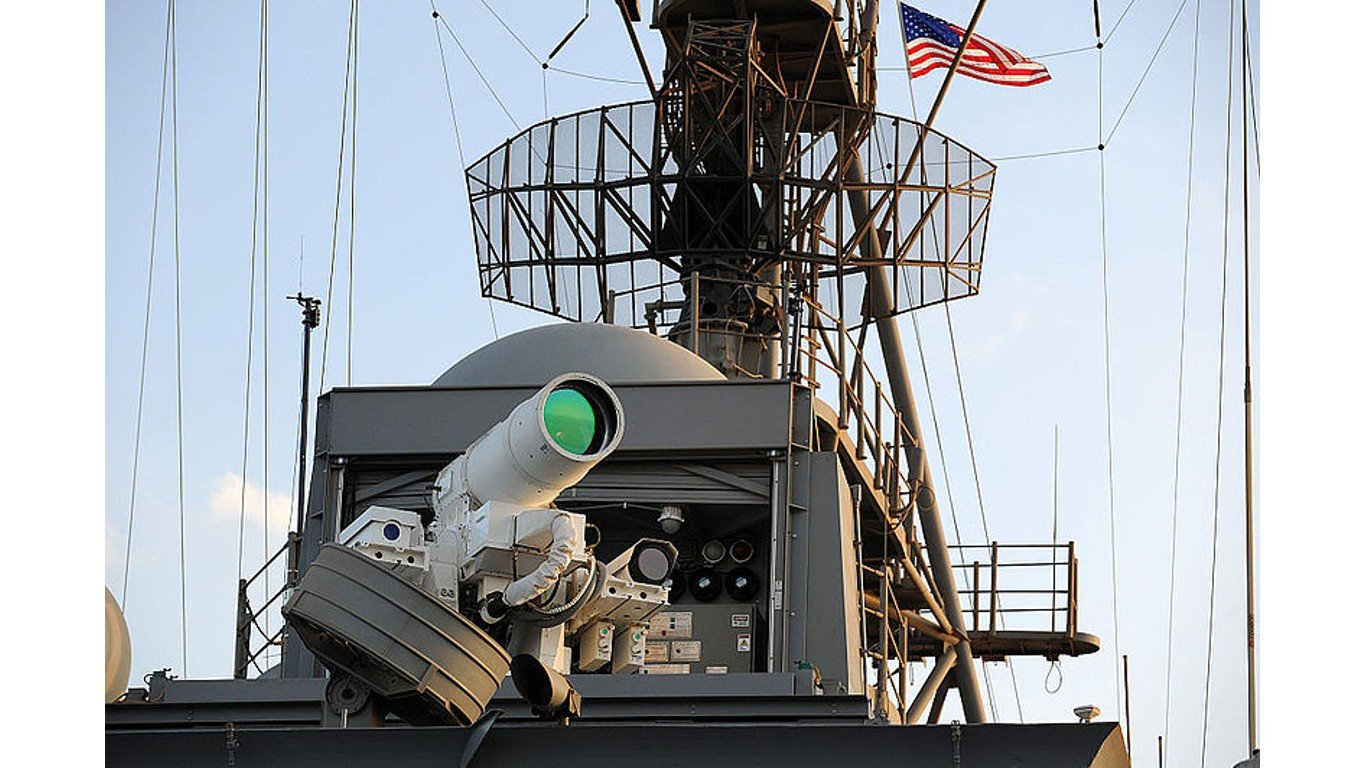
Bloomberg Intelligence defense analyst Wayne Sanders opened his Odd Lots appearance with a physics lesson: older laser weapons “were the size of buildings” because of the power they demanded. The directed-energy trade rests on shrinking that footprint onto a truck or ship. The catch: the diodes that fire the beam start with gallium, terbium, dysprosium, and neodymium, and China has restricted 12 critical minerals from US access.
If you’re a defense investor, you’re aware RTX (NYSE:RTX | RTX Price Prediction) is one of the purest way to own the Patriot/AMRAAM/Standard Missile complex, and this is the risk hiding behind a monster backlog.
Why the Mineral Cutoff Hits Raytheon First
Raytheon’s Q2 revenue rose 18% to $8.27 billion, driven by Patriot, Standard Missile, and AMRAAM. Bookings included over $5 billion of GEM-T Patriot effectors, $1.8 billion for AMRAAM, and $1.1 billion for AIM-9X. Total RTX backlog hit $289 billion, up 22% year over year.

CEO Chris Calio told analysts: “At Raytheon, we’ve more than doubled year over year output across our critical munitions through the first half of the year.” Doubling output means doubling material draw. RTX’s risk disclosures flag “Tariffs and trade restrictions impacting supply chains” and “Supply chain disruptions and material cost increases.” Calio was blunter on the call: “All of this, whether it be executing on the backlog we’ve got today or any of the things that may come into our backlog from the framework agreement, is going to be predicated on the supply chain market.”
Peers Are Saying the Quiet Part Out Loud
Lockheed Martin (NYSE:LMT) explicitly listed “rare-earth mineral availability” as a Q2 risk. Lockheed just signed a $35 billion multi-year THAAD contract and a 500 kilowatt containerized laser award. Sanders puts the Pentagon target at 1 megawatt by 2030, versus Israel’s Iron Beam at roughly 150 kilowatts.
Boeing (NYSE:BA) flagged similar exposure. CEO Kelly Ortberg said “The demand signal on our defense and space products remains very strong with notable increased demand in missiles and munitions.” Leidos (NYSE:LDOS) is scaling a $1 billion low-cost containerized munitions framework into the same constrained supply base.
What the Market Is Actually Pricing
RTX is up 30% over one year and 11% year to date, though it slipped 7% over the past month to $202.13. Lockheed is up 22% over the past year. Yet MP Materials, the US rare-earth pure play investors would need to solve the chokepoint, is down 19% over the past year.
Buy RTX if you believe Calio can source second and third suppliers “outside the defense industrial base” fast enough to feed a $289 billion backlog. Fade it if you think the beam still starts in Beijing.
Contact [email protected] for any questions or corrections.
I've been writing about stocks and personal finance for 20+ years. I believe all great companies are tech companies in the long run, and I invest accordingly.