Tesla vs SpaceX: Elon Musk’s Two Companies Are Chasing the Same AI Prize. Only One Is Positioned to Win It
Elon Musk is running two separate companies toward the same AI finish line, but their strategies, cash positions, and timelines could not be more different. One already earns revenue from compute today while the other burns billions building the infrastructure…

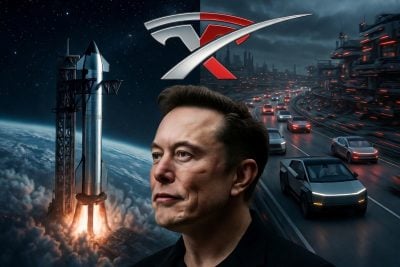
Tesla (NASDAQ: TSLA | TSLA Price Prediction) just closed a bruising quarter that put its AI ambitions on full display, reporting $28.24B in revenue alongside a 1.4% operating margin. SpaceX reported its own results in early August. Both Musk companies are chasing the same AI prize from opposite directions: Tesla on the ground, SpaceX in orbit and inside data centers. Only one currently owns the compute.
Ground Robots Versus Orbital Compute
Tesla’s quarter was a spending story. CapEx surged to $5.79B, up 141.81% year over year, and free cash flow flipped to negative $1.09B. CFO Vaibhav Taneja said CapEx will grow for “the next two or three years” across Robotaxi, Optimus, a semiconductor fab, and AI compute. Robotaxi expanded to seven U.S. metros, and active FSD subscriptions reached 1.48 million, up 56% YoY.
SpaceX’s AI angle is different. After merging with xAI in February, its Colossus data centers in Memphis became the revenue engine, with the launch business (still only roughly $4 billion) increasingly a side act. SpaceX also committed to building AI infrastructure exclusively on Nvidia, including a Vera Rubin NVL72 variant designed for orbit.
| Business Driver | Tesla | SpaceX |
| AI Revenue Engine | FSD subscriptions, future Robotaxi fleet | Data center rentals, Grok compute |
| Hardware Bet | Optimus, Cybercab, AI5/AI6 chips | Starlink, Starship, Nvidia-based clusters |
| Cash Profile | Negative FCF, $43.5B cash | Heavily shorted, ~$3T |
One Owns Compute Today. One Is Still Building It.
This is where the strategies diverge sharply. SpaceX already rents compute at a premium because Grok has capacity while rivals scramble. Tesla is still constructing the picks-and-shovels. Musk called TerraFab “a necessary” project to avoid being constrained in scaling Optimus by a lack of AI chips. Optimus itself faces skepticism: Polymarket puts the probability of a 2026 release at just 0.031. California Robotaxi by year-end sits at 0.23.
Tesla booked a $1 billion mark-to-market gain on its SpaceX holdings, a quiet reminder that shareholders already own a slice of both bets. Merger chatter is louder than execution: the strongest Polymarket outcome, an announcement by December 31, 2027, prices at 0.465.
What Decides the Prize in 2027
Reddit sentiment on Tesla is sitting at 22, bearish, driven by a viral post titled “Tesla Cybercab Flops, Elon Ghosts, NHTSA Knocks: TSLA Dropped 6%”. Three things to watch: whether FSD v15 hits Ashok’s “ridiculously safe and capable” bar, whether TerraFab yields working AI5 chips by mid-2027, and whether Starlink integration into Cybercab actually ships.
Why I Lean Toward SpaceX for the AI Prize, and Tesla for the TAM
Both cases have merit. SpaceX has the clearer near-term software and infrastructure path following the xAI absorption: compute already earning revenue, Grok managing Digital Optimus, and Starlink monetizing connectivity. Tesla owns the bigger physical-AI opportunity if Optimus actually scales toward Musk’s aspirational 10 million units a year target, but that number sounds cartoonish today. For public-market investors, TSLA at a P/E of ~369 is a bet on execution. Key execution milestones include Robotaxi crossing a million autonomous miles cleanly and TerraFab producing first silicon.
Contact [email protected] for any questions or corrections.
Alex Sirois is a financial writer with experience spanning both retail and institutional investing. He has written for InvestorPlace and held roles at BNY Mellon and Bernstein, giving him a perspective that bridges Main Street portfolios and Wall Street analysis.
Alex holds an MBA from George Washington University and has built his career across multiple industries, including e-commerce, education, and translation — a breadth of experience that informs how he breaks down complex financial topics for everyday investors. His writing is conversational, actionable, and grounded in long-term, buy-and-hold investing principles.
At 247 Wall St., Alex focuses on delivering analysis that is both accessible and useful, with a clear emphasis on helping readers make more informed decisions with their money.