Tesla vs. Alphabet: The Better Investment May Surprise You
Tesla and Alphabet both reported earnings on the same day, both stocks trade near the same price, and both companies are pouring billions into AI. But one of them is burning cash on promises while the other is already cashing…

Tesla (NASDAQ: TSLA | TSLA Price Prediction) and Alphabet (NASDAQ: GOOG) both reported Q2 2026 results on July 22, 2026, and the same-day comparison reveals two very different AI stories.
Tesla is spending furiously on Robotaxi, Optimus, and chips while today’s automotive margins buckle. Alphabet is spending even more, yet Google Cloud and Gemini are already turning that capital into recurring revenue at scale.
Both stocks trade near the same price. The businesses behind them look nothing alike.
Margin Pain at Tesla. Margin Expansion at Alphabet.
Tesla delivered $28.24 billion in revenue, up 25.52% year over year, with a record 480,126 vehicle deliveries and 13.5 GWh of energy storage deployed. That is real operational momentum.
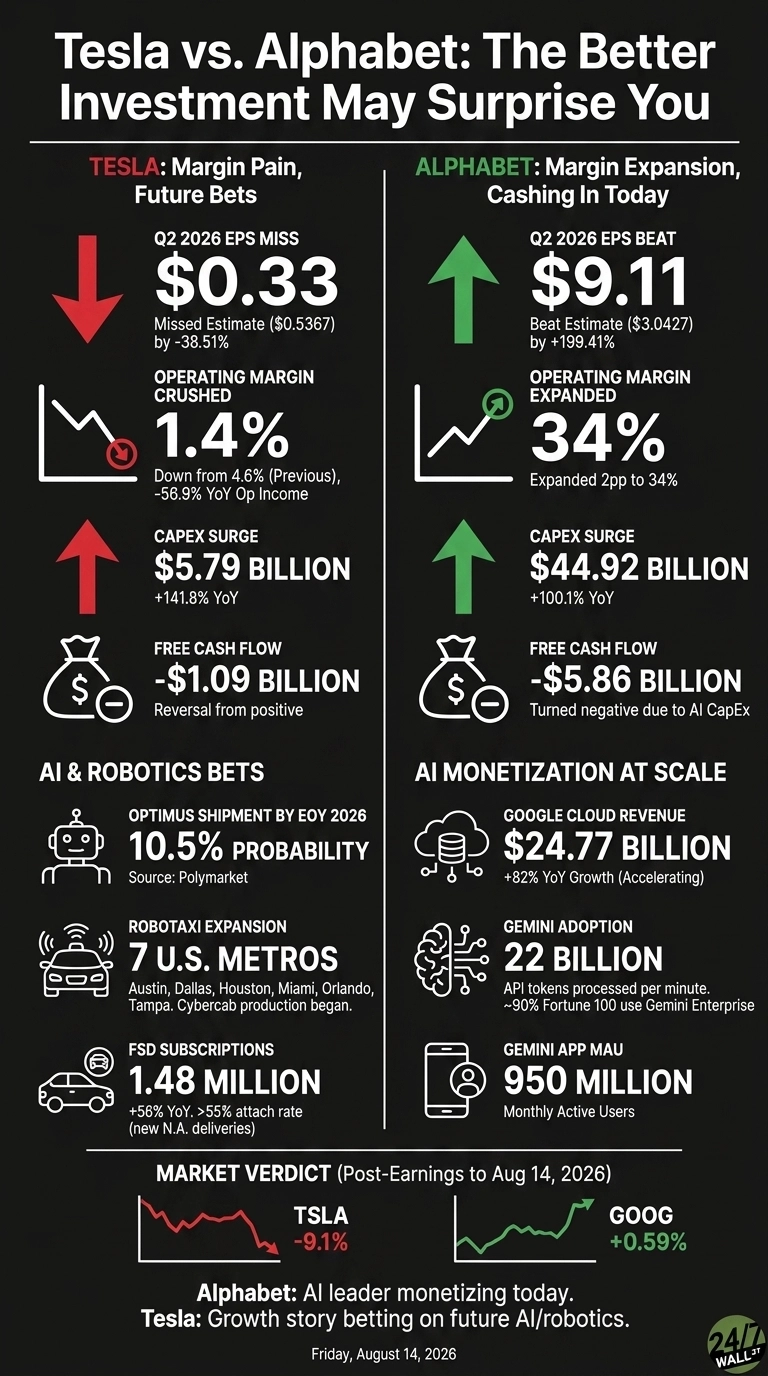
But non-GAAP EPS of $0.33 came in missing expectations by 38.51%, and operating margin collapsed to 1.4% as opex jumped 47% on AI infrastructure and CEO award stock-comp. CFO Vaibhav Taneja acknowledged “automotive margins excluding regulatory credits declined sequentially from 19.2% to 16.3%”.
Alphabet posted $119.8 billion in revenue and blew past estimates with EPS of $9.11 versus a $3.0427 estimate. The star of the quarter was Google Cloud at $24.768 billion, up 82%, with a cloud backlog that swelled to $514 billion. Sundar Pichai told investors “nearly 90% of the Fortune 100” now use Gemini Enterprise. Operating margin expanded to 34%.
| Business Driver | Tesla | Alphabet |
| Revenue growth | 25.5% | 24.2% |
| Operating margin | 1.4% | 34% |
| Q2 CapEx | $5.79B | $44.92B |
Betting on Future Robots vs. Cashing Checks Today
Tesla’s thesis is entirely forward. Elon Musk framed the spend bluntly: “This is a massive CapEx year, but I’m confident that all the things that we’re investing in will yield incredible returns.”
Robotaxi now runs in seven markets, active FSD subscriptions hit 1.48 million, and Cybercab production has begun. Yet free cash flow flipped to -$1.09 billion, and Polymarket traders assign just a 10.5% probability that Optimus ships commercially by year-end.
Alphabet is monetizing AI while it builds. Gemini processes 22 billion API tokens per minute, the consumer app hit 950 million MAUs, and Search still grew 17% to $63.27 billion. Free cash flow did turn negative at -$5.86 billion, and long-term debt more than doubled to $98.2 billion.
Those are real risks. They just come attached to a business already generating $185.7 billion in trailing operating cash flow.
The Next Test Is Whether Tesla’s Spend Converts
I will be watching whether Tesla’s operating margin can climb back above 5% before capex eases, and whether Robotaxi miles compound at the rate Ashok described: “more than 10% a week”.
For Alphabet, the story is TPU supply. Management said “vast majority of TPU system sales revenue expected in 2027”, meaning today’s backlog becomes tomorrow’s earnings only if capacity keeps pace.
Why I Lean Toward Alphabet on This Earnings Report
Personally, I would rather own Alphabet here. At a P/E near 14 with 34% operating margins, you get an AI leader monetizing today, not a promise.
Tesla at a P/E of 354 requires believing Optimus, Robotaxi, and TerraFab all land on schedule. Tesla stock has fallen 9.1% since earnings while Alphabet is roughly flat at +0.59%, which tells you what the market thinks too.
If you are a turnaround investor who believes AI robotics arrives faster than the crowd expects, Tesla still has asymmetric upside. For everyone else, Alphabet looks like the more compelling AI trade this quarter.
Contact [email protected] for any questions or corrections.
Vandita Jadeja is a financial publisher with over a decade of experience writing about financial topics, including investment, savings, retirement, insurance and banking. Vandita is a Chartered Accountant who loves to debunk financial concepts for readers.
Her work has appeared on sites that include The Motley Fool, InvestorPlace, and Benzinga. She covers investing and focuses on stock picks and price prediction for 24/7 Wall St.
When not looking for the next stock investment opportunity, she can be found traveling, reading, chasing sunsets and enjoying her iced latte.