Amazon Just Handed Qualcomm a Slice of AWS’s AI Buildout
AWS is sitting on a $496 billion backlog and doubling its power capacity, and the pressure is now pulling a surprising new name into the AI silicon race alongside Broadcom. Whether that newcomer can actually deliver before the window closes…

Amazon’s AWS unit is now the loudest buyer in the AI compute market, and this morning it handed a piece of its silicon roadmap to a new supplier. Qualcomm announced a multi-generational product collaboration with Amazon to build next-generation AI data center infrastructure, extending AWS’s custom-chip strategy beyond in-house Trainium and incumbent Broadcom. The scale of what AWS is trying to feed is the point: AWS backlog stands at $496 billion, and Amazon is on pace to double its power capacity by the end of 2027 versus 2025. That is the demand pressure that just pulled Qualcomm into the accelerator conversation.
Amazon: Anchor Buyer With a $496 Billion Backlog
Amazon (NASDAQ:AMZN | AMZN Price Prediction) is the customer at the center of this story, and its Q2 FY2026 print explains why silicon vendors are lining up. AWS revenue was $42.2 billion, up 36.7% year-over-year, the fastest AWS growth in 18 quarters, with an annualized revenue run rate of $169 billion. Amazon’s own AI revenue run rate is now over $25 billion, and its chips business separately eclipsed a $25 billion run rate. Cash capital expenditures hit $53.1 billion in the quarter, and CEO Andy Jassy said AWS could “very possibly be a trillion dollar annual revenue business for us in time.”
The bull case is straightforward: Amazon has already reserved the lion’s share of 2027 capacity and is signing 2028, and management said most AI capacity is being contracted for at least five-year terms. Shares trade at a P/E of 36 with the stock up 11.03% year to date. The risk: near-term free cash flow is under pressure while data centers are built ahead of monetization, a point Amazon flagged directly on the call.
Qualcomm: New Data Center Entrant With a Signed Amazon Deal
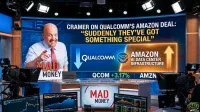
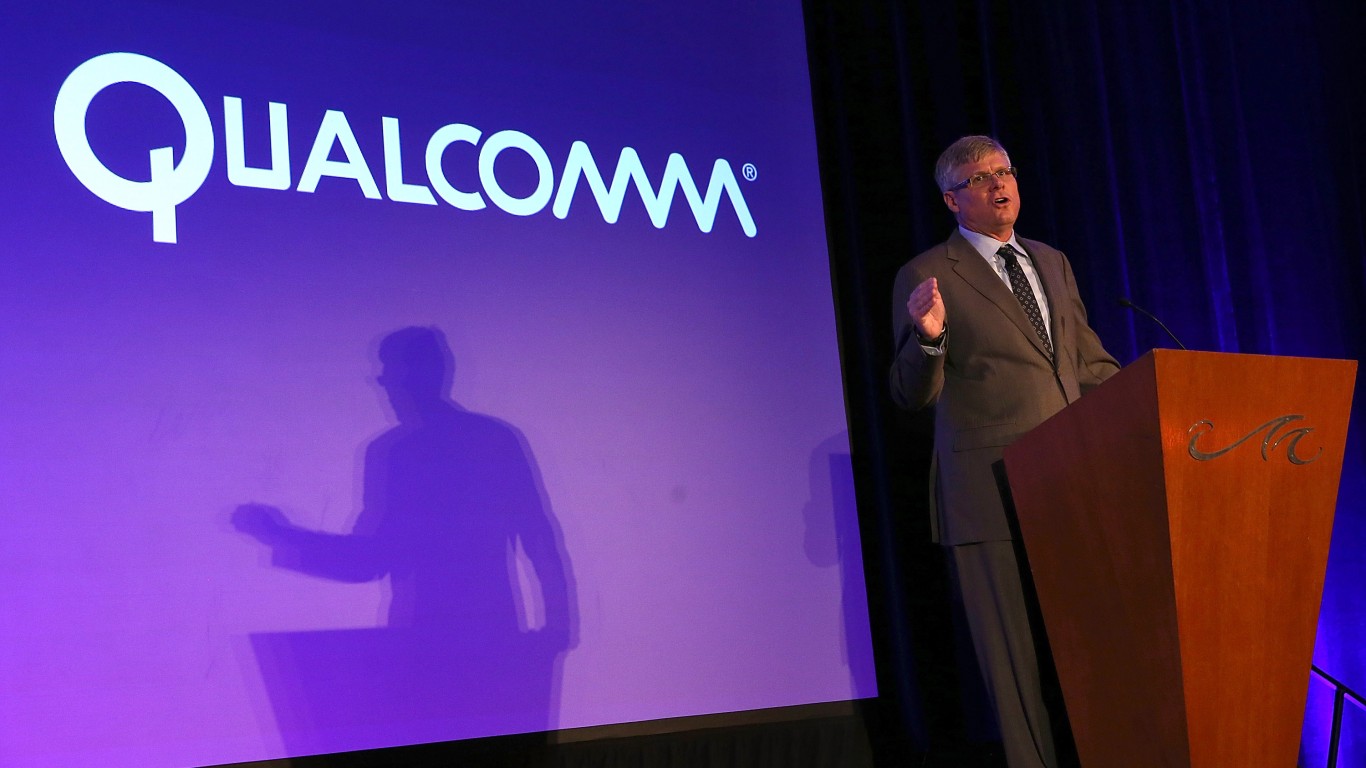
Qualcomm (NASDAQ:QCOM) just converted what had been a vaguely disclosed “leading hyperscaler” engagement into a named Amazon partnership. Per CNBC, Qualcomm is working with Amazon “across multiple generations of customized silicon” focused on inference workloads for AWS AI infrastructure, and per user context, the scope also reaches into 1.6T optical connectivity, giving Qualcomm a shot at selling both compute and networking around AI workloads. On the July earnings call, CFO Akash Palkhiwala said Qualcomm already has purchase orders and has started wafer production on its two hyperscaler engagements, with revenue starting in the December quarter.
The numbers behind the pivot: Qualcomm is targeting $5 billion in data-center revenue in fiscal 2027 and $15 billion in fiscal 2029, with total non-handset revenue targeted at $40 billion by fiscal 2029. CEO Cristiano Amon said non-handset growth will accelerate from 24% in fiscal 2026 to greater than 60% in fiscal 2027. The stock ripped on the news, up 7.4% over the past week and 3.94% on the session to $175.39, trading at a P/E of 33 with a 2.11% dividend yield.

The bull case: this is Qualcomm’s second major hyperscaler win, following Meta’s commitment to use the Dragonfly C1000 starting in 2028 production, and Bank of America sees the CPU market growing from $27 billion in 2025 to $60 billion by 2030. The risk is real and management flagged it themselves: initial custom-chip data-center revenue carries gross margins significantly lower than baseline and will reduce QCT weighted-average gross margin by one and a half to 2% during the ramp. Handset revenue also declined 20% year-over-year last quarter, so the data-center story has to work to offset the core business.
Broadcom: Incumbent With a $115 Billion AI Runway
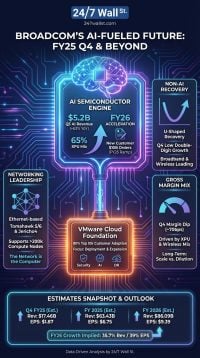
Broadcom (NASDAQ:AVGO) is the incumbent Qualcomm is trying to catch, and last week’s print set the bar. Q3 AI semiconductor revenue was $16.70 billion, up 221% year-over-year and 54% quarter-over-quarter, representing 56% of total revenue. Q4 guidance calls for AI semi revenue of $21.7 billion, and management expects fiscal 2026 AI revenue of $58 billion, scaling to approximately $115 billion in fiscal 2027 and $230 billion in fiscal 2028. CEO Hock Tan pegged Broadcom’s content at $20 billion to $30 billion per gigawatt of AI infrastructure deployed.

The customer roster is what makes the incumbency stick: Google TPUs (Broadcom said it plans to deliver “multi-tens of billions of dollars of TPUs annually over the next several years”), Anthropic (a one-gigawatt Ironwood deployment in 2026 and another five gigawatts of TPU v8i in 2027), OpenAI (Jalapeno accelerator with 1.3 gigawatts of deployment in 2027), and Meta’s MTIA program. The stock is up 20.62% over the past year but down 12.37% over the past month to $366.52, with free cash flow last quarter of $13.66 billion (46% of revenue). The risk is customer concentration: the “vast majority” of AI demand originates from a concentrated group of frontier-model developers, and any of those customers dual-sourcing (as AWS is now doing with Qualcomm) chips away at the addressable moat.
What to Watch
These are three fundamentally different bets on the same buildout. Amazon has the balance sheet and the backlog to fund the demand pull, Broadcom has the incumbent AI-silicon P&L with real free cash flow behind it, and Qualcomm is an early-revenue data-center entrant whose thesis rests on execution against a fiscal 2029 $15 billion target that has not yet shown up in the reported numbers. December-quarter shipments and the fiscal 2027 ramp are the two proof points that will decide whether Qualcomm actually takes durable share, or whether Broadcom’s TPU, Jalapeno, and MTIA pipelines simply absorb the next leg of hyperscaler capex. For readers hunting the next monster run in AI silicon, we reverse-engineered what the biggest tech winners looked like early in a free playbook here.
Contact [email protected] for any questions or corrections.
After two decades of patrolling the dark corners of suburbia as a police officer, Rich Duprey hung up his badge and gun to begin writing full time about stocks and investing. For the past 20 years, he’s been cruising the markets looking for companies to lock up as long-term holdings in a portfolio while writing extensively on the broad sectors of consumer goods, technology, and industrials. Because his experience isn’t from the typical financial analyst track, Rich is able to break down complex topics into understandable and useful action points for the average investor. His writings have appeared on The Motley Fool, InvestorPlace, Yahoo! Finance, Money Morning, and, of course, 24/7 Wall St. He has been featured in both U.S. and international publications, including MarketWatch, Financial Times, Forbes, Fast Company, and USA Today.