Prediction: Oracle is Ready to Explode. Here’s Our Price Target.
Oracle cratered nearly 40% over the past year while quietly assembling a backlog that dwarfs its annual revenue, and now a single earnings date separates the stock from a potential breakout or a painful setback.


Oracle touched an all-time high of $341.82 a year ago, collapsed to $114.50 earlier this summer, then ripped back 25.89% in the past month as investors reassess a $638 billion AI contract backlog. That reset is why Oracle (NYSE:ORCL | ORCL Price Prediction) is ready to explore higher ground.
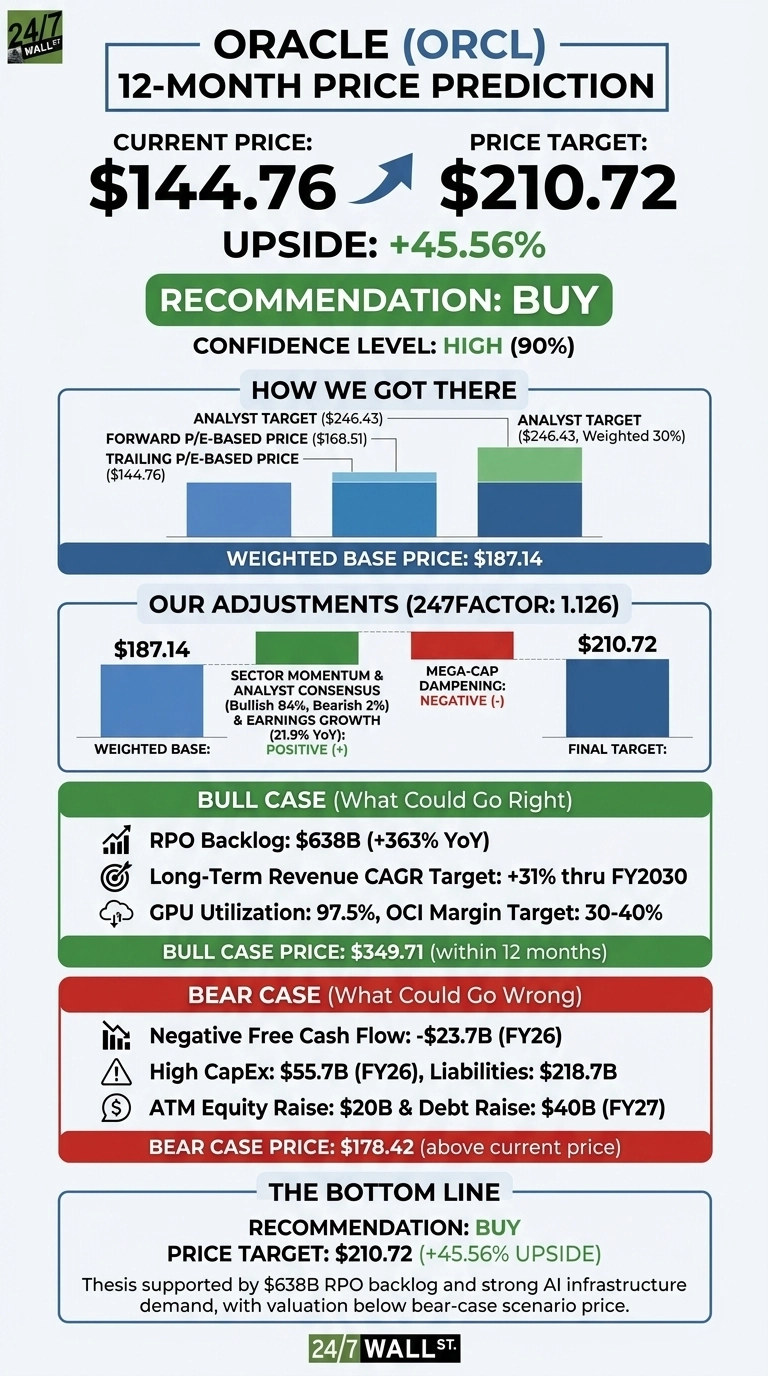
Our 24/7 Wall St. price target for Oracle is $210.72, implying 45.56% upside from $144.76. Confidence is high at 90%, and our recommendation is buy.
24/7 Wall St. Price Target Summary
| Metric | Value |
|---|---|
| Current Price | $144.76 |
| 24/7 Wall St. Price Target | $210.72 |
| Upside | 45.56% |
| Recommendation | BUY |
| Confidence Level | 90% |
A Wild Round Trip, Then a June Reset
ORCL is down 25.01% year to date and 37.80% over the past year, largely on fears Oracle is overspending to chase AI capacity. Retail sentiment turned bearish in early August on concerns that Larry Ellison has 346 million Oracle shares pledged as loan collateral. Sentiment has since flipped bullish on the options desks.
The pivot was the Q4 FY2026 report on June 10, 2026. Revenue hit $19.184 billion with EPS of $2.11, OCI grew 93%, and management disclosed $67 billion in AI infrastructure contracts signed during the quarter. Q1 FY2027 results land September 10.

Why Bulls See a Breakout Ahead
The bull case rests on RPO backlog of $638 billion, up 363%, giving Oracle multi-year revenue visibility no software peer matches. Safra Catz reaffirmed a plus 31% revenue CAGR and plus 28% EPS CAGR through fiscal year 2030.
Multicloud database revenue grew 404% in Q4, GPU utilization sits at 97.5%, and management targets a 30% to 40% margin profile at OCI steady state. Our bull scenario points to $349.71 within twelve months if data-center ramps land on schedule.

What Could Go Wrong
Free cash flow was negative $23.68 billion in FY26, with CapEx of $55.66 billion and total liabilities at $218.70 billion. Oracle plans to raise roughly $40 billion in debt and equity in FY27, including a $20 billion ATM equity program that could pressure the stock. Software license revenue declined 6% in Q4.
Bulls counter that this outspend is largely funded by $75 billion in prepaid or customer-supplied GPU arrangements, which management says arrive with no degradation in margin. Our bear scenario still sees $178.42, above today’s price.

How Oracle Compares to Microsoft and Salesforce
Oracle trades at a forward P/E of 18x, well below the analyst target implied multiple.
Microsoft (NASDAQ:MSFT) is the direct hyperscaler comp because Azure competes with OCI on AI workloads. MSFT is up 2.32% YTD to $491.71, versus Oracle’s 25.01% YTD decline. Microsoft’s steadier performance shows the market pays up for scale and profitability, which is exactly what Oracle promises once OCI reaches its 30% to 40% margin profile. That gap makes our target look conservative if Oracle closes half the sentiment discount.
Salesforce (NYSE:CRM) is the SaaS counterpoint. Salesforce trades at a P/E of 23 with an operating margin of 21% and guided FY27 revenue of $45.9 billion to $46.2 billion. Oracle’s FY27 guide of $90 billion is roughly double, growing faster, at a lower forward multiple. On a growth-adjusted basis, Oracle looks cheap relative to CRM, supporting our $210 target.
| Company | Forward P/E | YTD Return |
|---|---|---|
| Oracle | 18 | -25.01% |
| Microsoft | n/a | +2.32% |
| Salesforce | 23 | n/a |
Oracle Price Prediction 2026-2030
I’m at buy with 90% confidence and a 24/7 Wall St. price target of $210.72. Oracle is trading below the bear-case scenario price while carrying a backlog worth roughly nine years of FY26 revenue.
The setup looks constructive if the September 10 earnings report confirms cloud growth in the 58% to 64% guided range. The thesis weakens if the ATM equity raise arrives earlier or larger than expected.
| Year | 24/7 Wall St. Price Target |
|---|---|
| 2026 | $164 |
| 2027 | $218 |
| 2028 | $293 |
| 2029 | $340 |
| 2030 | $367 |
These projections assume Oracle executes its 31% revenue CAGR plan and OCI margins scale as guided. Significant upside or downside could result from GPU supply, data-center ramp timing, or the pace of the FY27 debt and equity raise. The same buildout has to be powered, cooled, and networked by somebody, and we profiled seven of those suppliers in a free AI infrastructure report.
Contact [email protected] for any questions or corrections.
Vandita Jadeja is a financial publisher with over a decade of experience writing about financial topics, including investment, savings, retirement, insurance and banking. Vandita is a Chartered Accountant who loves to debunk financial concepts for readers.
Her work has appeared on sites that include The Motley Fool, InvestorPlace, and Benzinga. She covers investing and focuses on stock picks and price prediction for 24/7 Wall St.
When not looking for the next stock investment opportunity, she can be found traveling, reading, chasing sunsets and enjoying her iced latte.