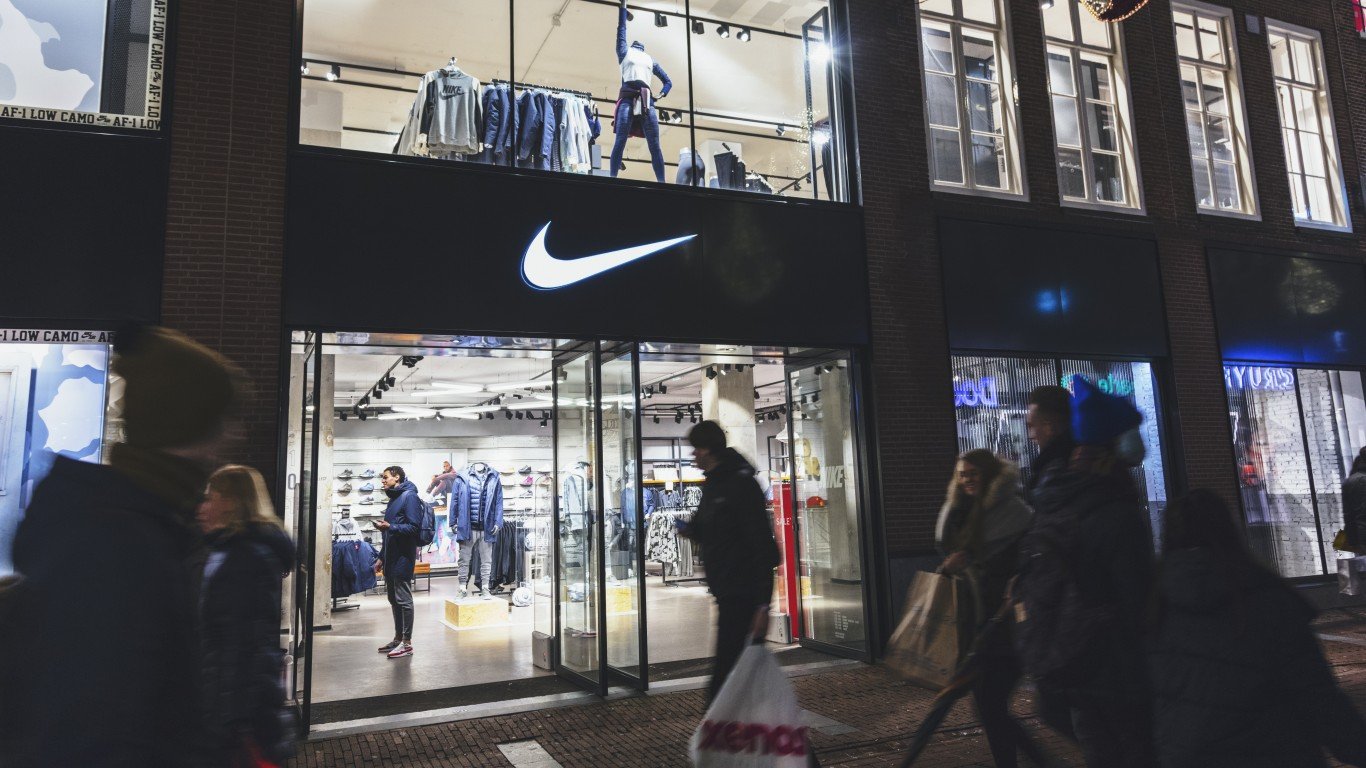
Nike Gets Booted From S&P 100 After Losing 80% of Its Value
Nike just lost its seat at the S&P 100 table after 18 years, and the earnings beat that was supposed to signal a comeback may be masking something far more troubling beneath the surface.


Nike (NYSE:NKE | NKE Price Prediction) faces mounting structural pressure, and here’s exactly why. Effective Sept. 21, the stock is being dropped from the S&P 100 after an 18-year run, capping a slide that has wiped roughly $200 billion from the market cap. It remains in the S&P 500, but the message is the same: shares are down 75.21% over five years and 48.07% in the last 12 months. The pattern points to structural decline in the underlying business.

Headline Earnings Are an Illusion
Q4 FY26 looked like a blowout: diluted EPS of $0.72 vs. $0.13 consensus. Strip out a one-time $986 million IEEPA tariff-recovery benefit and underlying EPS was $0.20. Full-year FY26 EPS was $2.10, down 3%; ex-tariff, it was $1.58. Analysts are cutting numbers accordingly. Fiscal 2027 consensus EPS has slipped to $1.7211 from $1.8423 ninety days ago, with 7 downward revisions and zero upward revisions in the last 30 days.

Growth Engines Are Broken
Greater China revenue fell 17% in Q4, with Nike Digital in China down 25%. CEO Elliott Hill conceded, “We have to get back to growth in China”, and told investors to expect near-term trends in line with recent performance. Converse keeps bleeding, with revenue down 32% across all territories. Nike Digital fell 12% in Q4 as the direct-to-consumer bet unwinds; that division’s revenue has slid from roughly $21 billion in 2024 to $17.7 billion in 2026. Full-year FY26 revenue of $46.4 billion sits well below $51.4 billion in FY24, and management guided fiscal 2027 revenue to decline low to mid-single digits.
Valuation Isn’t Cheap on Real Earnings
At $37, NKE trades at a forward P/E of 22 on estimates that are still being cut. Morgan Stanley resumed coverage with an Underweight rating and $31 price target. The 4.28% dividend yield is real, but the $18 billion buyback authorization saw only $123 million repurchased in FY26, a pace that signals defensive capital management.

Better-Built Alternatives for the Same Exposure
The brands taking Nike’s share offer a cleaner read on athletic-footwear demand. Deckers Outdoor (NYSE:DECK), parent of HOKA and UGG, grew Q1 FY27 revenue 5.7% year-over-year to $1.02 billion, with HOKA up 7.7% and direct-to-consumer up 13.0%. Management guides FY27 diluted EPS to $7.35 to $7.50 on gross margin above 56.5%. On Holding (NYSE:ONON) posted Q2 FY26 revenue growth of 13.5% to $1.05 billion, direct-to-consumer up 26%, and a 65.4% gross margin. Nike’s underlying Q4 gross margin, stripping the tariff benefit, was 40.2%. That 25-point margin gap is the story.
Verdict
The turnaround case requires two things to change together: Greater China revenue stops declining, and analyst EPS revisions flip positive. Neither is on the horizon.

Contact [email protected] for any questions or corrections.
After two decades of patrolling the dark corners of suburbia as a police officer, Rich Duprey hung up his badge and gun to begin writing full time about stocks and investing. For the past 20 years, he’s been cruising the markets looking for companies to lock up as long-term holdings in a portfolio while writing extensively on the broad sectors of consumer goods, technology, and industrials. Because his experience isn’t from the typical financial analyst track, Rich is able to break down complex topics into understandable and useful action points for the average investor. His writings have appeared on The Motley Fool, InvestorPlace, Yahoo! Finance, Money Morning, and, of course, 24/7 Wall St. He has been featured in both U.S. and international publications, including MarketWatch, Financial Times, Forbes, Fast Company, and USA Today.