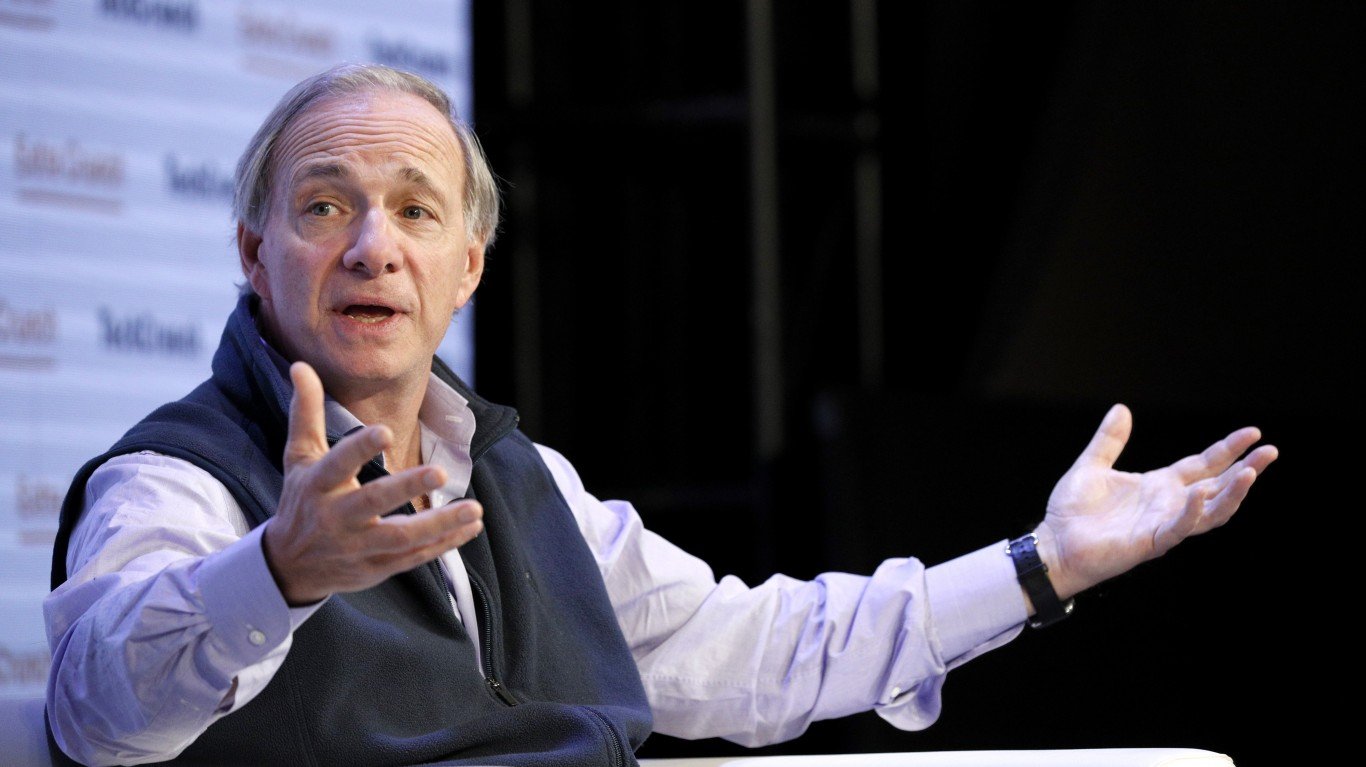
Ray Dalio Says Interest Costs Are Crowding Out Everything Else—Here’s His Three-Year Warning
Ray Dalio has put a rough expiration date on America's ability to keep deferring its debt reckoning, and the arithmetic he uses to justify it is harder to dismiss than the timeline.


Ray Dalio, the founder of Bridgewater Associates, used a August 21, 2026 LinkedIn essay, later summarized by yellow.com on August 23, to argue that the United States is running out of room to defer a reckoning on its debt. His headline claim: “My guess … is that it will come in three years, give or take two.” He paired it with a stark self-assessment, writing that “I am confident that the government’s financial condition is at an inflection point.”, according to Bridgewater Associates
Interrogate the Window Before You Buy the Alarm
It’s worth pointing out here that ‘three years give or take two’ is a five-year window. A forecast that wide is almost impossible to falsify in real time, and Dalio himself flags that policy changes or shocks can move it.
What Dalio can be pinned down on is his arithmetic. He says federal spending is running about 40% above revenue, and he puts annual debt-service needs near $11 trillion, about twice government revenue. These are his figures, not verified Treasury statistics, and he uses them to justify a specific prescription: cutting the budget deficit to 3% of GDP through lower spending, higher tax revenue, and lower interest rates, deployed together, according to Bridgewater Associates. His words: “All three need to happen concurrently.”
Why Dalio’s Mechanism Deserves Attention
Ignore the countdown clock for a moment and look at the chain Dalio is describing, because it is where the argument earns its keep.
- Interest costs crowd out everything else. When more of each tax dollar goes to paying bondholders, less is available for defense, entitlements, and investment. Fortune reported this week that federal interest payments have climbed to $1.25 trillion a year against a $40 trillion national debt, and Bloomberg pegged the fiscal 2026 budget gap at $1.97 trillion with a month still to go, according to yellow.com.
- Bond demand weakens at the margin. Buyers require more yield to hold longer paper. The Treasury par curve on September 10, 2026 printed the 10-year at 4.95% and the 30-year at 5.37%, with the Fed funds upper bound sitting at 3.75%, according to yellow.com. Long rates are pulling away from the policy rate, which is exactly the tension Dalio is pointing at.
- Pressure builds toward money creation. If auctions strain, the path of least resistance is a more accommodative central bank and a larger balance sheet, which pushes M2 higher. M2 already sits at a record $23.22T as of July 1, 2026. Core PCE was up 0.2% month over month in July, so the inflation cushion is thin.
Growth is not bailing anyone out of that loop. Real GDP expanded 1.5% in the second quarter of 2026, a step down from 2.1% in the first quarter, according to yellow.com. You can read the full Dalio essay on his LinkedIn page.
What Actually Changes for a Retiree
If you are at or near retirement, the five-year window is noise. The mechanism is what matters. Long yields above 5% mean that laddered Treasuries and investment-grade credit finally pay you to wait, and locking in duration at these levels is a defensible move even if Dalio’s countdown proves early or late. Cash yielding around the 4% short-end is not a parking spot forever, because the same fiscal pressure that lifts long yields is the pressure that eventually forces the Fed to cut the front end.
Hold real assets for the tail Dalio is warning about. Keep equity exposure for the growth that pays your bills across a 25-year retirement. A fiscal shock that lands in the first few years of withdrawals does far more damage than one that arrives a decade in, which is the whole subject of a free guide we put together on defending that opening stretch. And treat any politician promising to hit a 3% of GDP deficit without touching spending, taxes, and rates at once the way Dalio treats it: as arithmetic that does not close.
Contact [email protected] for any questions or corrections.
Chris Lange is a financial and geopolitical writer with more than a decade of experience covering a myriad of topics. He has published thousands of articles for 24/7 Wall St., with past coverage focused heavily on stocks, IPOs, healthcare, defense, global affairs, and technology.
His work has been quoted, or referenced by a number of outlets including Business Insider, USA Today, Yahoo Finance, MSN, The Motley Fool, and many other publications. A graduate of Southwestern University, he studied business with a focus on investments and has previous experience in banking and startups.
When not reading or writing the news, he is following his passion for Lacrosse, playing chess, or building solar projects with his dad.