Trump Promises Every American $5,000 “Dividend” Check — But Who’s Going to Pay For It?
Trump just promised every adult American a $5,000 check, but the math raises serious questions about where the money comes from, whether the proposal is even legal, and whether any check will ever actually arrive.

The federal government is already spending more money than it collects, borrowing at a pace that keeps the national debt climbing while interest costs consume an increasing share of the budget. The Congressional Budget Office estimates the federal deficit reached $1.8 trillion during the first 10 months of fiscal 2026, with the full-year deficit projected at $1.9 trillion. Meanwhile, the national debt has surpassed $40 trillion.
Last night, though, President Trump proposed another massive cash payment to Americans. This time, the price tag could exceed $1 trillion.
A $5,000 Dividend Comes With a $1 Trillion Price Tag
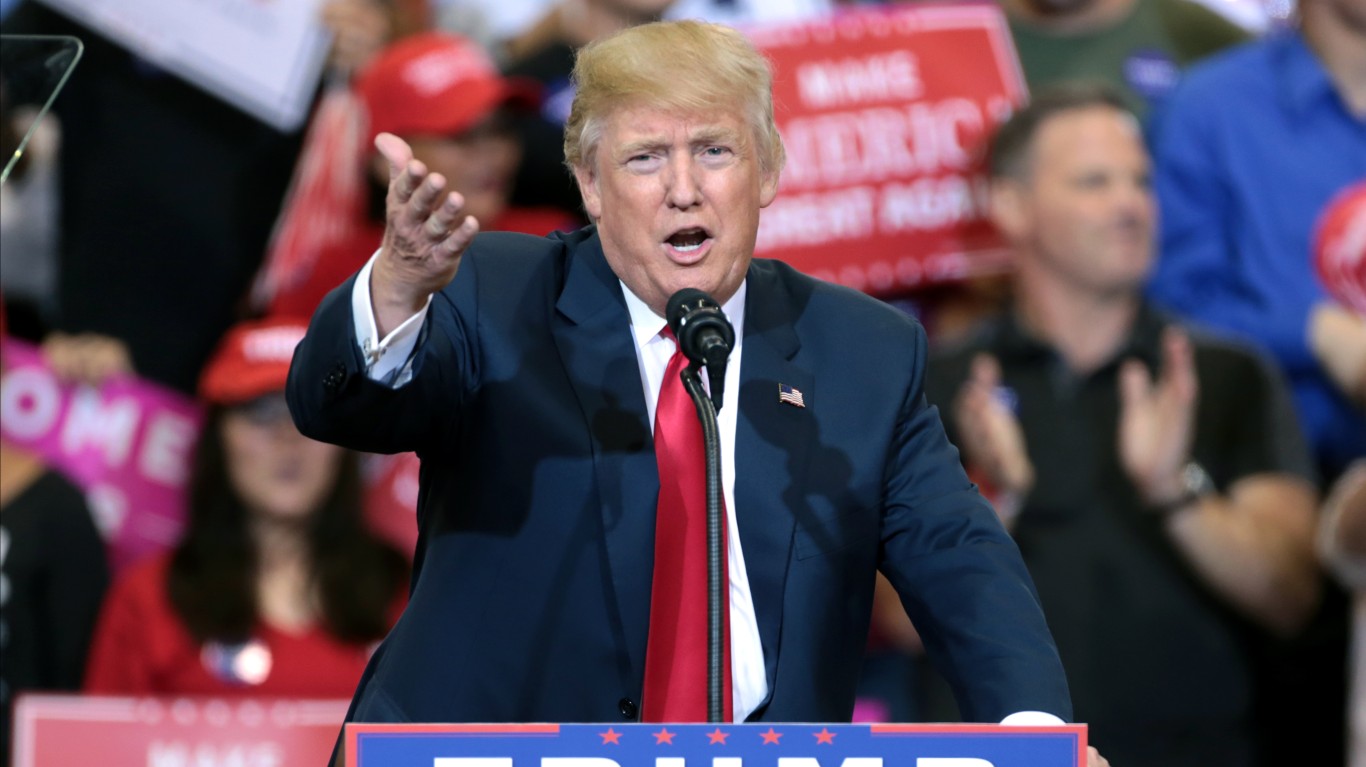
Trump promised at the Republican Party’s midterm convention in Dallas that every adult American citizen would receive a $5,000 “dividend” if Republicans retain control of both the House and Senate after the Nov. 3 midterm elections.
“If the Republicans win, you win with us and you get $5,000,” Trump said. He also said the money would have to be spent in the United States.
Yet, the arithmetic gets difficult quickly. Reuters estimates the proposal could cost about $1.35 trillion, while other estimates put the figure above $1 trillion depending on eligibility. That’s roughly 71% of the CBO’s projected $1.9 trillion fiscal 2026 deficit.
And there is an obvious funding problem: Trump didn’t provide a detailed financing plan. Vice President JD Vance suggested wealthy Americans might be excluded and pointed toward tariff revenue as a potential funding source. But tariff collections would not automatically produce enough cash for a payment of this size.
The Legal Problem Is Even More Complicated
The timing of the promise creates another hurdle. Federal law, specifically 18 U.S.C. §597, makes it a crime to offer an expenditure to someone in exchange for voting, withholding a vote, or voting for or against a candidate. Violations can carry fines and imprisonment.
Trump’s statement ties the proposed payment directly to Republicans winning both chambers of Congress, which raises an obvious question about whether the promise is intended to influence voting.
That said, the legal issue isn’t quite as simple as declaring the proposal automatically illegal. The statute specifically addresses payments conditioned on an individual’s vote or a vote for or against a candidate. Legal experts cited by The Associated Press noted that the proposed payment is not explicitly conditioned on an individual voter casting a particular ballot.
So the proposal raises a serious legal question, but its ultimate legality would depend on how Congress and the administration structured the program.
Investors Have Seen This Movie Before
This isn’t Trump’s first proposed check. He previously floated a $2,000 tariff-funded “dividend,” while a separate $5,000 DOGE dividend was also discussed. Neither proposal has produced a nationwide check. CNBC reported in July that the tariff dividend remained uncertain, particularly after the Supreme Court’s February ruling against tariffs imposed under the International Emergency Economic Powers Act.
Promises aren’t checks. The $5,000 payment could put money into consumers’ pockets if Congress actually authorized and funded it. But borrowing another $1 trillion-plus would also add to federal financing needs at a time when the government is already running a projected $1.9 trillion annual deficit. And inflation might be ignited further, as occurred after the pandemic stimulus checks went out.
Key Takeaway
Investors shouldn’t treat the proposed $5,000 dividend as money Americans are about to receive. It remains a political promise requiring congressional authorization, a funding mechanism, and resolution of significant legal questions. Not to mention Republicans holding on to both houses.
The more important number for markets may be the $1.35 trillion potential price tag. Against a $1.9 trillion projected annual deficit, that’s not a rounding error. It’s another major fiscal commitment that could increase borrowing and keep pressure on Treasury yields.
Until there is legislation showing who qualifies, how much the program costs, and where the money comes from, the $5,000 dividend belongs in the category of political promises — not household balance sheets.
Contact [email protected] for any questions or corrections.
After two decades of patrolling the dark corners of suburbia as a police officer, Rich Duprey hung up his badge and gun to begin writing full time about stocks and investing. For the past 20 years, he’s been cruising the markets looking for companies to lock up as long-term holdings in a portfolio while writing extensively on the broad sectors of consumer goods, technology, and industrials. Because his experience isn’t from the typical financial analyst track, Rich is able to break down complex topics into understandable and useful action points for the average investor. His writings have appeared on The Motley Fool, InvestorPlace, Yahoo! Finance, Money Morning, and, of course, 24/7 Wall St. He has been featured in both U.S. and international publications, including MarketWatch, Financial Times, Forbes, Fast Company, and USA Today.