Eli Lilly Fell Like a Rock Over the Last Month: This Big Bank Expects 45% Returns Over The Next Twelve
Eli Lilly shed billions in market value over the past month while its underlying business kept breaking records, and now one major Wall Street firm sees a setup that almost never appears in a stock this dominant.

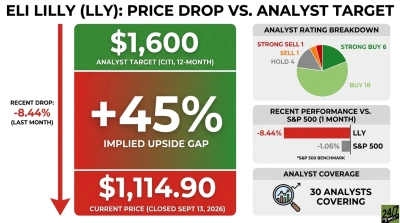
Eli Lilly (NYSE:LLY | LLY Price Prediction) recently closed at $1,114.90, while the average Wall Street 12-month price target sits at $1,318.66. Citi is far more aggressive, carrying a Street-high $1,600 target that implies roughly 45% upside from here.
Eli Lilly is the runaway leader in the GLP-1 obesity and diabetes market, with Mounjaro and Zepbound now doing roughly $14.9 billion in combined quarterly revenue. It is also a diversified pharma with more than 40 active phase three programs across oncology, immunology and neuroscience.
Wall Street has been paying close attention because Lilly is one of the largest weight-loss stories in market history, and the recent pullback has opened a rare gap between where the stock trades and where analysts think it belongs.
Why Lilly Just Gave Back Two Months of Gains
Lilly dropped 8.44% over the past month, sliding from $1,218.49 to $1,115.70. That is a real air pocket in a stock this heavy, and it happened against an S&P 500 that only fell 1.06% over the same window. The selloff was clearly company and sector specific.
Two dynamics have weighed on sentiment. Realized U.S. prices dropped roughly 9% excluding rebate adjustments, feeding a narrative that the incretin market is entering a price-war phase. On top of that, Lilly booked $2.78 billion of acquired IPR&D charges from deals including Orna, Kelonia, Ajax and Centessa, muddying reported earnings and raising questions about capital discipline.
The reaction looks outsized versus what actually happened operationally. Q2 revenue still grew 48% year over year, and Lilly raised full-year 2026 revenue guidance to $85 to $87 billion. The market is punishing pricing headlines while the underlying franchise keeps expanding.
What Citi and the Analyst Majority Still See
Because Citi’s target implies more than 40% upside, this is the analytical heart of the story. Citi analyst Geoff Meacham raised his target from $1,500 to $1,600 with a Buy rating, framing Lilly’s incretin franchise as a structural, multi-year volume story.
The bull thesis rests on three pillars. First, Mounjaro and Zepbound still take roughly 6 out of 10 total U.S. obesity prescriptions and about 7 out of 10 injectable ones. Second, Foundeo, the once-daily oral GLP-1, expanded from 8,000 prescribers to 36,000 prescribers in a single quarter, with a global rollout set for 2027. Third, retatrutide, Lilly’s triple-agonist, showed weight loss approaching bariatric surgery levels in TRIUMPH-1, with a BLA submission planned for Q1 2027.
The broader analyst community backs the direction if not the magnitude. Coverage splits into 6 Strong Buy, 18 Buy, 4 Hold, 1 Sell and 1 Strong Sell. Recent revisions skew positive: fiscal 2027 EPS estimates rose from $44.49 ninety days ago to $47.26 today, and the 2026 quarter ending September 30 has drawn 13 upward revisions against just 1 downward.
The catalysts investors are watching are concrete: label expansion for tirzepatide into cardiovascular risk (already approved August 28, 2026), the retatrutide filing early next year, and the Foundeo international launch.
Novo and Merck Show Lilly Is the Outlier on Upside
The pharma peer group has moved in different directions, and Lilly’s gap to target is by far the widest. Novo Nordisk (NYSE:NVO) trades at $43.07, down 5.96% over the past month and 11.3% year to date. Its consensus target of $47.23 implies just under 10% upside, and analysts are cautious with 3 Buys and 11 Holds.
Merck (NYSE:MRK) has gone the other way, up 8.28% in the last month and 38.76% year to date. At $143.87 against a $152.96 target, upside is only about 6%, with 5 Strong Buy, 15 Buy and 8 Hold ratings.
Across this group, the largest analyst-implied upside sits with Lilly by a wide margin. That points to a Lilly-specific reset within a mixed sector.
Lilly by the Numbers Right Now
Lilly trades at $1,114.90 with a market cap near $995 billion and a forward P/E of 24. The consensus 12-month target of $1,318.66 implies about 18% upside; Citi’s $1,600 implies roughly 44%. Targets are one data point, subject to revision.
Coverage is deep. Alpha Vantage lists 30 rating firms tracking the stock, and forward EPS estimates for 2027 have climbed to $47.26 from $44.49 ninety days ago.
On performance, Lilly is up 4.32% year to date and 48.46% over one year. The S&P 500 is up 12.08% year to date and 16.22% over one year. Lilly has lagged the index this year despite delivering four straight EPS beats.
My Take: Franchise Strength Versus Price War Risk
The bull case holds if you believe retatrutide files on schedule in Q1 2027, Foundeo scales as an oral GLP-1, and volume growth continues to overwhelm the price givebacks that spooked investors this quarter. That is the path to Citi’s $1,600: incretin volume compounds, pipeline optionality gets valued, and the multiple normalizes on 2027 EPS closer to $47.
The bear case builds if the U.S. price decline of 9% excluding rebate adjustments is the start of a Zepbound margin unwind, if oral competition erodes injectable share faster than Lilly can convert its own users, or if IPR&D charges keep obscuring the earnings picture.
I lean bullish. The operating results are too strong, and Wall Street’s revisions are trending higher. Citi’s $1,600 is a stretch case, but even the consensus $1,318.66 rewards patience from these levels.
Contact [email protected] for any questions or corrections.
Alex Sirois is a financial writer with experience spanning both retail and institutional investing. He has written for InvestorPlace and held roles at BNY Mellon and Bernstein, giving him a perspective that bridges Main Street portfolios and Wall Street analysis.
Alex holds an MBA from George Washington University and has built his career across multiple industries, including e-commerce, education, and translation — a breadth of experience that informs how he breaks down complex financial topics for everyday investors. His writing is conversational, actionable, and grounded in long-term, buy-and-hold investing principles.
At 247 Wall St., Alex focuses on delivering analysis that is both accessible and useful, with a clear emphasis on helping readers make more informed decisions with their money.