Eli Lilly Wavered Over the Last Month: One of Wall Street’s Biggest Banks Says 35% Gains Still to Come
Citigroup sees a path to 35% gains from here, but Eli Lilly's pricing headwinds, a slow oral GLP-1 launch, and a rival in freefall raise a real question about whether this pause signals opportunity or a longer stall ahead.

Eli Lilly (NYSE:LLY | LLY Price Prediction) currently trades at $1,183.72, and the average analyst price target is $1,325.39. That puts the stock about 12% below where Wall Street thinks it belongs.
Lilly makes Mounjaro and Zepbound. Together the two tirzepatide drugs brought in $14.87B in Q2, and they helped lift the company’s market cap to about $1.055 trillion. Revenue rose 47.67% year over year last quarter.
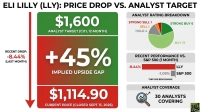
The consensus gap is fairly small. The bigger number comes from Citigroup, where analyst Geoff Meacham has the top $1,600.00 target among analysts and a Buy rating. That target means about 35% upside, which leaves investors with one question: is this stall a pause or a warning?
Lilly’s Record Rally Stalls Below $1,300 as Pricing Slips
Pricing is the biggest drag. In Q2, Lilly’s U.S. price fell 3%, mostly because of Zepbound and Mounjaro. Leave out changes to rebate and discount estimates and the drop was 9%. Management also expects wider access to keep weighing on price. As a result, shares slipped 0.5% over the past month and now sit about 8.4% below the 52-week high of $1,292.65.
Other concerns piled on. Acquisitions brought $2.78B in IPR&D charges that cut into reported earnings. Management also admitted the U.S. launch of Foundayo, its oral GLP-1, started slower than expected. This was a soft pullback compared with a real selloff. Over the same month, Novo Nordisk fell 17.78% and the S&P 500 gained 0.69%.
Citi’s $1,600 Case Rests on Market Share, Pills, and New Plants
Meacham’s model has Lilly holding about 60% global share in obesity and type 2 diabetes. Current data supports that. Lilly’s obesity drugs account for about 6 out of 10 U.S. prescriptions, and its international incretin share is near 55%.
The next catalysts are already on the calendar. Lilly plans to file retatrutide in the U.S. in quarter one, 2027. CEO Dave Ricks called its efficacy “really unprecedented”. On Foundayo, the number of U.S. prescribers grew from about 8,000 to 36,000. Lilly also broke ground in Houston, which is one of ten U.S. manufacturing sites announced since 2020.
Of the 30 analysts covering the stock, most are bullish:
- Strong Buy: 6
- Buy: 18
- Hold: 4
- Sell: 1
- Strong Sell: 1
Recent notes have mostly repeated existing views. JPMorgan kept its overweight rating with a $1,400 target. Keep in mind that price targets are estimates. They don’t guarantee anything.
Novo Nordisk Took the Real Hit in GLP-1s
The two GLP-1 leaders diverged. Lilly barely moved, while its closest rival dropped sharply. Novo Nordisk (NYSE:NVO) trades at $38.80, down 20.09% year to date. Its average target of $46.39 means about 19.6% upside. Analysts are lukewarm, though: 11 of 14 rate it Hold, and quarterly earnings fell 20.6% year over year. Novo has more consensus upside than Lilly. Citi’s Lilly target still points higher than either one.
Lilly Trails the S&P 500 This Year Despite 48% Growth
Lilly is up 10.66% year to date, compared with 13.11% for the S&P 500. Over one year, Lilly gained 66.66% and the index gained 17.22%. The 30 covering analysts have an average target that means about 12% upside from the current price.
Lilly has beaten EPS estimates for five straight quarters. Q2 EPS came in at $8.38 against an estimate of $6.01. Full-year guidance now calls for $85.0-$87.0B in revenue and $35.50-$36.50 in non-GAAP EPS. The stock trades at about 24 times forward earnings and 40 times trailing earnings.
Retatrutide’s Timeline Decides Whether Citi’s Target Holds Up
I’d be comfortable owning Lilly here if retatrutide’s filing stays on track, Foundayo keeps picking up speed, and new plants let sales volume outrun price cuts. But I’d stay cautious if U.S. prices keep falling faster than volume grows, or if acquisition charges keep eating into reported earnings.
For Citi to be right, Lilly needs to hold about 60% share while prices normalize. Concentration poses the main risk. Mounjaro and Zepbound make up most of the revenue, and generic semaglutide plus other oral drugs are coming. Tariffs on pharmaceuticals are another open question.
My view is bullish. A forward multiple near 24 looks reasonable for a company growing close to 50%. The move to $1,600 depends on retatrutide news in 2027. The average analyst target of $1,325.39 is a more realistic near-term goal.
Contact [email protected] for any questions or corrections.
Alex Sirois is a financial writer with experience spanning both retail and institutional investing. He has written for InvestorPlace and held roles at BNY Mellon and Bernstein, giving him a perspective that bridges Main Street portfolios and Wall Street analysis.
Alex holds an MBA from George Washington University and has built his career across multiple industries, including e-commerce, education, and translation — a breadth of experience that informs how he breaks down complex financial topics for everyday investors. His writing is conversational, actionable, and grounded in long-term, buy-and-hold investing principles.
At 247 Wall St., Alex focuses on delivering analysis that is both accessible and useful, with a clear emphasis on helping readers make more informed decisions with their money.