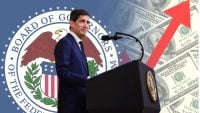
The White House Thinks the Fed Is About to Hike Into a Slowdown
The White House's top economist built a statistical case that inflation is already dead, presented it as a hypothetical dissenter's argument, then handed it to no one. Whether the Fed agrees tomorrow determines what the next chapter looks like for…


The day before the Federal Reserve meeting, the White House’s top economic official argued that the inflation problem the committee worries about has already faded. Kevin Hassett, director of the National Economic Council, made a specific technical claim: measured over the last three months and annualized, core CPI has fallen to 2%, even as the year-over-year figure the committee tends to cite still looks elevated.
The tension for equity holders is direct. The S&P 500, tracked by the SPDR S&P 500 ETF (NYSEARCA:SPY), has slipped over the past month while remaining up double digits on the year, meaning some tightening risk is already in prices and some is not.
The statistical case Hassett made is worth understanding on its merits. It also comes from the one voice in American economic policy with the most direct interest in lower borrowing costs, and the job here is to separate the method from the messenger.
Reading the Three-Month Annualized Case
Year-over-year inflation is a rolling twelve-month average that lags turning points, while a three-month annualized rate weights the most recent quarter. At an inflection, the two can point in opposite directions.
Hassett’s specific claim: “If you look at the last three months, that core CPI averaged and then annualized is 0.2. I mean top line is 0.2 and core is two, which is the target. If you look at what it was the three months prior, the top line was eight point something and the core was three point something.”, according to White House. If that comparison holds, price momentum has shifted sharply, and a committee focused on the annual figure could tighten after the underlying trend has already cooled.
Joe Kernen’s counter was the conventional case: unemployment sits near full employment, and per Hassett’s own framing, the Fed’s preferred core PCE gauge is still running above the 2% target, reinforced by a core PCE index that rose 0.2% in July to 130.66.
Why the Same Method Cuts Both Ways
Short-window annualized series are volatile by construction. One hot energy print or a shelter rebound can flip the same three-month math back above target in a single release. Energy prices are elevated, and shelter disinflation has been uneven. A policymaker who reaches for the faster measure only when it supports a preferred conclusion is doing advocacy.
Hassett stopped short of saying the committee should hold. His framing: “So if you look at the sort of near term memory in the stochastic process that drives inflation, then you could see that things are slowing down. And so that would be the argument that one would make if you were going to dissent tomorrow.” He built the case, then handed it to a hypothetical dissenter rather than owning the recommendation, which is the posture of a White House official who benefits from cheaper money without wanting to be quoted demanding it.
What This Means for an Index Investor
The policy rate upper bound sits at 3.75%, unchanged since the start of 2026 after coming down from a 4.5% high in September 2025. That is still restrictive by any pre-2022 standard, and the 10-year minus 2-year Treasury spread has narrowed to 0.33%, down from 0.51% in May.
SPY is down 2.44% over the past month and 1.11% over the past week, while remaining up 11.07% year to date and 14.6% over the last year. That pattern fits a market that has priced some tightening risk without giving up the year’s advance. More than one meeting for a top-heavy index, where NVIDIA (NASDAQ:NVDA | NVDA Price Prediction) at 7.58% and Apple (NASDAQ:AAPL) at 6.66% dominate the fund, is the sustained cost of capital that discounts long-duration earnings.
Bull and Bear Case
The bull case rests on Hassett’s three-month reading proving durable. If the committee eventually cuts, the multiple on mega-cap growth expands with lower discount rates, and a broadening earnings picture carries the index higher from an already positive year.
The bear case is a hike into a slowing economy, historically the combination that compresses equity multiples. With the curve near flat and consumer spending increasingly reliant on wealth effects rather than real wage growth, another round of tightening lands on a household sector thinner than the equity market suggests. The next core PCE release and the committee’s updated projections will determine which framing describes the economy in front of you.
Contact [email protected] for any questions or corrections.
Omor Ibne Ehsan is a writer at 24/7 Wall St. He is a self-taught investor with a focus on growth, cyclical, and dividend equities that have strong fundamentals, value, and long-term potential. He also has an interest in high-risk, high-reward investments such as penny stocks.