Nvidia’s Not Going to Be King for Life, So I Buy This Now
Every AI boom crowns a new king, and betting on the current one at peak valuation is how investors get caught holding the bag when the throne shifts. There is a quieter company already collecting royalties from every challenger lining…

This post may contain links from our sponsors and affiliates, and Flywheel Publishing may receive compensation for actions taken through them.

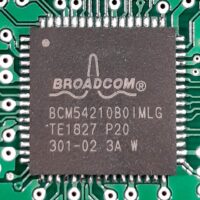
I keep hitting the buy button on Broadcom, and the reason is simple: I do not believe any single chip designer stays king of AI forever, and I want to own the company that gets paid when the throne changes hands. That company is Broadcom (NASDAQ:AVGO | AVGO Price Prediction), and I am buying it as a long-term hold against NVIDIA (NASDAQ:NVDA), the obvious mega-cap AI name.
Why Custom Silicon Is Eating the Merchant GPU Story
As frontier models mature, hyperscalers are learning what workloads they actually run, and they want silicon shaped to those workloads. Broadcom builds that silicon. On the September call, Hock Tan said “when you co-develop a chip that is optimized for your particular LLM workloads, you will outperform any GPU” and that a custom accelerator can run frontier models “at half the cost of a GPU.” Broadcom is already shipping XPUs to six customers, including Google’s TPU v7 and v8i, Meta’s MTIA line, and OpenAI’s Jalapeno accelerator. Jensen Huang would tell you NVIDIA’s platform is fungible across every workload, and he is right. He is also, in his own words, running “supply constrained” while telling customers to expect roughly 70% revenue growth in fiscal 2028 against demand that is higher. Every gigawatt he cannot fill is a gigawatt Broadcom’s customers will fill with their own silicon.
Receipts on Growth, Cash, and the Dividend
Q3 fiscal 2026 revenue came in at $29.59B, up 85.5% year over year, with AI semiconductor revenue of $16.70B, up 221% year over year. Free cash flow was $13.67B, equal to 46% of revenue. Management guided Q4 AI semi to $21.7B and said fiscal 2028 AI semiconductor revenue should reach roughly $230 billion with supply already secured. That cash funds a real dividend policy: $0.65 per share quarterly, raised 10% last year, marking the fifteenth consecutive annual increase since fiscal 2011.
Why Not Just Buy NVIDIA
NVIDIA is a wonderful business. It is also priced like one, at a P/E of 44 and a market cap of $5.296 trillion, with a dividend yield of 0.018% on a token $0.25 quarterly payout. For a retirement-focused portfolio, that is not income. Broadcom sits at a $1.658 trillion market cap with a dividend history that actually compounds. NVIDIA also told investors its Q3 outlook excludes any Data Center compute revenue from China, and its supply commitments have swelled to $279 billion, largely tied to memory for Vera Rubin. That is customer, geographic, and supply-chain concentration all at once.
Real Risk I Am Underwriting
Broadcom’s AI revenue leans on a handful of hyperscale customers, and the company itself lists dependence on a limited number of significant customers for AI semiconductor demand as a top risk. If Google, Meta, or OpenAI cut orders, the growth curve bends fast. What keeps me buying is the VMware Private AI Cloud layer, the $8.8 billion Q3 software business growing 29% year over year, and Tan’s comment that Broadcom is “very much on target to exceed $30 in earnings per share in fiscal 2028.”
What Keeps the Buy Button Active
I buy Broadcom because when the next generation of models decides which silicon it wants, the answer will be plural, and Broadcom gets paid on almost every answer. If you are hunting for the traits that showed up early in the last monster tech winner, we cataloged them in a free playbook here.
Contact [email protected] for any questions or corrections.
Alex Sirois is a financial writer with experience spanning both retail and institutional investing. He has written for InvestorPlace and held roles at BNY Mellon and Bernstein, giving him a perspective that bridges Main Street portfolios and Wall Street analysis.
Alex holds an MBA from George Washington University and has built his career across multiple industries, including e-commerce, education, and translation — a breadth of experience that informs how he breaks down complex financial topics for everyday investors. His writing is conversational, actionable, and grounded in long-term, buy-and-hold investing principles.
At 247 Wall St., Alex focuses on delivering analysis that is both accessible and useful, with a clear emphasis on helping readers make more informed decisions with their money.