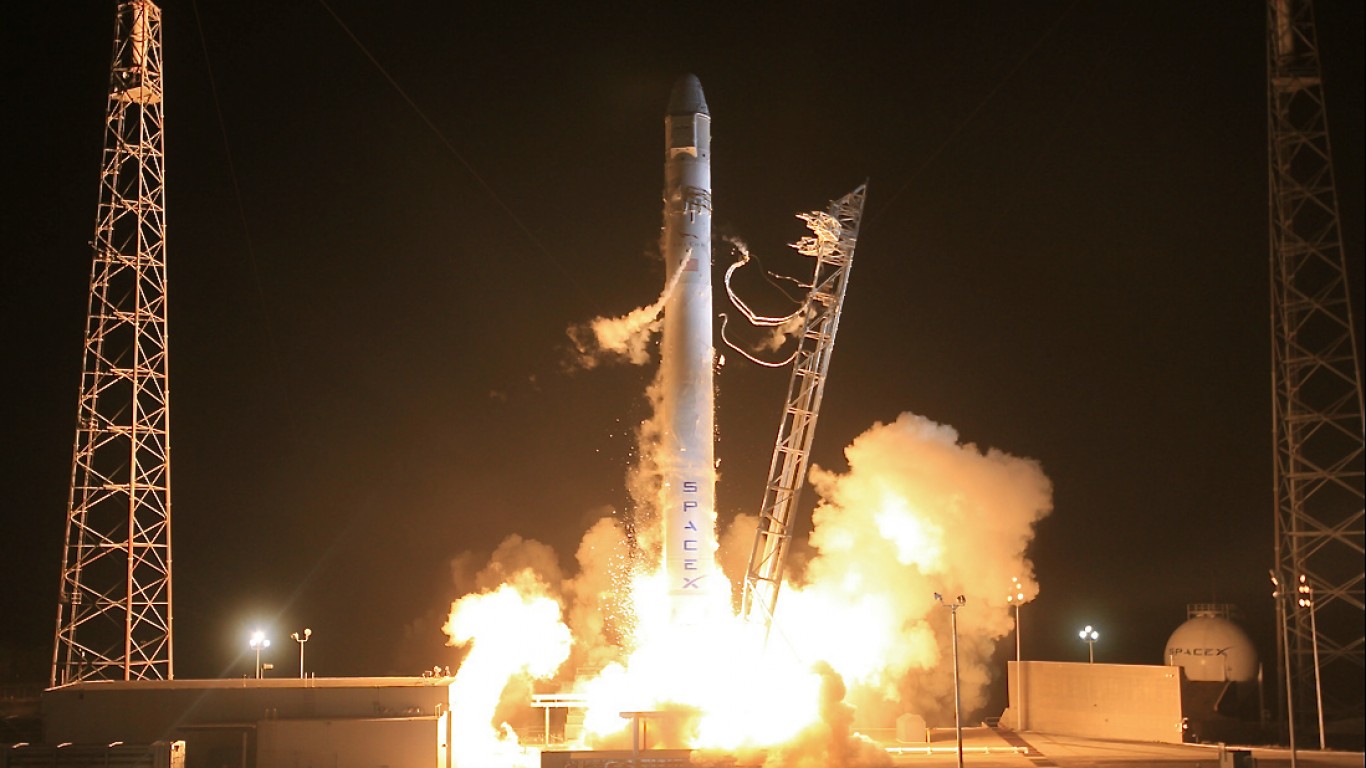
SpaceX IPO’d at $1.8 Trillion, Crashed 32%, and Morgan Stanley Still Sees It Doubling
SpaceX's historic IPO cratered by nearly a third, yet 28 Wall Street analysts refuse to downgrade it. The question is whether the bull case rests on transformative compounding or on contracts that expire in 90 days.

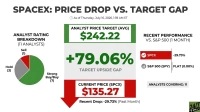
SpaceX (NASDAQ:SPCX | SPCX Price Prediction) currently trades at $152.71 against a Wall Street average price target of $222.42, an implied gap of roughly 45.65%.
SpaceX has grown into three businesses in one. Starlink is now the cash engine, the AI segment is scaling into a hyperscaler-adjacent business, and Starship is the moonshot funded by both. That combination is why the largest IPO in American history is also its most polarizing stock.
Morgan Stanley argues the market is mispricing what SpaceX has already built.
A Trillion-Dollar IPO That Lost a Third of Its Value in Weeks

SpaceX priced its June IPO near a $2 trillion valuation, then fell by roughly a third as a 4-5% public float whipsawed trading.
Reddit sentiment shifted sharply. One July thread titled “Short sellers notch $15.5 billion profit as SpaceX shares slide” captured the mood, and by early August, wallstreetbets was circulating “SpaceX will plummet on 8/6” ahead of the first earnings report.
The August 4 earnings report left the stock under pressure. Revenue jumped 92% to $7.8 billion, adjusted EBITDA climbed 191%, yet SpaceX sold off because a 911.5M share unlock loomed the next day. SpaceX spent $18.37B on capex that quarter, with $15.83B going to AI compute.
Why Morgan Stanley and 28 Buy Ratings Have Not Budged
The bull case rests on Starlink plus AI compounding into something the market has not yet priced. Management guided to a $100 billion annualized revenue run rate by December, with cloud services now the largest contributor. Bret said this outcome was “not a question mark” under current assumptions.
The AI segment posted $2.6 billion in quarterly revenue, up 247% year over year. SpaceX added $6.7 billion of cloud-services contracts in early Q3 and hit 1.4 gigawatts of compute capacity, targeting above 2 gigawatts by year-end. The power, cooling, and networking suppliers standing behind that kind of buildout are the subject of a free report on seven AI infrastructure names that aren’t the chipmakers everyone already owns.
Starlink added 1.7 million net subscribers, reached 167 markets, and Elon argued the V3 satellite could deliver a two-order-of-magnitude bandwidth jump. Even with monetization per bit falling, he said revenue could still grow 10x. Enterprise revenue alone grew 108% year over year.
The analyst posture reflects that setup. Coverage breaks down as 6 Strong Buy, 22 Buy, 5 Hold, 2 Sell, and 0 Strong Sell, and a widely shared Reddit post carried the Barron’s-style headline “SpaceX’s Stock Is Whipsawing Around Its IPO Price. Morgan Stanley Says It’s ‘Attractively Valued.'” Recent revisions have leaned toward reiteration rather than downgrade despite the drawdown.

Rocket Lab Is the Only Real Public Comp, and It Is Also Down
SpaceX and its closest public peer sold off together, but for different reasons. Starlink and Grok have no direct listed equivalents, so Rocket Lab (NASDAQ:RKLB) is the closest launch comparison.

Rocket Lab trades at $64.57, down 14.86% over the past month and 7.44% year to date, though still up 36.86% over one year. Coverage skews Buy with a mildly positive revision trend, but the analyst-implied upside from consensus is smaller than the roughly 46% gap Wall Street sees on SpaceX. AST SpaceMobile and Iridium round out the thinly populated peer group, but neither offers a comparable business mix.
Numbers That Show Why the Gap Is Real
SpaceX currently trades at $152.71, up 9.35% over the past month but well below the 52-week high of $225.64. Against a consensus target of $222.42 from 35 covering analysts, that leaves 45.65% of implied upside.
Over the same period, the S&P 500 is up 11.7% year to date and 15.01% over one year. SPCX has trailed both by wide margins since listing.
Valuation still commands a premium. Alpha Vantage lists a forward P/E of 204 and a price-to-sales of 87, on TTM EPS of -$1.1. Prediction markets are more cautious near term, assigning 0.44 probability to a weekly close above $155.
Why I Lean Cautiously Long on SPCX
The bull thesis holds if you believe Starlink’s cash generation can fund Starship and AI capex without serial dilution, and that the AI segment’s 247% growth is durable rather than a pull-forward from short-dated contracts. The path back to $222 runs through the December $100 billion run-rate goal, V3 Starlink satellites hitting critical mass around Q2 next year, and Cursor closing without integration drama.

The bear thesis holds if you think the AI premium, estimated by one analysis at roughly $1 trillion of the valuation, is built on 90-day-terminable cloud deals and a company that lost $541M last quarter while spending $15.8 billion on GPUs. A $5 billion full-year loss and a razor-thin float make future secondary offerings feel inevitable.
Analyst targets are one data point among many. But when 28 of 35 covering analysts still rate the largest IPO in American history a Buy after a 32% drawdown, that dislocation deserves attention. I lean cautiously long, sized small, with the Q3 report as the decisive catalyst.
Contact [email protected] for any questions or corrections.
Omor Ibne Ehsan is a writer at 24/7 Wall St. He is a self-taught investor with a focus on growth, cyclical, and dividend equities that have strong fundamentals, value, and long-term potential. He also has an interest in high-risk, high-reward investments such as penny stocks.