3 Dividend Stocks to Buy Before September Ends and Hold Forever
Three recession-resilient blue chips with decades of unbroken dividend raises are trading at levels that rarely appear at the same time, and the window before Q3 earnings close narrows by the day.

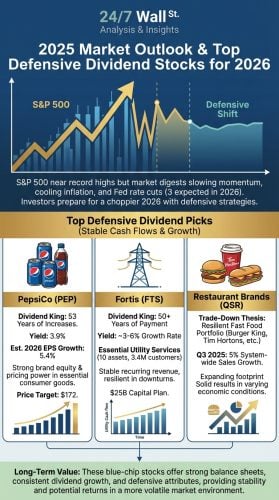
With the third quarter closing out, income investors have a narrow window to lock in three cash-generative blue chips before Q3 earnings reset expectations. The shared hook: recession-resilient franchises, multi-decade dividend histories, and reaffirmed or raised 2026 guidance. Coca-Cola alone just lifted its full-year outlook to organic revenue growth of ~5% and comparable EPS growth of 9-10%, a rare combination of visibility and pricing power in the current market.
PepsiCo
PepsiCo (NASDAQ:PEP | PEP Price Prediction) is the highest-yielder in the group at 4.31%, with the stock down 6.96% year to date and trading around $129.59. That drawdown is the entry the "buy before September ends" thesis is built on.
Dividend safety looks solid. PepsiCo announced a 4% increase in annualized dividend per share beginning with the June 2026 payment, representing its 54th consecutive annual increase, which places it firmly in Dividend King territory. The most recent quarterly payout is $1.48 per share, payable September 30, 2026, with an annualized forward dividend of $5.92. Management guided 2026 total cash returns to shareholders of ~$8.9B, split between $7.9B in dividends and $1.0B in buybacks, with free cash flow conversion of at least 80% and capex below 5% of net revenue. Interest coverage of 12.03x leaves ample cushion.
The bull case: Q2 26 delivered revenue of $24.18B (+6.4% YoY), core EPS of $2.20, and organic volume growth at the highest rate since 2022, with international engines firing (LatAm Foods +15%, EMEA +10%, Asia Pacific Foods +12%). At a P/E of 21, investors are paying a reasonable price for a global snack and beverage machine that has raised the payout every year for more than five decades.
Risk: the North American snacks business is still soft. PFNA revenue fell 2% and core operating margin contracted 40 basis points in Q2. If US consumer weakness persists, near-term margin recovery will lag international growth.
AbbVie
AbbVie (NYSE:ABBV) yields 2.49%, with growth rate and coverage doing the real work for a forever hold. The quarterly dividend now sits at $1.73 per share, versus $1.64 in 2025 and $1.55 in 2024, with the next payment on November 16, 2026.
On the surface, AbbVie’s trailing P/E of 75 and EPS of just $3.54 against a $6.83 annual dividend make the payout look mathematically impossible on GAAP earnings alone. GAAP net income is depressed by acquisition-related amortization, IPR&D charges, and other non-cash items tied to a long deal history. The economic reality is very different: free cash flow yield is 3.81%, comfortably above the dividend yield, and the forward P/E is just 16. In plain language: AbbVie generates far more cash than its GAAP earnings suggest, and that cash is what funds the dividend. Also worth flagging: the company’s book value is negative because of aggressive buybacks, a balance-sheet quirk rather than a distress signal, with interest coverage of 6.94x.
Bull case: Q2 26 revenue rose 10.2% to nearly $17 billion, adjusted EPS of $3.65 came in six cents above the guidance midpoint, and Skyrizi and Rinvoke are each growing above 20%. Management raised full-year revenue guidance and now sees FY26 adjusted EPS of $13.87-$14.07. AbbVie’s CEO said the "long-term outlook remains very strong," and the recently closed Apogee Therapeutics acquisition adds pipeline depth in immunology.
Risk: Humira sales fell 35.9% to $756M on biosimilar erosion and Imbruvica dropped 29.4%. If Skyrizi and Rinvoke growth ever stalls before Humira finishes bleeding out, the growth math tightens quickly.
Coca-Cola
Coca-Cola (NYSE:KO) yields 2.34% at a recent price of $87.13. The stock is up 27.05% year to date and 34.65% over the past year, though it has pulled back 3.8% over the last month from recent multi-year highs. The verified dividend history covers quarterly payments from March 1999 through September 2026, with the quarterly amount rising every year in that window, consistent with Coca-Cola’s broadly documented Dividend King status of more than 60 consecutive annual increases.
Dividend safety: the current quarterly payout is $0.53 per share, up from $0.51 in 2025 and $0.485 in 2024, with an annualized forward dividend of $2.12. Coca-Cola runs on operating margins of 28.71%, net margins of 27.34%, ROE of 45.97%, and interest coverage of 8.32x. Q2 26 operating margin actually expanded to 34.9% from 34.1%. FCF yield of 1.41% is thinner than PEP’s, but management now guides FCF of ~$12.4B for 2026.
Bull case: Q2 26 revenue of $13.38B (+6.7% YoY) beat by 1.56%, adjusted EPS of $0.97 beat $0.93, and global unit case volume grew 5% led by India, China, US, and Brazil. Coca-Cola Zero Sugar volumes rose 16%, and Trademark Coca-Cola +5% got a lift from FIFA World Cup 2026 activation. Management raised the full-year outlook across every headline metric.
Risk: Asia Pacific price/mix fell 9%, Q4 26 will have six fewer selling days versus Q4 25, and pending IRS tax litigation remains an overhang. At a P/E of 29, the stock is not cheap, so future returns will lean heavily on execution rather than multiple expansion.
Forever Hold Case
These three names share the traits that make a "buy and forget" portfolio actually work: pricing power in recessions, cash flow that visibly covers the dividend, and multi-decade histories of raising the payout through every macro cycle. PepsiCo offers the highest current yield and a clean discount to its recent trading range; AbbVie provides the fastest dividend growth once you look past GAAP noise; Coca-Cola brings the most globally durable brand and just raised guidance on every line that matters. For income investors building a September shopping list, this trio is as close to a set-and-hold consumer and pharma sleeve as the market currently offers (if you want more names in the same vein, we ranked ten Dividend Kings by valuation right now in a free report here).
Contact [email protected] for any questions or corrections.
Joel South covers large-cap stocks, dividend investing, and major market trends, with a focus on earnings analysis, valuation, and turning complex data into actionable insights for investors.
He brings more than 15 years of experience as an investor and financial journalist, including 12 years at The Motley Fool, where he served as an investment analyst, Bureau Chief, and later led the Fool.com investing news desk. He has also co-hosted an investing podcast and appeared across TV and radio discussing market trends.