Eli Lilly’s Tough Month: One of The Biggest Global Banks Says 37% Gains Begin Soon
Eli Lilly just posted a quarter that crushed estimates on every major metric, yet the stock has spent the past month getting punished anyway. One of Wall Street's biggest banks thinks the selloff created the most compelling entry point in…

This post may contain links from our sponsors and affiliates, and Flywheel Publishing may receive compensation for actions taken through them.
Eli Lilly (NYSE:LLY | LLY Price Prediction) currently trades at $1,164.79, while Wall Street’s average analyst price target sits at $1,325.39. That leaves roughly 14% of implied upside between where the stock is and where the consensus says it belongs.
Lilly is the dominant force in the GLP-1 obesity and diabetes market, with Mounjaro and Zepbound now generating a combined $14.9 billion in a single quarter. Wall Street watches this stock closely because it is one of the largest healthcare companies in the world, with a market cap near $1.03 trillion, and because its pipeline may decide whether the entire obesity category becomes a multi-decade franchise.
Lilly just wrapped a rough stretch, and one major bank is arguing the selling is overdone.
A One-Month Slide That Peers Mostly Sidestepped
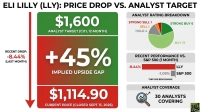
Lilly shares have dropped 7.21% over the past month, sliding from about $1,255.40 to current levels even as the broader market pushed higher. Q2 revenue beat consensus by 11.06% and EPS came in 27.27% above estimates.
Pricing anxiety weighed on the stock. Realized U.S. prices fell 9% excluding rebate adjustments, and international pricing compressed after Mounjaro’s inclusion in China’s National Reimbursement Drug List. Investors also digested $2.78 billion in acquired IPR&D charges and fresh competitive noise from Novo Nordisk’s post-Wegovy strategy update on Monday.
Why Citi Still Sees a Path to $1,600
Citigroup’s Geoff Meacham carries a Street-high $1,600 price target with a reiterated Buy rating, implying roughly 37% upside from current levels. His model assumes Lilly holds a ~60% commanding global share of the obesity and type 2 diabetes markets, with next-generation assets like oral orforglipron and triple-agonist retatrutide extending the runway well into 2027 and beyond.
Of 30 analysts covering the name, 6 rate it Strong Buy, 18 Buy, 4 Hold, 1 Sell, and 1 Strong Sell. The 2027 EPS consensus climbed from $44.4551 ninety days ago to $47.3443, with 19 upward revisions in the trailing 30 days.
Near-term catalysts include a retatrutide BLA submission targeted for Q1 2027, continued ramp of oral Foundayo, and the Medicare GLP-1 Bridge Program that granted 20 million eligible Americans coverage at $50 per month.
Novo Nordisk (NYSE:NVO) closed at $39.81, down 7.93% in a single session after its post-Wegovy strategy update disappointed. With an average target of $46.80, implied upside is about 17.6%. Analysts skew Hold, with 11 Holds against 3 Buys and no Sells.
Viking Therapeutics (NASDAQ:VKTX) trades at $30.11 against a consensus target of $92.39, for an implied upside near 207%. That is a clinical-stage biotech skew: 5 Strong Buys, 13 Buys, and 2 Holds. Wall Street is pricing binary trial risk on a clinical-stage biotech.
Pfizer (NYSE:PFE) sits at $27.74 versus a $28.88 target, an underwhelming 4.1% of upside. Ratings lean Hold at 16 Holds, 10 Buys, and 2 Sells.
Among cash-generative large-caps, Lilly’s 14% consensus gap and Citi’s 37% bull case remain the most credible risk-adjusted setup.
Underperforming the Index Despite Trillion-Dollar Scale
Year to date, Lilly is up 8.92%, trailing the S&P 500’s 13.43% gain. Over one year, Lilly has returned 55.89% against the SPDR S&P 500 ETF Trust (NYSEARCA:SPY) return of 16.54%.
Valuation reflects the growth premium. Lilly trades at a trailing P/E of 39 and a forward P/E of 24, on TTM revenue of $79.67 billion and TTM EPS of $29.75. Consensus sees 2026 EPS of $36.7319 rising to $47.3443 in 2027.
Bull Case Weighed Against Pricing and Pipeline Risk
The bull case rests on retatrutide clearing the FDA on schedule, Foundayo maintaining its inflection (management says nearly one out of four new incretin starts are choosing it), and the Medicare Bridge Program expands U.S. access. In that scenario, 2027 EPS above $47 makes today’s forward multiple reasonable, and Citi’s $1,600 case becomes math rather than hope.
The bear case builds if pricing compresses faster than volume can offset, if retatrutide filing delays push growth into 2028, or if tariffs and payer pressure squeeze margins. Lilly is a premium multiple on premium execution; any crack reprices quickly.
Position sizing should account for volatility. Consensus at $1,325.39 is a reasonable base case; Citi’s $1,600 is the reward if the pipeline delivers.
Contact [email protected] for any questions or corrections.
Alex Sirois is a financial writer with experience spanning both retail and institutional investing. He has written for InvestorPlace and held roles at BNY Mellon and Bernstein, giving him a perspective that bridges Main Street portfolios and Wall Street analysis.
Alex holds an MBA from George Washington University and has built his career across multiple industries, including e-commerce, education, and translation — a breadth of experience that informs how he breaks down complex financial topics for everyday investors. His writing is conversational, actionable, and grounded in long-term, buy-and-hold investing principles.
At 247 Wall St., Alex focuses on delivering analysis that is both accessible and useful, with a clear emphasis on helping readers make more informed decisions with their money.