Eli Lilly Beat Big and Raised Guidance. Wall Street Sees More Room to Run
Eli Lilly just posted its fourth straight earnings beat and raised guidance again, but the real question is whether a next-generation obesity drug still sitting below Wall Street's radar could push the stock well past current targets.

Eli Lilly (NYSE:LLY | LLY Price Prediction) delivered a monster quarter with revenue growth, a fourth consecutive EPS beat, and a fresh guidance raise. The stock has climbed 9.86% in the past week alone. Our proprietary model sees room to run.
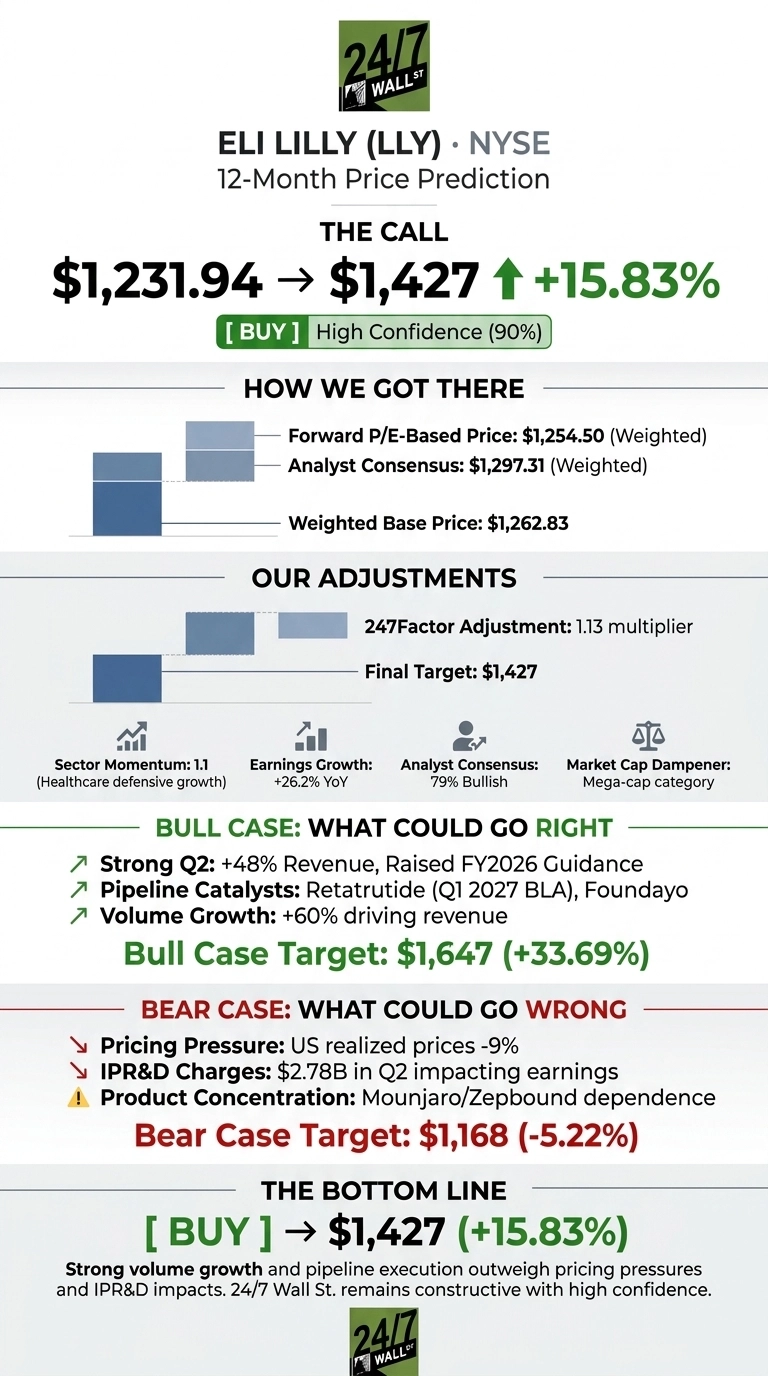
Eli Lilly trades at $1,231.94 as of August 10, 2026. Our 24/7 Wall St. price target is $1,427, implying 15.83% upside over the next twelve months. Our model rates Lilly Bullish, with high confidence at 90%.
24/7 Wall St. Price Target Summary
| Metric | Value |
|---|---|
| Current Price | $1,231.94 |
| 24/7 Wall St. Price Target | $1,427 |
| Upside | 15.83% |
| Model Rating | Bullish |
| Confidence Level | 90% |
A Blowout Quarter Reset the Narrative
Lilly is up 15.02% year to date and 98.29% over the past year, sitting just 4% below its 52-week high of $1,249.45.
Q2 revenue landed at $22.97 billion, beating expectations, and EPS of $8.38 came in 27.27% above the $6.5845 consensus. Mounjaro alone did $9.94 billion (+91%), boosted by international growth after China added the drug to its National Reimbursement Drug List. Management raised full-year revenue guidance to $85 to $87 billion and lifted the performance margin range to 49% to 50.5%.

The Case for $1,647 and Higher
Our bull scenario points to $1,646.99, a 33.69% total return. Retatrutide, the next-generation triple-agonist obesity drug with a complete Phase 3 data package and Q1 2027 BLA, drives the thesis.
Layer in Foundayo, the oral GLP-1 pill approved for obesity and submitted for type 2 diabetes, plus VERVE-102’s 62% LDL-C reduction. Wall Street is aligned with 22 buy ratings against just 2 sells, and CEO David Ricks calls Lilly’s future “never been brighter.”

The Risks Worth Watching
Our bear case suggests $1,167.64, a 5.22% decline. U.S. realized prices fell roughly 9% excluding rebates, and Q2 absorbed $2.78 billion in IPR&D charges from four acquisitions.
Concentration in Mounjaro and Zepbound remains a real risk if a competitor breaks through. Bulls argue the IPR&D hit is non-recurring and pricing pressure is swamped by 60% volume growth. At an implied forward P/E of 39, Lilly needs to keep executing.
How Lilly Compares to Merck and AbbVie
Merck (NYSE:MRK) trades at $130.92 and is up 26.22% YTD, outpacing Lilly. It offers Keytruda-driven oncology exposure at a fraction of Lilly’s multiple, making Lilly’s forward P/E of 39 look demanding. But Merck lacks a GLP-1 franchise growing 91%.
AbbVie (NYSE:ABBV) at $247.97 is up 11.09% YTD, roughly tracking Lilly on a one-month basis but lagging over one year at 29.1% versus Lilly’s 98.29%. AbbVie navigates Humira erosion while Lilly rides a franchise still accelerating. The peer group makes our 24/7 Wall St. price target reasonable: Lilly deserves a premium, but not an unlimited one.
Eli Lilly Price Prediction 2026-2030
The 24/7 Wall St. price target of $1,427 reflects a constructive setup at 90% confidence. The volume-driven growth engine is real, and retatrutide is a near-term catalyst the market has yet to fully price.
The bull thesis strengthens if retatrutide’s BLA stays on track for Q1 2027 and Foundayo scripts ramp cleanly. The thesis weakens if U.S. pricing declines accelerate past the current 9% pace or if payer pushback broadens. For now, momentum plus pipeline wins.
| Year | 24/7 Wall St. Price Target |
|---|---|
| 2026 | $1,300 |
| 2027 | $1,427 |
| 2028 | $1,569 |
| 2029 | $1,725 |
| 2030 | $1,896 |
These projections extend our base case annualized return of 9.94% and assume Lilly executes on retatrutide, Foundayo, and manufacturing scale-up. Meaningful deviation could come from GLP-1 competition or a broader pricing reset from U.S. payers.
Contact [email protected] for any questions or corrections.
Vandita Jadeja is a financial publisher with over a decade of experience writing about financial topics, including investment, savings, retirement, insurance and banking. Vandita is a Chartered Accountant who loves to debunk financial concepts for readers.
Her work has appeared on sites that include The Motley Fool, InvestorPlace, and Benzinga. She covers investing and focuses on stock picks and price prediction for 24/7 Wall St.
When not looking for the next stock investment opportunity, she can be found traveling, reading, chasing sunsets and enjoying her iced latte.