You Only Need $2,000 and 1 Fund to Start Building a Dividend Portfolio. Here’s the ETF to Use
Most beginners chase the highest yield they can find and end up owning a ticking time bomb. One fund built around a completely different logic has quietly turned $2,000 starting positions into compounding income machines for over a decade.

This post may contain links from our sponsors and affiliates, and Flywheel Publishing may receive compensation for actions taken through them.

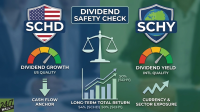
Starting a dividend portfolio comes down to one good decision. For a beginner with $2,000 to put to work, that decision can be a single fund: the Schwab U.S. Dividend Equity ETF (NYSEARCA:SCHD). One ticker, one trade and a diversified position across roughly 102 U.S. large-cap dividend payers.
Here is the core math, using inputs pulled at generation rather than any hand calculation. SCHD closed at $33.74 on Sept. 22. The fund pays quarterly, with an annualized forward dividend of $1.01 per share and a trailing 12-month total of $1.048. A $2,000 stake at that price builds a starter position that throws off modest but real cash flow, paid four times a year. Setting the expectation clearly matters here: a $2,000 position generates a small dollar figure at any realistic dividend yield. The value lies in the habit and the compounding.
Why SCHD Instead of the Highest Yield You Can Find
SCHD’s argument is methodology. The fund tracks a rules-based index that screens for dividend quality and consistency rather than raw yield. That approach filters out the two most common traps beginners walk into: Shrinking payers dressed up as bargains, and single-stock blowups where a double-digit yield signals distress. The screen leans toward companies with durable cash flows, a long record of paying, and financial strength to keep paying.
The tradeoff is that SCHD’s headline yield sits below what a mortgage REIT or leveraged closed-end fund would show. With the 10-Year Treasury yielding around 5% as of Sept. 22, SCHD’s distribution rate looks unspectacular in isolation. The reason to accept that is total return and growth of income over time. SCHD has returned 27.89% over the past year, 61.56% over five years and 234.82% over 10 years on a price basis. The dividend has stepped higher over that same window, with quarterly amounts rising from the 12-cent range in late 2011 to the 25-cent to 28-cent range in 2025 and 2026.
What You Actually Own
SCHD holds a broad mix of large, cash-generative US companies. Based on the May 31, 2026 NPORT snapshot, the top positions include:
- QUALCOMM at 6.74% of net assets
- Texas Instruments at 5.90%
- UnitedHealth Group at 5.09%
- Coca-Cola at 3.96%
- Merck at 3.86%
- Chevron at 3.83%
From there the roster reads like a dividend playbook: Verizon, Procter & Gamble, ConocoPhillips, Amgen, PepsiCo, Home Depot, Abbott Laboratories, Altria, Bristol-Myers Squibb, Accenture, Lockheed Martin and Blackstone. Sector exposure spans consumer staples, healthcare, energy, financials, semiconductors, communications, and industrials. Total net assets stand at roughly $94.9 billion, which keeps trading costs low and spreads tight.
Limits Worth Knowing Before You Buy
One fund is a starting point on the way to a finished portfolio. SCHD is entirely US large-cap dividend equity. There is no bond allocation, no international exposure, no small-cap or growth tilt. When the value factor lags, SCHD lags. It also holds cyclical weight in energy, financials, and semiconductors, so it moves with the economy. Recent trading reflects that: SCHD is down 4.17% over the past month but remains up nearly 22% year to date.
For a first dividend position, that profile is a feature. A beginner gets diversified ownership of quality payers, an income stream that has grown over more than a decade, and a single-line brokerage entry that can be added to over time. Later positions can layer in bonds, international stocks, or higher-yield vehicles once the base is in place. The point of the first $2,000 is to start the compounding clock, and SCHD is a straightforward way to do it.
Contact [email protected] for any questions or corrections.
Joel South covers large-cap stocks, dividend investing, and major market trends, with a focus on earnings analysis, valuation, and turning complex data into actionable insights for investors.
He brings more than 15 years of experience as an investor and financial journalist, including 12 years at The Motley Fool, where he served as an investment analyst, Bureau Chief, and later led the Fool.com investing news desk. He has also co-hosted an investing podcast and appeared across TV and radio discussing market trends.