High Dividend ETFs Are Beating the S&P 500 Again in 2026 and These 3 Pay Over 3 Percent While Doing It
Growth stocks dominated for years, but 2026 has handed dividend ETFs an unexpected edge, and three funds yielding over 3% are proving the rotation is real. The question is whether you own the right one for what comes next.

This post may contain links from our sponsors and affiliates, and Flywheel Publishing may receive compensation for actions taken through them.

Dividend investors have watched growth names lead the market for years, but 2026 has flipped that script. The Schwab U.S. Dividend Equity ETF (NYSEARCA:SCHD), the iShares Core High Dividend ETF (NYSEARCA:HDV), and the Schwab International Dividend Equity ETF (NYSEARCA:SCHY) all pay yields north of 3%, and two of the three are running well ahead of the S&P 500 through late September.
The S&P 500 is up 13% year-to-date on a price basis. SCHD is up 24%, HDV is up 19%, and SCHY, the international counterpart, is up 9%. The three funds cover different corners of the dividend world, and picking between them comes down to what problem you are trying to solve.
Why Dividend Payers Are Winning Again
After a long stretch when mega-cap growth crowded out everything else, capital has rotated this year toward cash-generative businesses trading at reasonable multiples. Healthcare, staples, energy, and industrials — sectors dividend indexes lean into — have carried the rally. That rotation is showing up cleanly in fund performance rather than in a handful of individual winners, which is why comparing screened dividend baskets against the cap-weighted index is especially meaningful right now.
SCHD: The Quality-Dividend Flagship Doing the Heavy Lifting
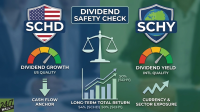
SCHD is the strongest choice on this list for most investors, and the numbers explain why. It tracks the Dow Jones U.S. Dividend 100 Index, which screens for companies with at least a decade of consecutive dividend payments and then ranks them by cash-flow-to-debt, return on equity, dividend yield, and five-year dividend growth. The result is a portfolio built around durable balance sheets rather than the highest nominal yields.
The fund holds roughly $94.9 billion in net assets, charges 0.06% annually, and carries a 30-day SEC yield of 3.3%. Top positions include QUALCOMM at 7%, Texas Instruments at 6%, and UnitedHealth Group at 5%, with Coca-Cola, Merck, Chevron, Verizon, and Procter & Gamble rounding out the top ten. That is a portfolio designed to pay you while you wait, without the yield traps that plague higher-payout screens.
The tradeoff worth understanding: SCHD’s methodology reconstitutes once a year, which means the fund can carry outsized weights in a handful of sectors between rebalancings. Its underweight in mega-cap technology has been a drag during AI-driven rallies, and it will lag if the market narrows back toward growth leadership. What you are buying is a value tilt with quality guardrails.
HDV: A Higher Yield With a Defensive Moat Screen
HDV takes a different route to the same destination. BlackRock’s fund tracks the Morningstar Dividend Yield Focus Index, which starts with companies that Morningstar’s analysts have rated as having wide or narrow economic moats, then screens for financial health, and selects the highest-yielding names. The moat filter matters here. It biases the portfolio toward businesses with pricing power and defensible competitive positions, which is why energy majors, integrated pharma, and consumer staples dominate.
The expense ratio sits at 0.08%, and the 30-day SEC yield of 3.3% edges out SCHD. HDV has returned 19% year-to-date, comfortably ahead of the S&P 500 but behind its Schwab counterpart. HDV runs a more concentrated portfolio than SCHD, typically holding around 75 names with meaningful weights in the top ten. That concentration is the source of both its yield advantage and its risk profile: a single bad quarter from a major energy or pharma holding hurts HDV more than it would hurt a broader dividend basket.
HDV suits investors who want a check every quarter and are comfortable with a more defensive, sector-tilted portfolio. It has outperformed SCHD during periods when energy and healthcare lead, and underperformed when technology takes over.
SCHY: The Overlooked International Angle
SCHY is the fund most readers will overlook, and that is precisely why it deserves attention. Schwab designed it as the international counterpart to SCHD, tracking the Dow Jones International Dividend 100 Index using the same cash-flow-to-debt and dividend-growth screens applied to non-U.S. developed and emerging markets. The expense ratio matches HDV at 0.08%, and the fund pays a distribution yield near 3.3%.
The portfolio holds $2.3 billion in assets across roughly 100 names spanning Europe, Australia, Canada, Asia, and select emerging markets. Top weights include BHP Group at 5%, Eni at 5%, TotalEnergies at 5%, Deutsche Post at 4%, and Allianz at 4%, with British American Tobacco, Roche, GSK, Unilever, and Vinci also in the top tier. This represents genuine geographic diversification.
The tradeoff: SCHY’s 9% price return lags both its U.S. siblings and the S&P 500 this year. The case for holding it is not near-term outperformance but structural diversification. International dividend payers trade at persistently lower multiples than U.S. equivalents, currency exposure works both ways over long horizons, and dollar weakness would flip the relative return math quickly. For a portfolio already concentrated in U.S. large caps, SCHY adds yield from a different opportunity set.
Choosing Between the Three
If you can only own one dividend ETF, SCHD is the default. It has the lowest fee, the strongest 2026 return, the largest asset base, and a methodology that balances yield against quality without leaning too far in either direction.
HDV fits investors who prioritize current income and want a defensive tilt through pharma, staples, and energy. It carries the highest headline yield of the three and behaves more like a value-and-yield play than a total-return vehicle.
SCHY earns its place as the diversifier. If your equity book is 90% U.S. names, adding it gives you a 3% yield stream from businesses that will not move in lockstep with the S&P 500. Own it for the correlation profile and the valuation gap.
Contact [email protected] for any questions or corrections.
Ryne Mauck is an investment writer covering exchange-traded funds, retirement planning, and portfolio strategy. Through his work at 24/7 Wall St. and other investment platforms, including Seeking Alpha, he aims to provide clear, research-driven insights that help investors make more informed decisions while maintaining a long-term approach to investing.
Ryne holds a B.Sc. in Finance and an M.A. in Political Science. He is a formerly registered Municipal Advisor Representative and has passed the Series 50, Series 63, and Series 65 exams. His articles are not intended to be, nor should they be interpreted as, financial advice.