Better Recession-Proof Dividend Stock: KMI or OKE?
Both KMI and OKE slid hard over the past month, leaving retirement investors stuck choosing between a bigger yield and a safer payout history. These two midstream giants look similar on the surface, but their contract structures and balance sheets…

This post may contain links from our sponsors and affiliates, and Flywheel Publishing may receive compensation for actions taken through them.
For investors saving for retirement who need a dividend that lasts an energy downturn, which deserves the slot right now: Kinder Morgan (NYSE:KMI | KMI Price Prediction) or ONEOK (NYSE:OKE)? The question is pressing because both stocks slid over the past month: ONEOK fell 12.04% and Kinder Morgan fell 6.92%.
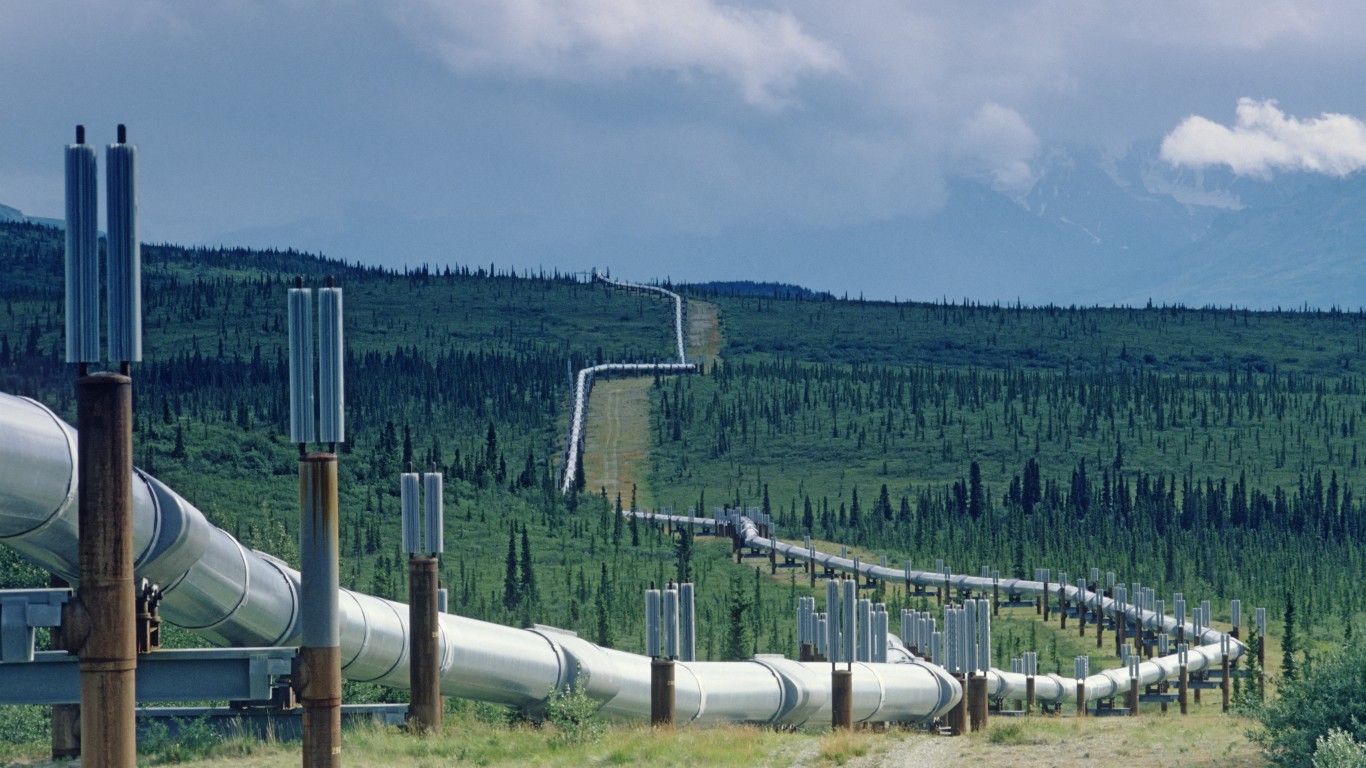
Midstream companies own the pipelines, processing plants, storage tanks and export docks that move oil, natural gas and natural gas liquids (NGLs) from the wellhead to buyers. The sturdiest revenue comes from fee-based contracts, often take-or-pay, where a customer pays for reserved capacity whether or not it ships anything. That cash acts like a toll road. Commodity-sensitive revenue rises and falls with prices and with how hard drillers are working. The more of that second type a company carries, the more a price drop can squeeze the cash behind the dividend.
ONEOK Wins on Yield and Raise History
ONEOK raised its quarterly dividend 4% to $1.07 in January 2026, or $4.28 annualized, for a yield of 4.88%. Kinder Morgan pays $1.19 annualized, a 2% increase, against a share price of $30.01.
History leans further toward ONEOK. Kinder Morgan’s quarterly payment dropped from $0.51 in October 2015 to $0.125 in January 2016. ONEOK held at $0.935 through 2020, 2021 and 2022, then resumed raising. Operating cash flow offers a clear gauge of dividend coverage. ONEOK generated $5.6 billion in 2025 against $2.58 billion in dividends, while Kinder Morgan produced $3.45 billion year to date in 2026 against $1.315 billion paid out.


Kinder Morgan’s Contracts Shield the Payout Better
Kinder Morgan’s project backlog is ~92% natural gas, with more than 60% tied to power generation and utility demand. Its tanker fleet is 100% leased through 2026 and 97% through 2027, and management said its largest Haynesville customers had hedged, making those volumes largely price insensitive. Gas demand is a boost: the EIA expects U.S. LNG export capacity to reach 27.7 Bcf/d by 2030.
ONEOK earned ~90% of 2025 earnings from fees, a solid figure, but its guidance assumes WTI crude at $55 to $60 per barrel and management cited moderating producer activity as a risk. Its 2026 commodity hedges also roll off, leaving 2027 more exposed to NGL prices in both directions.
Balance Sheet Strength Favors Kinder Morgan
Kinder Morgan ended the second quarter at 3.6x net debt to adjusted EBITDA, down from 3.8 at the start of the year. Moody’s upgraded it to Baa1, putting all three agencies at BBB+ equivalent. Management plans more than $3 billion a year of expansion spending. The company says it is funded “almost completely with our internally generated cash flow,” adding: “Right now, we don’t feel like we are capital constrained at all.”
ONEOK is still working toward its long-term leverage target of 3.5x. Cash fell to $78 million from $733 million a year earlier, and 2026 capex of $2.7 billion to $3.2 billion is heading toward the upper end. Credit where due: it retired nearly $3.1 billion of debt in 2025 and deferred meaningful cash taxes until 2031. Leverage and ratings carry this comparison.


Verdict: Kinder Morgan Owns the Safer Dividend
Kinder Morgan wins for retirees whose top priority is a check that never declines, as its gas-weighted contracts, lower leverage and internally funded growth matter more today than a cut from a decade ago. Management also raised 2026 guidance, expecting adjusted EPS at least 12% above budget.
ONEOK suits the income investor with a longer runway who wants more yield today and faster raises, and can stomach commodity swings to get them. That trade has paid: ONEOK’s 10-year price gain of 202% tops Kinder Morgan’s 116.3%. Next, watch two developments. First, whether Kinder Morgan converts its $10 billion opportunity set into backlog before year end, and whether ONEOK closes the gap to its leverage target as drilling activity cools.
Contact [email protected] for any questions or corrections.
Chris Lange is a financial and geopolitical writer with more than a decade of experience covering a myriad of topics. He has published thousands of articles for 24/7 Wall St., with past coverage focused heavily on stocks, IPOs, healthcare, defense, global affairs, and technology.
His work has been quoted, or referenced by a number of outlets including Business Insider, USA Today, Yahoo Finance, MSN, The Motley Fool, and many other publications. A graduate of Southwestern University, he studied business with a focus on investments and has previous experience in banking and startups.
When not reading or writing the news, he is following his passion for Lacrosse, playing chess, or building solar projects with his dad.