Can SanDisk Hit $2,000 by 2027? Here’s Why the Answer Is Yes
SanDisk already reached $2,354 once this year, then pulled back sharply with the broader AI selloff, and what happens on October 29 could determine whether that high was a ceiling or a floor.


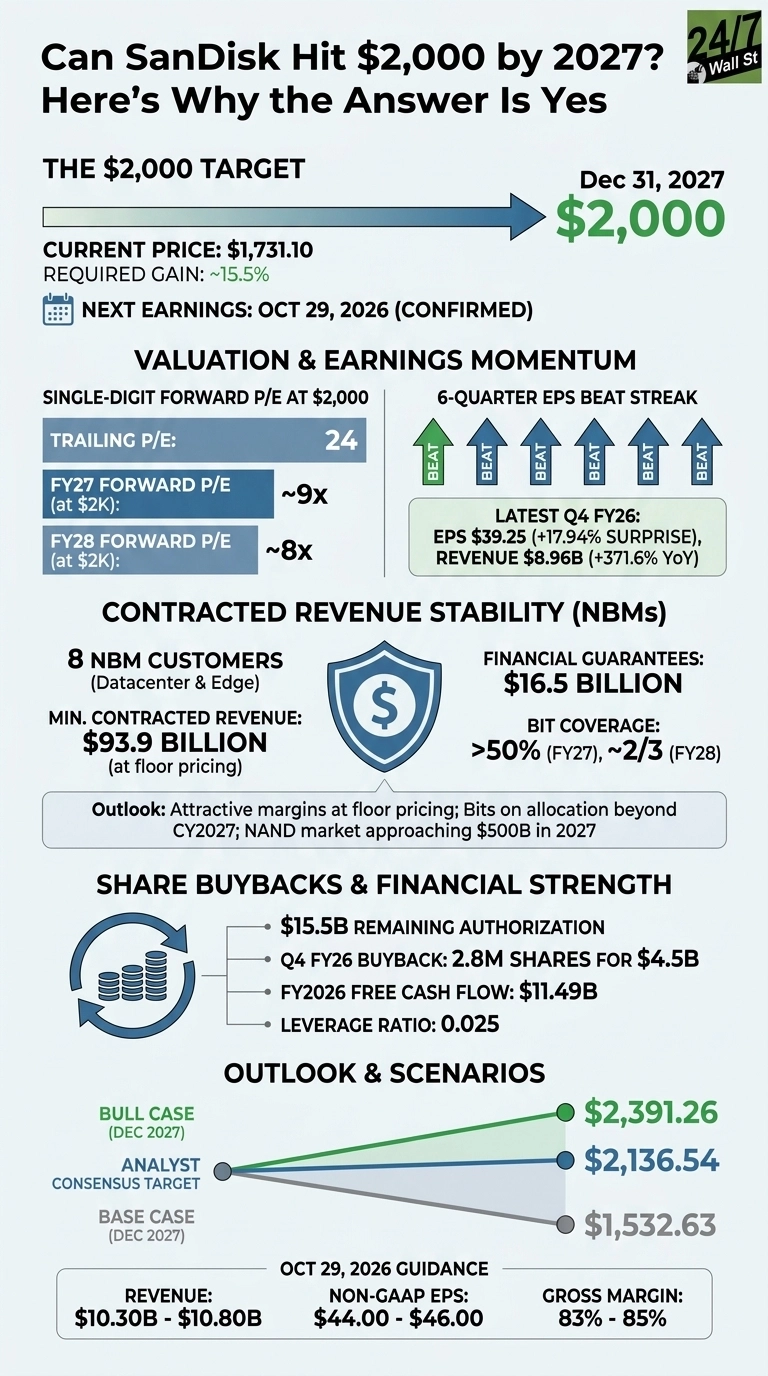
SanDisk (NASDAQ:SNDK | SNDK Price Prediction) will close above $2,000 per share on or before December 31, 2027. The first checkpoint is its confirmed October 29, 2026 earnings report.
The stock trades at $1,731.10 this morning, so it needs a gain of about 15.5% over 15 months. It has already been above that level: it hit a 52-week high of $2,354.39 and traded at $2,107.86 in mid-June.

At $2,000, SanDisk Still Trades at a Single-Digit Multiple
For fiscal 2027, which ends in June, 21 analysts expect average EPS of $213.903. That puts a $2,000 share price at about 9x forward earnings. On the fiscal 2028 consensus of $263.4855, it falls to roughly 8x. The trailing P/E is 24.
SanDisk has beaten EPS estimates in six straight quarters. The latest was fiscal Q4 non-GAAP EPS of $39.25, a 17.94% surprise, on revenue of $8.96B, up 371.6% year over year.
Contracted Revenue Takes Much of the Cyclical Risk Out
SanDisk has signed new business model (NBM) agreements with eight datacenter and edge customers. These are multi-year supply contracts with firm financial commitments. At floor pricing, they carry at least $93.9 billion in expected revenue and are backed by $16.5 billion in financial guarantees.
Management expects NBMs to cover more than 50% of bits in fiscal 2027, rising to approximately two-thirds in fiscal 2028. Management also said, “We expect attractive margins even at floor pricing.”
It expects bits to stay on allocation beyond calendar year 2027, which means customers get limited supply because demand exceeds output. It also sees the NAND market approaching $500 billion in 2027.

Buybacks Are Shrinking the Share Count Behind the Target
Fiscal 2026 free cash flow reached $11.49B, and the leverage ratio stands at 0.025. In fiscal Q4, SanDisk bought back 2,836,000 shares for $4.5 billion.
It still has $15.5B of repurchase authorization left. With fewer shares outstanding, each share gets a bigger slice of earnings, so every quarter of buybacks lifts per-share value on its own.
What to Watch on October 29
Guidance for fiscal Q1 calls for revenue of $10.30B to $10.80B and non-GAAP EPS of $44 to $46. The consensus of $46.1841 already sits at the top of that range. Retirement investors should check three things in the report:
- Whether revenue lands above $10.80B
- Whether non-GAAP gross margin holds within 83% to 85%
- Whether new NBM deals add to the contracted backlog
The stock fell 8.26% over the past week as AI stocks sold off broadly. That decline came with no change to the company’s guidance. Forward estimates point to a bull case of $2,391.26 by late December 2027, against a base case of $1,532.63. The consensus analyst target is $2,136.54.

If spot NAND pricing crashes and hyperscaler spending stalls, SanDisk will finish 2027 below $2,000. The whole thesis rests on AI data-center demand holding up, which is why we mapped seven suppliers supporting that expansion in a free report you can grab here. Still, with most of its bits contracted at guaranteed floor prices and the stock at about 9x forward earnings, I expect it to close above $2,000 by December 31, 2027.
Contact [email protected] for any questions or corrections.
Vandita Jadeja is a financial publisher with over a decade of experience writing about financial topics, including investment, savings, retirement, insurance and banking. Vandita is a Chartered Accountant who loves to debunk financial concepts for readers.
Her work has appeared on sites that include The Motley Fool, InvestorPlace, and Benzinga. She covers investing and focuses on stock picks and price prediction for 24/7 Wall St.
When not looking for the next stock investment opportunity, she can be found traveling, reading, chasing sunsets and enjoying her iced latte.