The Only Way I Stop Adding Broadcom is an AI Collapse
Every time I run the numbers on Broadcom, something keeps pulling me back to add more shares, and one specific scenario is the only thing that could make me stop.

This post may contain links from our sponsors and affiliates, and Flywheel Publishing may receive compensation for actions taken through them.

I added more Broadcom (NASDAQ:AVGO | AVGO Price Prediction) this month, and I already plan to add again after the next earnings report. Each time I go through the numbers, I find the same thing: a company that co-designs the chips the biggest AI builders depend on, turns that work into cash, and sends part of that cash back to me every quarter.
Why My Buy Button Stays Warm
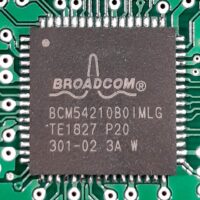
Broadcom builds custom AI accelerators with a small group of frontier labs and links them with its Ethernet networking. These customers commit to roadmaps that run for years. On the fiscal Q3 call, management said Alphabet (NASDAQ:GOOGL) unit Google signed a long-term agreement for future TPU generations, and that Broadcom is “planning to deliver multi-tens of billions of dollars of TPUs annually over the next several years.” I want that kind of visibility in a portfolio I plan to hold into retirement.
Three Data Points Keeping Me in the Stock
Growth. Fiscal Q3 revenue reached $29.59 billion, up 85.5% YoY. AI semiconductor revenue hit $16.70 billion, up 221%. Q4 guidance calls for approximately $34.8 billion in total revenue. Management also laid out about $115 billion in AI semiconductor revenue for fiscal 2027 and $230 billion for fiscal 2028.
Cash. Free cash flow came in at $13.67 billion, equal to 46% of revenue. Broadcom paid down $5.6 billion of long-term debt during the quarter, and its cash balance rose to $23.98 billion.
Income and consistency. The quarterly dividend stands at $0.65 after a 10% raise, which marked the fifteenth consecutive annual dividend increase since fiscal 2011. Broadcom has exceeded EPS estimates every quarter since Q2 24. Most recently it reported $3.32 vs $3.24 consensus.
Why My Money Goes Here Instead of NVIDIA
NVIDIA (NASDAQ:NVDA) is the name most readers would pick first. It trades at roughly 46 times earnings. It pays $0.25 per quarter, a dividend it raised from $0.01 only in May 2026. Broadcom’s raise run goes back 15 years. At $351.19, Broadcom trades near 12 times the fiscal 2028 EPS that its CEO, Hock Tan, says the company is “very much on target to exceed”: $30. That compares a trailing figure with a forward target, so I read it only as a directional signal. Broadcom also says its Jalapeno chip for OpenAI costs “half the cost of a GPU.”
The forward yield comes to about 0.74%. It is modest, but it has a long record of growing. (If the NVIDIA-versus-Broadcom question interests you, we reverse-engineered what the earliest trillion-dollar tech winners looked like before their runs in a free guide here: The Next Nvidia Playbook.)
Risk That Could Break My Thesis
Six customers drive this growth, so an AI spending slowdown would hit them at the same time. Management said only four of the six can fully fund their own investments. Broadcom set up a financing platform with Apollo Global Management (NYSE:APO) and Blackstone (NYSE:BX) that may require “modest residual value guarantees,” which are contingent liabilities. Land, power, and data center buildings also control when investments happen. The stock has pulled back: it traded at $495.00 at the June filing and sits at $351.19 today.
I accept that risk because management says it has secured supply for fiscal 2027 and that “demand actually exceeds this outlook.” Multi-year commitments like the Google agreement support that pipeline.
What Keeps Me Adding From Here
The next test arrives on December 9th, 2026, when Broadcom reports fiscal Q4. I will be checking whether AI revenue reaches the $21.7B guide and whether free cash flow keeps pace. As long as the AI expansion holds up, I keep adding.
Contact [email protected] for any questions or corrections.
Alex Sirois is a financial writer with experience spanning both retail and institutional investing. He has written for InvestorPlace and held roles at BNY Mellon and Bernstein, giving him a perspective that bridges Main Street portfolios and Wall Street analysis.
Alex holds an MBA from George Washington University and has built his career across multiple industries, including e-commerce, education, and translation — a breadth of experience that informs how he breaks down complex financial topics for everyday investors. His writing is conversational, actionable, and grounded in long-term, buy-and-hold investing principles.
At 247 Wall St., Alex focuses on delivering analysis that is both accessible and useful, with a clear emphasis on helping readers make more informed decisions with their money.