By 1873, The Railroad Boom Had Built Some Of The Largest Fortunes In American History. Then A Brutal Crash Bankrupted More Than 100 Railroads And Brought A 5-Year Depression. Now, Brookings Projects The AI Buildout Will Be An Even Larger Share Of The Economy Than The Railroad Mania
Jay Cooke's bank failure in 1873 wiped out more than a hundred railroads and triggered a five-year depression, and a new Brookings paper argues the AI buildout dwarfs that spending frenzy as a share of the economy.

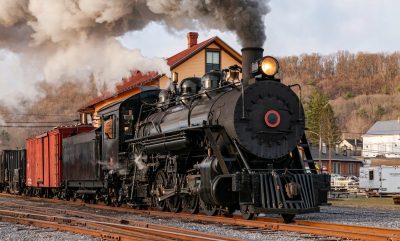
Railroads made Cornelius Vanderbilt America’s richest person by the 1860s, dying in 1877 with an estate estimated at $95 million to $105 million, larger than U.S. Treasury holdings. By share of GDP, Vanderbilt places third among the richest Americans, behind Rockefeller and Carnegie. Within years, his industry’s financing gave way, a warning for today’s AI expansion.
Bonds Built the Rails, Then Broke Them
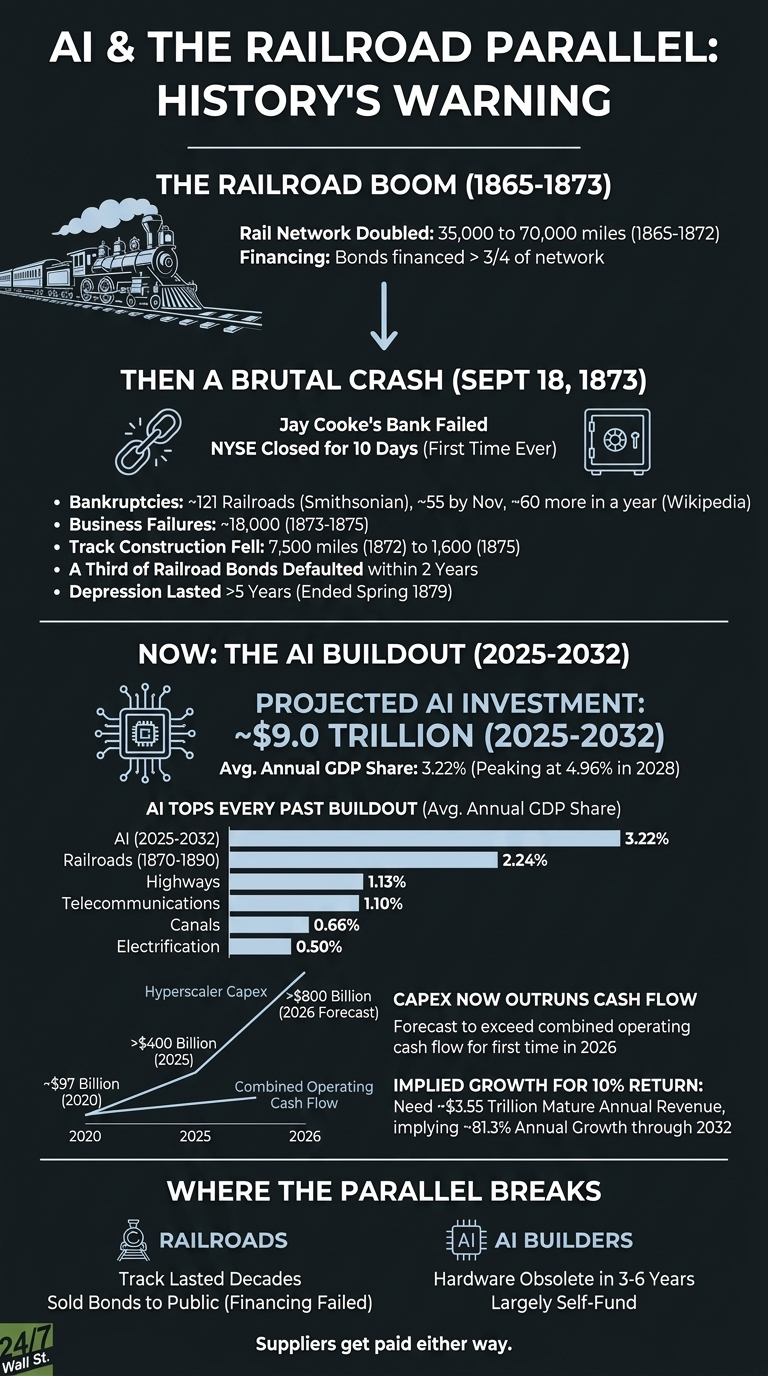
The rail network doubled from 35,000 to 70,000 miles between 1865 and 1872, with bonds financing more than three-quarters of it. On September 18, 1873, Jay Cooke’s bank failed. The New York Stock Exchange closed for ten days, its first closure ever.
Smithsonian counts 121 bankrupt railroads; Wikipedia counts 55 by November and 60 more within the first year. About 18,000 businesses failed from 1873 to 1875. Track construction fell from 7,500 miles in 1872 to 1,600 in 1875. Within two years, a third of railroad bonds stopped paying interest. The depression lasted more than five years, ending in spring 1879.
AI Tops Every Past Buildout on Paper
Stijn Van Nieuwerburgh’s Financing the AI Buildout, dated October 2, 2026, projects about $9.0 trillion in AI infrastructure investment from 2025 through 2032, averaging 3.22% of GDP per year and peaking at 4.96% in 2028.
| Expansion | Avg. Annual Share of GDP |
|---|---|
| AI (scenario average, 2025 to 2032) | 3.22% |
| Railroads (1870 to 1890) | 2.24% |
| Highways | 1.13% |
| Telecommunications | 1.10% |
| Canals | 0.66% |
| Electrification | 0.50% |
The paper says the expansion “would exceed” the major U.S. canal, railroad, electrification, highway and telecommunications investment booms.
Four Caveats That Matter
- Railroads exceeded 4% of GDP in 1870 and 1881; the paper offers no peak-to-peak comparison.
- The paper assumes 213.5 GW of announced capacity never gets built.
- An earlier draft carried $10.3 trillion and a 3.63% share. Numbers may move again.
- The railroad figure leaves out some locomotives and rolling stock.
Capex Now Outruns Cash Flow
Combined capital spending at Oracle (NYSE:ORCL | ORCL Price Prediction), Microsoft (NASDAQ:MSFT), Amazon (NASDAQ:AMZN), Meta Platforms (NASDAQ:META) and Alphabet (NASDAQ:GOOGL) reached about $97 billion in 2020 and more than $400 billion in 2025, with more than $800 billion forecast for 2026, exceeding combined operating cash flow for the first time. A 10% unlevered return would require about $3.55 trillion in mature annual revenue, or about 81.3% annual growth through 2032.
Where the Parallel Breaks
Railroad track lasted decades; today’s hardware may be obsolete in three to six years. Railroads sold bonds to the public; today’s builders largely self-fund. The railroads got built and carried freight for a century. The financing stacked on top failed, with losses falling largely on those who funded the track. The suppliers who sold the rails, ties and locomotives got paid either way, which is the same reason we pulled together seven power, cooling and networking companies behind the expansion of computing facilities for AI workloads in a free report you can grab here.
Contact [email protected] for any questions or corrections.
AJ spent 10 years writing about financial markets at The Motley Fool. His coverage centers on technology stocks and the broader macroeconomic trends, from interest rates to geopolitics, that shape where markets are headed next. AJ is drawn to the stories where big-picture economics and individual companies collide.