Adobe Keeps Cratering: One Wall Street Pro’s Thesis Projects 50% Gains in the Next Year
Adobe keeps beating earnings estimates and raising guidance, yet the stock has cratered 30% this year while peers held up far better. One Bernstein analyst sees a massive mispricing that the rest of Wall Street is not ready to believe.

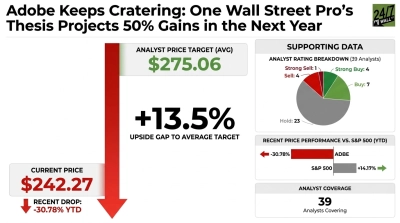
Adobe (NASDAQ:ADBE | ADBE Price Prediction) is now trading at $242.27, and Wall Street’s average price target is $275.06. Roughly 13.5% of implied upside to consensus remains.
Adobe sells the professional creative toolkit (Photoshop, Illustrator, Premiere), plus Acrobat and an enterprise marketing suite. It keeps beating estimates and raising guidance, and the stock keeps falling anyway. Bernstein’s Mark Moerdler reads that as a mispricing. His Street-high $373 target means about 54% upside, well above the 40% line that usually marks a serious disconnect.
The whole debate sits between a modest consensus and that aggressive bull target. One possibility is that Adobe is making money from AI faster than the market gives it credit for. The other is that its moat is wearing away faster than the reported numbers show.
Record Quarters Failed to Stop a 30% Slide
The main driver is fear that generative AI tools will erode Adobe’s creative moat. That fear has pushed the stock down 30.78% year to date from a starting price of $349.99. A record Q3 didn’t stop it. Revenue of $6.76 billion rose 12.9% and beat the $6.70 billion consensus. Non-GAAP EPS of $6.13 beat the $6.09 estimate, the fifth straight beat. Even so, shares fell 4.94% over the past month.
Bears focus on the forward-looking numbers. Total ARR grew 11.2%, and full-year guidance calls for 10.2% ARR growth. Both trail the 14% gain in subscription revenue. RPO rose just 8%. There’s also a leadership change. After 18 years, Shantanu Narayen hands the CEO role to Anil Chakravarthy effective December 1. Retail investors have turned bearish, and one popular WallStreetBets post declared “ADOBE is cooked.”
Bernstein’s $373 Case Hinges on Enterprise AI Dollars
Most of the Street isn’t convinced. Here’s how the 39 analysts rate the stock:
- Strong Buy: 4
- Buy: 7
- Hold: 23
- Sell: 4
- Strong Sell: 1
In September, Moerdler cut his target from $379 to $373 and kept his Outperform rating. His thesis is built around three drivers. The first is enterprise monetization. With Firefly built into Photoshop, Illustrator, Premiere and GenStudio, he expects growth from more enterprise seats, higher pricing levels and paid AI credits. So far, AI-first ARR is above $650 million and growing more than 150%. Firefly ARR grew 40% quarter over quarter, and GenStudio ARR is up over 20%.
The second pillar is a “safe AI” moat. Firefly is trained on Adobe Stock and licensed content, so Adobe can protect customers against copyright claims (IP indemnification), which Fortune 500 legal teams require before using AI at scale. The third pillar is cash. Q3 free cash flow was $2.44 billion, Adobe bought back about 9.5 million shares for $2.232 billion, and roughly $24.55 billion remains under its buyback authorization.
Earnings estimates are moving the bulls’ way. Over the past 30 days, analysts made 26 upward revisions to fiscal 2026 EPS against 3 cuts. The fiscal 2027 consensus is $27.6733. Still, reaching $373 requires the stock’s valuation multiple to expand, and a Street dominated by Hold ratings doesn’t expect that yet.
Software Sold Off Together, but Adobe Fell Hardest
The whole peer group fell, but Adobe fell furthest.
Salesforce (NYSE:CRM) is down 13.51% this year. With shares at $229.13 and a $283.36 target, it offers about 23.7% upside. Ratings lean much more bullish, with 6 Strong Buy ratings, 32 Buy, 15 Hold and 2 Strong Sell.
Autodesk (NASDAQ:ADSK) is down 20.49% year to date but has rebounded 10.81% over the past month. With shares at $235.35 and a $307.54 target, it means about 30.7% upside. It carries 7 Strong Buy ratings, 23 Buy and 6 Hold, with no Sells.
Autodesk has the largest consensus upside in the group. Adobe has the lowest despite the steepest drop, and only Bernstein’s outlier target puts it on top. Every one of these targets is an estimate.
A 9x Forward Multiple Meets a Hold-Heavy Street
Adobe trades at $242.27, against a $275.06 average target from 39 analysts, for 13.5% implied upside. Shares are down 30.78% year to date and 30.28% over the past year. Over the same periods, the S&P 500 gained 14.17% and 16%.
Over the past 52 weeks, the stock has ranged from $190.12 to $363.70. It trades at about 14 times trailing earnings and 9 times forward earnings. Analyst targets are one input among many.
Adobe’s 9x Multiple Sets Up a Decisive AI Test
Bulls get more support if AI-first ARR keeps compounding, enterprises turn Firefly credit use into more paid seats, and total ARR growth climbs back above the 10.2% guidance. That’s the path to $373: proof that AI is growing Adobe’s business.
The bear case gains ground if ARR keeps slowing down, AI-native rivals like Canva and OpenAI’s image and video tools keep winning new creators, and the CEO transition stalls execution. Under those conditions, 9x earnings could prove a value trap.
Valuation leans toward the bulls. A forward multiple of 9 prices in a long decline even as estimates rise. Chakravarthy’s first quarter-end earnings report as CEO will be the real test.
Contact [email protected] for any questions or corrections.
Alex Sirois is a financial writer with experience spanning both retail and institutional investing. He has written for InvestorPlace and held roles at BNY Mellon and Bernstein, giving him a perspective that bridges Main Street portfolios and Wall Street analysis.
Alex holds an MBA from George Washington University and has built his career across multiple industries, including e-commerce, education, and translation — a breadth of experience that informs how he breaks down complex financial topics for everyday investors. His writing is conversational, actionable, and grounded in long-term, buy-and-hold investing principles.
At 247 Wall St., Alex focuses on delivering analysis that is both accessible and useful, with a clear emphasis on helping readers make more informed decisions with their money.