Nvidia’s 15% Price Hike Reveals the Hidden Cost of the AI Boom
The AI boom is quietly sending a surge of inflation through every corner of the tech industry, and Nvidia's latest move suggests the pressure is only getting started.


The AI boom is producing an unusual side effect: The machines being built to power artificial intelligence are making other technology more expensive. Memory prices have already surged, with server DRAM roughly doubling in the first quarter of 2026. Counterpoint Research reported an 80% to 90% quarter-over-quarter increase across DRAM, NAND, and HBM during the period. And the shortage isn’t disappearing quickly.
Deloitte expects meaningful new capacity won’t arrive until 2029 or 2030, while Gartner has projected the supply crunch will persist at least through the first half of 2027. Now the memory bill is reaching the industry’s biggest AI chipmaker.
Nvidia Is Passing The Memory Bill Along
Nvidia (NASDAQ:NVDA | NVDA Price Prediction) has reportedly told major customers that servers containing its Grace Blackwell and next-generation Vera Rubin chips will cost more than 15% more in many configurations beginning with systems shipped early next year.
Bloomberg reported the increases, though Reuters said the report’s details could not immediately be independently verified. Contract manufacturers building systems for Microsoft (NASDAQ:MSFT), Alphabet (NASDAQ:GOOG), and Oracle (NYSE:ORCL) have already notified customers of the coming increases. The size of the hike will vary according to the Nvidia generation and memory configuration.
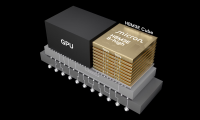
It’s not that Nvidia suddenly found that its GPUs cost 15% more to manufacture. Rather, memory is becoming one of the most expensive ingredients in the AI server recipe, particularly high-bandwidth memory (HBM), and server DRAM.
Deloitte estimates memory already represents roughly 25% of the bill of materials for high-end AI server racks. That gives suppliers enormous leverage when demand is rising faster than factories can add capacity.
The AI Boom Is Creating “AI-Flation”
The pricing pressure has already escaped the data center. Apple (NASDAQ:AAPL) raised prices on Macs, iPads, Apple TV, HomePod, and Vision Pro products in June, with some increases approaching 20%. CEO Tim Cook specifically blamed soaring memory and storage costs driven by AI data-center construction.
Now Amazon (NASDAQ:AMZN) is following its lead. Fortune reported that Amazon raised prices on Echo, Fire TV, Kindle, and eero products, including a 60% increase for the Echo Dot from $49.99 to $79.99 and a 37% increase for the base Kindle from $109.99 to $149.99. Amazon said the increases reflected “significant increases” in memory and storage component costs.
The pattern is important for investors. AI isn’t merely consuming electricity and GPUs. It is bidding up the price of the underlying components needed to build those systems. And the pressure could worsen. Gartner’s forecast calls for the shortage to last into 2027, while Deloitte expects AI-server DRAM prices to quadruple over the full year from their starting point.
Nvidia May Be A Winner Anyway
Ironically, higher memory prices could strengthen Nvidia’s position rather than weaken it.
Demand for Nvidia’s AI infrastructure remains strong enough that hyperscalers appear willing to absorb higher costs. Passing memory inflation through to Microsoft, Google, Oracle, and other customers allows Nvidia to protect its own economics instead of absorbing the entire increase.
The bigger concern is what happens to the cost of building AI data centers. A 15% increase in server prices doesn’t make the AI investment boom stop, but it does raise the capital required to deploy the same amount of computing capacity. That’s AI-flation in its simplest form.
Granted, there is a longer-term risk for Nvidia. If AI infrastructure becomes too expensive, hyperscalers have an even greater incentive to develop custom silicon and diversify away from Nvidia’s platform.
But that transition takes time, while the memory shortage is happening now.
Key Takeaway
For investors, the memory squeeze is better news for memory makers than for Nvidia customers. Micron Technology (NASDAQ:MU), SK hynix (NASDAQ:SKHY), and Samsung stand to benefit from pricing power created by scarce supply. Nvidia, meanwhile, is demonstrating that its demand remains strong enough to pass those costs along.
In short, investors shouldn’t dismiss the 15% Nvidia price increase as a minor cost adjustment. It is evidence that the AI boom is moving into its next phase — one where memory scarcity is becoming an inflationary force across the entire technology supply chain.
Contact [email protected] for any questions or corrections.
After two decades of patrolling the dark corners of suburbia as a police officer, Rich Duprey hung up his badge and gun to begin writing full time about stocks and investing. For the past 20 years, he’s been cruising the markets looking for companies to lock up as long-term holdings in a portfolio while writing extensively on the broad sectors of consumer goods, technology, and industrials. Because his experience isn’t from the typical financial analyst track, Rich is able to break down complex topics into understandable and useful action points for the average investor. His writings have appeared on The Motley Fool, InvestorPlace, Yahoo! Finance, Money Morning, and, of course, 24/7 Wall St. He has been featured in both U.S. and international publications, including MarketWatch, Financial Times, Forbes, Fast Company, and USA Today.