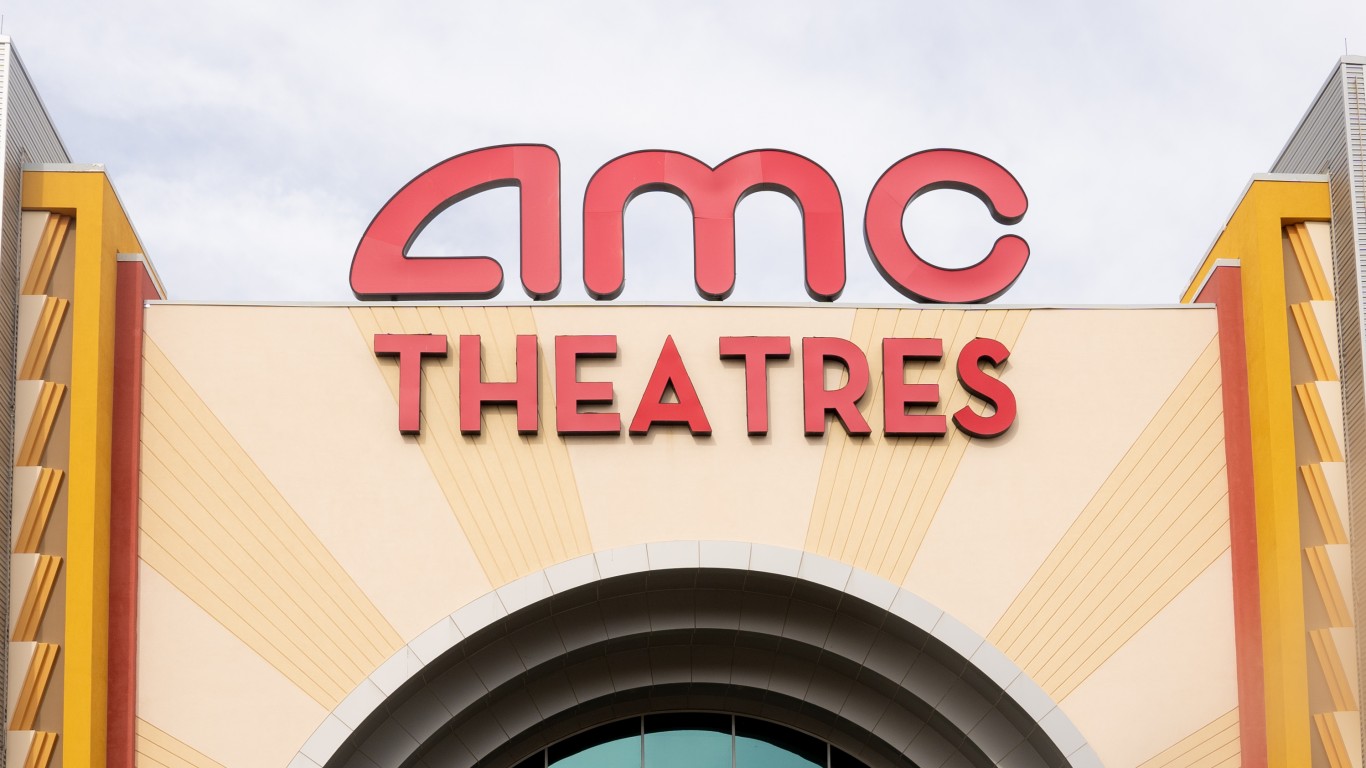
AMC Rallies 5% a Week After $3.97B Refinancing Closed; Cinemark Climbs 4%, IMAX Drifts Lower
AMC stock has doubled in 2025 while still carrying nearly $4 billion in debt and negative stockholders' equity, leaving investors to weigh whether a landmark refinancing buys enough time for box office momentum to close that gap.


AMC Entertainment (NYSE:AMC) stock is up 5% to $3.16 in afternoon trading, extending a rally that began when the company first announced its refinancing. The gain comes roughly a week after that $3.97 billion debt package closed, and it puts AMC stock up 101% year to date (YTD).
Meanwhile, Cinemark Holdings (NYSE:CNK) stock is up 4% to $38.17, running just behind AMC stock’s rally. At the same time, IMAX (NYSE:IMAX) stock is down 0.6% to $51.40, lagging both theater chains.
Those moves stand out against the SPDR S&P 500 ETF Trust (NYSEARCA:SPY), which is down 0.1%. With Cinemark stock climbing too, the peer figures point to something broader in exhibition sitting alongside whatever is specific to AMC. As a sector-level gauge, the Invesco Leisure and Entertainment ETF (NYSEARCA:PEJ) is up 1% to $63.59.
Refinancing Pushes AMC Maturities Into the Next Decade
AMC completed a refinancing of its existing debt in early October through a tender offer, a first lien notes offering and new term loan facilities. The transactions moved almost all of its remaining due dates into the next decade, building on balance sheet repairs from earlier in the year. AMC detailed the savings in its Q2 2026 report. Refinancing and equity raises had cut annual cash interest expense by $16 million, with leverage-triggered rate reductions on 75% of its borrowings expected to save another $51 million a year.
As the largest theater circuit in the U.S., AMC carries the heaviest debt load in the group, which explains why AMC shares react to balance sheet news far more than rival stocks do.
Lighter Balance Sheets Set Cinemark and IMAX Apart
Cinemark operates a smaller and less leveraged circuit, while IMAX licenses its projection systems to theater owners and takes a share of box office receipts, and both models leave their valuations far less sensitive to refinancing news than AMC stock. On a YTD basis, Cinemark stock is up 66% and IMAX stock is up 39%.
For bulls, pushing AMC’s due dates out buys the company years for attendance and pricing to recover. Its Q2 2026 results back that view, with revenue up 14.2% year over year to $1.6 billion and adjusted earnings before interest, taxes, depreciation and amortization (EBITDA) up 70% to $321.4 million. “The second quarter of 2026 was nothing short of extraordinary for AMC,” stated Adam Aron, who was chairman and CEO at the time of the company’s Q2 earnings call.

Premium screens give AMC another tool. Those large-format and extra-large auditoriums made up 8% of its screen count yet generated more than 50% of its ticket gross for The Odyssey‘s opening weekend. Management said AMC could add 150 to 250 more such screens over the next two to four years.
Skeptics counter that a refinancing changes the timing of AMC’s debt while leaving its size intact. At the end of Q2, AMC still carried $3,851.6 million in corporate borrowings and negative stockholders’ equity of $1,452.7 million. Sean Goodman, then AMC’s chief financial officer, addressed the targets. He stated that the company wants to reach “around a three-times leverage level,” admitting that “it’s going to take a little while to get there.”
What to Watch Next
Looking ahead, AMC expects 2026 to be the strongest post-pandemic year for theatrical exhibition, citing The Odyssey‘s $124 million domestic opening. Upcoming releases such as Dune: Part Three and Avengers: Doomsday can test how far attendance rises as AMC’s interest bill shrinks. Aron framed the link simply on the Q2 call: “If interest expense goes down, that means that the break-even box office level goes down as well.”
Investors can watch for whether Cinemark keeps tracking AMC, since a shared advance would signal group-wide strength. AMC’s next quarterly report may also reveal how much of the interest savings reach free cash flow, which was $190.1 million in Q2 2026. Given AMC’s remaining debt, investors may want to size their positions with that risk in mind.
Contact [email protected] for any questions or corrections.
David Moadel is financial writer specializing in stocks, ETFs, options, precious metals, and Bitcoin. David has written well over 1,000 articles for leading online publications, helping investors understand markets, income strategies, and risk.His work has appeared in The Motley Fool, InvestorPlace, U.S. News & World Report, TipRanks, ValueWalk, Benzinga, Market Realist, TalkMarkets, Finmasters, 24/7 Wall St., and others.With a master’s degree in education, David has taught at the elementary, high school, and college levels. That teaching background shapes his writing style: clear, educational, and practical. David has also built a loyal social-media audience by providing trustworthy financial content on YouTube, X/Twitter, and StockTwits.