Home Depot’s Dividend Is Doing Something Most Retail Stocks Cannot
Home Depot has raised its dividend through four straight years of record-low housing turnover, but one number in its quarterly reports could flip that story fast.

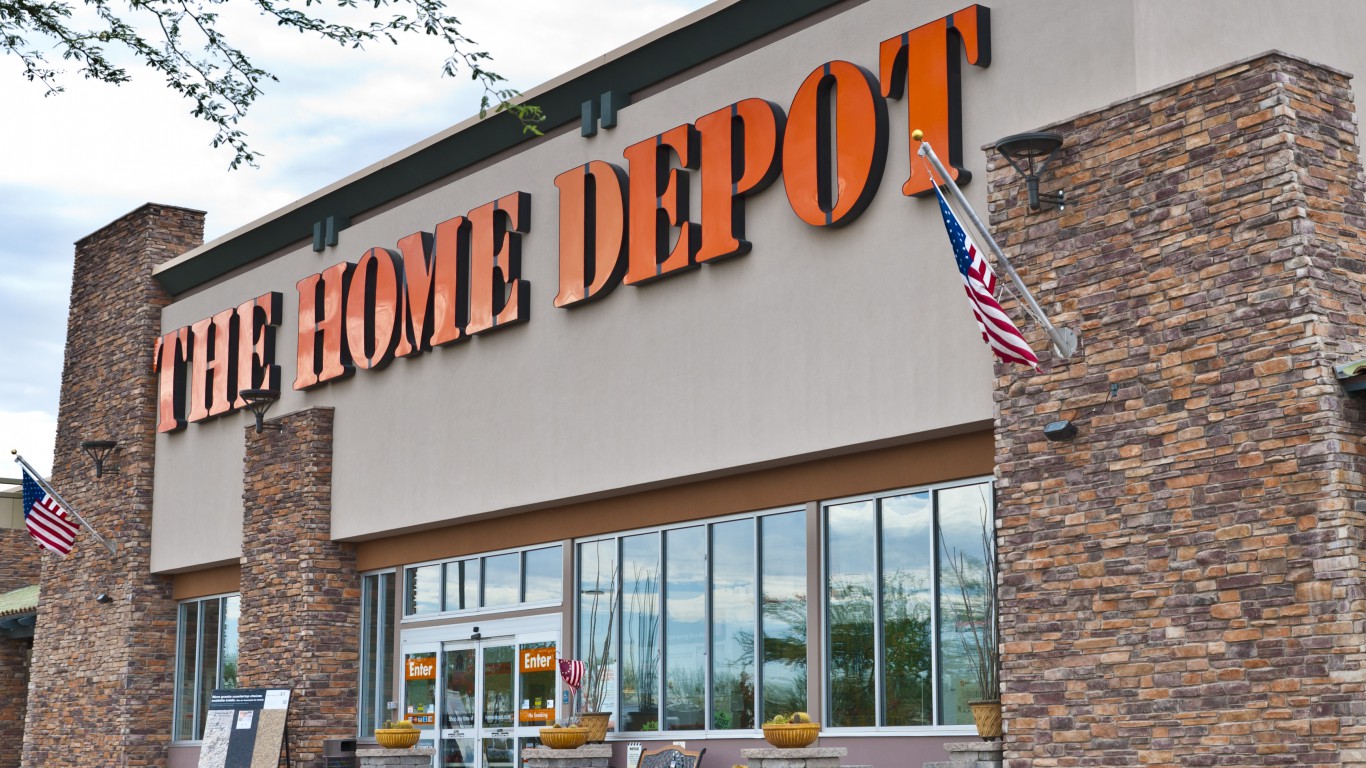
Shares of Home Depot (NYSE:HD | HD Price Prediction) are down 13.43% year to date and 20.96% over the past year. Through that decline, the company has kept paying $2.33 per share every quarter. For retirees who own the stock, the price reflects a frozen housing market. The dividend reflects a cash engine that still covers the bill comfortably.
Free Cash Flow Funds the $9.32 Payout
In February, Home Depot raised its quarterly dividend 1.3% to $2.33. That works out to $9.32 a year and marked its 156th consecutive quarterly cash dividend. The quarterly amount has gone up every year since 2013, rising from $0.39 then to $2.33 now.
Free cash flow pays for it. Home Depot produced $12.65 billion of free cash flow in fiscal 2025 from $16.33 billion of operating cash flow. Across 997.69 million shares, the current rate costs roughly $9.3 billion a year, or about 74% of that free cash flow. Measured against fiscal 2025 adjusted EPS of $14.69, the payout ratio is about 63%. The forward yield sits near 3.2%, and the stock trades at about 21 times earnings.

Free cash flow fell 29.53% in fiscal 2025.
Housing Turnover Will Decide This Dividend
Big renovations tend to follow home sales. Sellers fix up a house before they list it, and buyers redo kitchens after they move in. Homeowners who locked in low mortgage rates aren’t moving, so fewer of those projects happen. Existing-home sales ran at 3.99 million in September, just above August’s 3.93 million low. CFO Richard McPhail laid it out in August:
“Housing turnover, just as one point in the economy that we watch, has been at historical lows. It has never been lower as a percentage of the housing stock. We’ve seen housing turnover at these low levels for four years now.”
Even so, second-quarter adjusted EPS of $4.92 came in ahead of the $4.73 consensus, and revenue grew 5.7% to $47.86 billion. The company paid about $2.3 billion in dividends during the quarter. Earlier in the year, CEO Ted Decker said:
“The underlying demand in our business was relatively similar to what we saw throughout fiscal 2025, despite greater consumer uncertainty and housing affordability pressure.”
Lowe’s and Target Show the Trade-Offs
Lowe’s (NYSE:LOW) paid $4.75 per share in fiscal 2025 against $12.28 in adjusted EPS, a payout of about 39%. That leaves it more buffer, but its yield is only about 2.49%. Lowe’s also carries negative shareholders’ equity of $7.437 billion and has guided to flat comparable sales.
Target (NYSE:TGT) paid out about 60% of fiscal 2025 adjusted EPS, while its free cash flow fell 25.69% to $2.835 billion. Its second-quarter EPS of $4.11 included a one-time tariff refund worth $1.65 per share.

Home Depot pays a higher yield than Lowe’s, and it supports that payout with far more free cash flow than Target.
Verdict: Durable, With One Clear Tripwire
Home Depot’s dividend is durable. Free cash flow covers it with more than enough room to spare, and the company has raised it through four years of record-low housing turnover. Fiscal 2026 guidance calls for adjusted EPS growth of flat to 4.0%. That outlook supports more small raises, with modest increases the likely pattern.
One thing would change this answer: another free cash flow decline the size of fiscal 2025’s. That would leave free cash flow near $8.9 billion, below the dividend bill. If that happens, the board would have to fund the payout with debt or slow the raises. Watch free cash flow in each quarterly report.
Dividend investors who want checks arriving on a tighter cadence than Home Depot’s quarterly schedule have options; we rounded up seven monthly payers in a free guide here: The 7 Monthly Dividend Stocks That Pay You Every 30 Days.
Contact [email protected] for any questions or corrections.
Chris Lange is a financial and geopolitical writer with more than a decade of experience covering a myriad of topics. He has published thousands of articles for 24/7 Wall St., with past coverage focused heavily on stocks, IPOs, healthcare, defense, global affairs, and technology.
His work has been quoted, or referenced by a number of outlets including Business Insider, USA Today, Yahoo Finance, MSN, The Motley Fool, and many other publications. A graduate of Southwestern University, he studied business with a focus on investments and has previous experience in banking and startups.
When not reading or writing the news, he is following his passion for Lacrosse, playing chess, or building solar projects with his dad.