What Meta’s Quarter Has to Show to Justify Wall Street’s Highest Targets
Meta reports Q3 earnings on October 21 with its stock sitting 9% below its 52-week high, and three specific numbers will determine whether Wall Street's most aggressive price targets hold or collapse under the weight of surging capex and mounting…


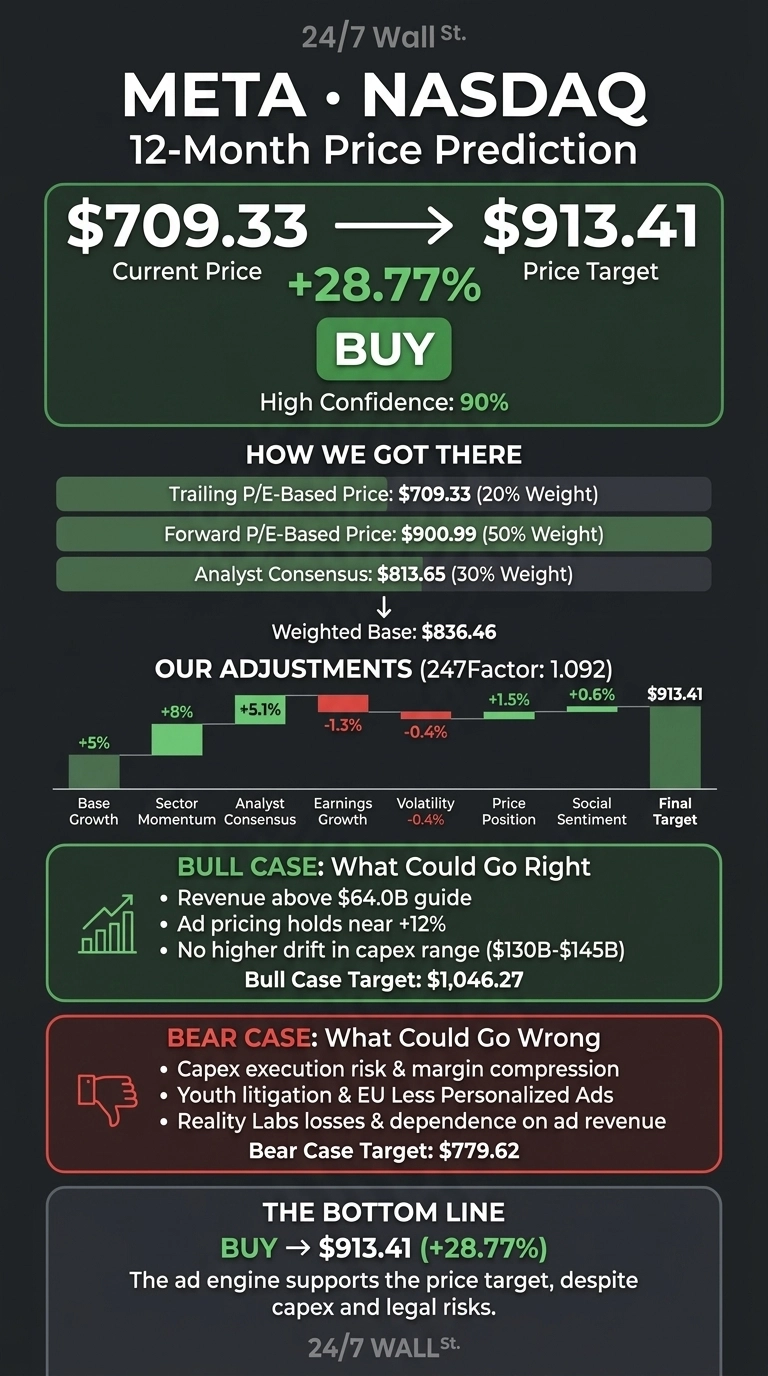
Meta Platforms (NASDAQ:META | META Price Prediction) reports Q3 2026 results on October 21 after the close, with the stock trading at $709.33. The 24/7 Wall St. price target stands at $913.41, implying 28.77% upside over 12 months. Meta earns a buy rating with high confidence.
| Metric | Value |
|---|---|
| Current Price | $709.33 |
| Price Target from 24/7 Wall St. | $913.41 |
| Upside | 28.77% |
| Recommendation | BUY |
| Confidence Level | 90% |

To justify the Street’s most aggressive views, Meta needs three things in this quarter: revenue at or above the top of its $61B to $64B guide, ad pricing that holds near Q2’s +12% gain, and no higher drift in the $130B to $145B capex range.
Q2 Revenue Beat Masked by an EPS Miss and Vanishing Free Cash Flow
Shares fell 3.72% in the latest session and 1.3% on the week, yet remain up 5.42% over a month and 7.72% year to date. The stock trades 9% below its 52-week high of $779.82 while sitting 36.6% above its low of $519.37.
In Q2, revenue rose 27.96% to $60.80B, beating estimates, but EPS of $6.18 missed the $7.2173 consensus, ending a six-quarter beat run. A $2.40B legal charge and $1.18B in severance weighed, while free cash flow shrank to $784 million.

What Q3 Must Prove for a $1,046 Bull Case
The bull-case target reaches $1,046.27. The ad engine supports it: impressions grew 14%, Advantage+ hit a $75 billion run rate, and Family of Apps other revenue climbed 73% on WhatsApp messaging.
Consensus Q3 EPS is $5.9382 with revenue near $63.35B, so an earnings report near the high estimate of $7.64 would reset the narrative. Analyst support runs deep, with 8 Strong Buy ratings alongside 47 Buy ratings against one Sell.

Capex and Courtroom Risks That Could Cap the Stock
Management gave no 2027 capex outlook and noted youth-related trials that may trigger material losses, alongside EU Less Personalized Ads enforcement.
Full-year EPS estimates fell from $33.0006 to $30.8051 over 90 days. Our bear case lands at $779.62. Bulls would counter that excluding legal and severance costs, Q2 operating income rose 9%.
Meta Trades in Line With Alphabet and Amazon on Forward Earnings
Meta’s closest digital ad rival is Alphabet (NASDAQ:GOOGL). The stock changes hands at 23x forward earnings with 24.2% quarterly revenue growth, a near match to Meta’s 23x.
Meanwhile, Amazon (NASDAQ:AMZN) shares the AI capex burden at 24x forward, yet its 13.7% operating margin trails Meta’s 41.4%.
The capex question is the real one here, and it extends well beyond Meta. We highlighted seven companies supplying the power, cooling, and networking behind the AI expansion in a report you can grab here: 7 Stocks Powering the AI Boom (That Aren’t Chipmakers).
| Company | Forward P/E | Operating Margin |
|---|---|---|
| Meta | 23x | 41.4% |
| Alphabet | 23x | 34% |
| Amazon | 24x | 13.7% |
Our target implies roughly 29x forward EPS, a premium to both peers. Given Meta’s superior margins, I view that as bold but reasonable.
Ad Pricing Power Decides Meta’s Next Move After This Report
The 24/7 Wall St. price target of $913.41 carries a buy rating and 90% confidence. The deciding factor is ad pricing power funding the AI expansion.
This outlook strengthens if Q3 revenue tops $64B with steady capex. The case weakens if legal losses mount or 2027 spending signals surge. On balance, the ad engine earns the benefit of the doubt.

Meta Price Prediction 2026-2030
This is where the 24/7 Wall St. price target model projects Meta could trade, assuming current trends hold.
| Year | Price Target from 24/7 Wall St. |
|---|---|
| 2026 | $741.88 |
| 2027 | $913.41 |
| 2028 | $1,029.23 |
| 2029 | $1,159.74 |
| 2030 | $1,306.80 |
These projections assume Meta keeps executing on AI-driven ad growth. Major upside could come from enterprise agent monetization, while youth litigation or runaway capex creates the biggest downside.
Contact [email protected] for any questions or corrections.
Vandita Jadeja is a financial publisher with over a decade of experience writing about financial topics, including investment, savings, retirement, insurance and banking. Vandita is a Chartered Accountant who loves to debunk financial concepts for readers.
Her work has appeared on sites that include The Motley Fool, InvestorPlace, and Benzinga. She covers investing and focuses on stock picks and price prediction for 24/7 Wall St.
When not looking for the next stock investment opportunity, she can be found traveling, reading, chasing sunsets and enjoying her iced latte.