3 Beaten-Down Food Stocks With High Dividend Yields. Which Payouts Are Safe?
Yields north of 6% look tempting while grocery giants bleed sales and write down brands. One of these three payouts was already slashed in half, so which dividend can income investors actually trust?

This post may contain links from our sponsors and affiliates, and Flywheel Publishing may receive compensation for actions taken through them.
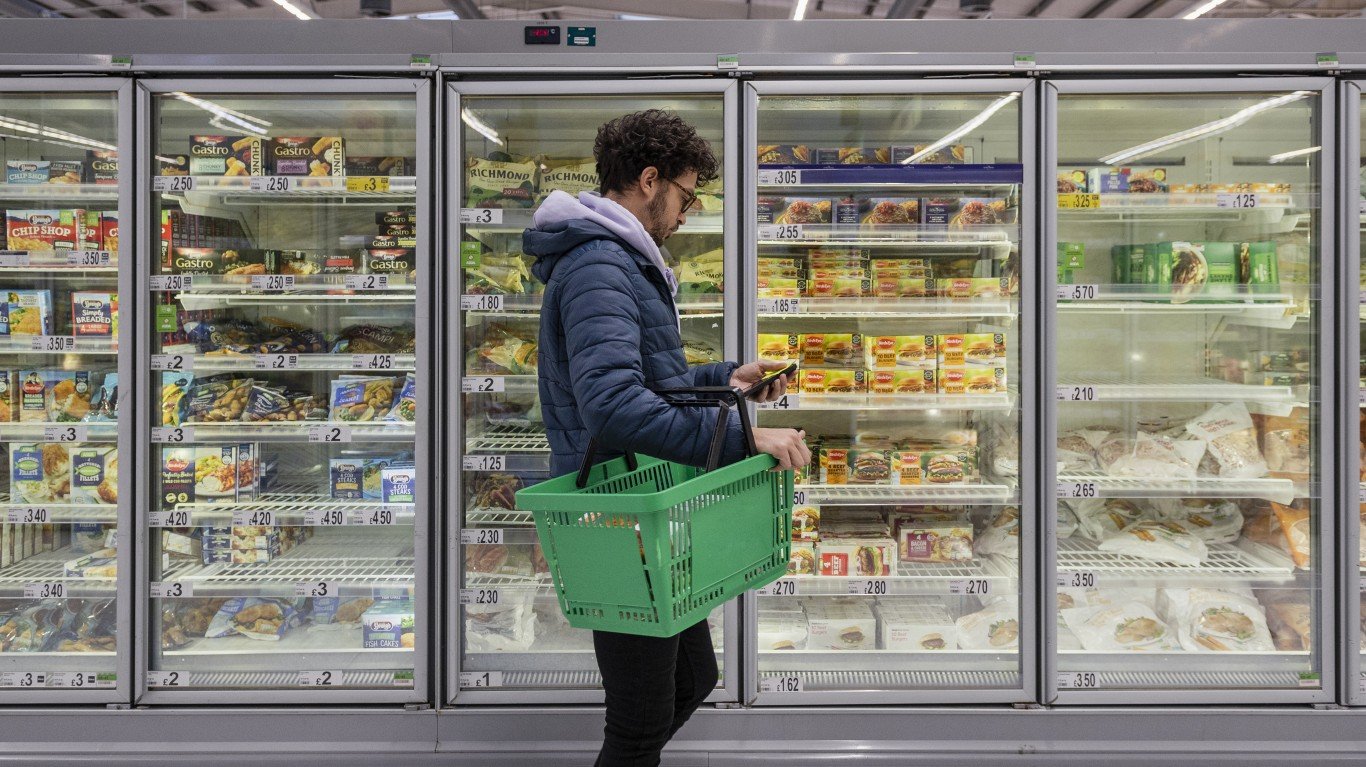
Packaged food has become one of the market’s sore spots. Shoppers are trading down, volumes are shrinking, and the industry’s biggest names have written off billions in brand value. General Mills (NYSE:GIS | GIS Price Prediction) is down 17.83% year to date. A slide like that pushes yields up and leaves income investors with one question: which dividends will hold? Below are General Mills, Kraft Heinz (NASDAQ:KHC) and Conagra Brands (NYSE:CAG), each judged first on dividend coverage and second on yield.
General Mills: A 127-Year Dividend Record Built for Rough Patches
General Mills fills the cereal aisle and much more. Its brands include Cheerios, Blue Buffalo, Pillsbury, Betty Crocker, Häagen-Dazs, Nature Valley, Old El Paso, and Annie’s. The quarterly dividend is $0.61 per share, or $2.44 a year. At a recent price of $35.76, that works out to a yield of about 6.8%, which puts General Mills in ultra-high-yield territory.

Dividend safety: Management guides fiscal 2027 adjusted EPS to $3.00 to $3.20. Against that range, the dividend uses about 76% to 81% of earnings. That is high, but still covered. Free cash flow gives more room. General Mills generated $1.626B of free cash flow last fiscal year, while the dividend costs about $1.30B a year at the current share count. Guidance also calls for free cash flow conversion of about 95% of adjusted after-tax earnings. It has already relieved the pressure by cutting buybacks to $500M from $1.2B the year before. Leverage stands “just a touch” above four times net debt to EBITDA, against a target of three times. Management expects the return to target to take “at least a couple years.”
Its history of increases is the best in this group. Management says the current payout marks its “127th consecutive year of uninterrupted dividends.” Increases have kept coming even as business conditions declined: the quarterly rate went from $0.59 to $0.60 and then to $0.61 beginning with the 2025-10-10 ex-dividend date.
Bull case: General Mills is targeting at least $750M in cost savings this fiscal year, part of a goal of $3B in total savings by fiscal 2030. Market share is starting to steady. Cereal share fell 0.9 in the year-ago quarter and only 0.1 this time. Latest-quarter adjusted EPS of $0.75 beat the $0.7178 estimate, and the shares trade at about 11 times forward earnings. Income buyers are paying a modest multiple for a dividend that has paid through more than a century of cycles.
Risk: Profits are still shrinking. Adjusted operating profit is guided down 8% to 13% in constant currency this fiscal year. If earnings land at the low end, the payout ratio climbs toward the top of its range and the room for future increases gets thin.
Kraft Heinz: A Reset Dividend Now Backed by Rising Guidance
Kraft Heinz sells condiments, cheese, meals, and snacks under the Kraft and Heinz names. It is also slimming down: it signed a deal to sell its North American coffee business to One Rock while keeping a 30% non-controlling equity stake. The quarterly dividend is $0.40, or $1.60 a year. At $24.74, the stock yields about 6.5%, another ultra-high-yield payout.

Dividend safety: Kraft Heinz increases its full-year adjusted EPS guidance to $2.07 to $2.13. That puts the payout at roughly 75% to 77% of earnings. Cash generation is the bigger story. Management expects free cash flow conversion of about 110%, which means cash should run ahead of adjusted earnings. The dividend costs roughly $1.90B a year. Kraft Heinz’s balance sheet is getting cleaner too, with $3,982M of long-term debt repaid so far this year and $1.888B in cash.
The history comes with a mark. The quarterly payout was $0.625 in 2018 and has been $0.40 since the 2019-03-07 ex-dividend date. The latest payment, declared on 2026-11-04, carries the same amount and goes out on 2026-12-23. Kraft Heinz has kept the dividend flat for years without increasing it, and that discipline is a big part of why the payout looks covered today.
Bull case: Third-quarter adjusted EPS of $0.53 beat the $0.4235 estimate, the company’s 6th straight beat. Emerging Markets organic sales rose 15.6%. The stock trades at 0.807 times book value and about 11 times forward earnings, and it is up 7.22% year to date, the only gain in this group. Chief executive Steve Cahillane said the plan “to turn around the U.S. business and accelerate growth internationally is on track.”
Risk: North America, the core business, is still shrinking. Segment revenue fell 3.4% to $4.485B, and constant-currency adjusted operating income is guided down 16% to 18% for the year. Cahillane also warned that “price is likely to have to be taken in 27 for sure,” which could cost the company more volume.
Conagra Brands: A Halved Dividend With the Best Coverage in the Group
Conagra stocks freezers and pantries with brands such as Banquet, Healthy Choice, Birdseye, Snack Pack, and Swiss Miss. It also cut its dividend. In its fourth-quarter fiscal 2026 results, chief executive John Brase said, “We are announcing today a reduction in our dividend to an annualized rate of $0.70 per share.” The quarterly payment dropped from $0.35 to $0.175. Trailing data still shows an 8.12% yield, but that number includes payments made before the cut. At the new rate and a price of $15.23, the forward yield is about 4.6%. That is high-yield, and it is the figure retirees should plan around.

Dividend safety: After the cut, Conagra’s dividend is the best covered of the three. Against fiscal 2027 adjusted EPS guidance of $1.40 to $1.50, the payout is about 47% to 50%. Last fiscal year’s free cash flow of $978.7M compares with a dividend bill of roughly $334M at the new rate, and management guides free cash flow conversion above 90%. Leverage was 3.99 times in the first quarter, against a target of three. On the earnings call, management said: “We are maniacally focused on getting there as soon as possible.” The company will reduce debt by about $250 million this year, and executives said rating agencies “looked at our cut of the dividend as a positive.”
Before the cut, Conagra had increased its quarterly rate from $0.2125 in 2020 to $0.35, and it held that level from the 2023-07-28 ex-dividend date through 2026-01-27. The new $0.175 rate has now been declared twice, with a payout scheduled for 2026-12-03.
Bull case: After the cut, the payout should now be safe for some time. First-quarter adjusted EPS of $0.41 beat the $0.2815 estimate. The stock trades at about 10 times forward earnings, and nearly all of its debt is fixed-rate, which shields it from interest-rate swings. Shares have climbed 14.51% over the past month.
Risk: Sales are still falling. Organic net sales are guided to -3% to -1% for the year. At the same time, input-cost inflation is running toward the high end of a 5% to 6% range. That leaves Conagra fighting for profit while it pays down debt.
Which Packaged Food Dividend Holds Up Best
General Mills combines the longest record with an ultra-high yield, and its cash flow covers the payout. Kraft Heinz offers a similar yield, supported by increased guidance and free cash flow expected to run ahead of earnings. Conagra pays the lowest yield, but after the cut, guided earnings cover its payout about twice over. In a sector where sales keep falling, the safest dividends are those supported by cash flow and falling debt, and all three companies are working on both.
Contact [email protected] for any questions or corrections.
Chris Lange is a financial and geopolitical writer with more than a decade of experience covering a myriad of topics. He has published thousands of articles for 24/7 Wall St., with past coverage focused heavily on stocks, IPOs, healthcare, defense, global affairs, and technology.
His work has been quoted, or referenced by a number of outlets including Business Insider, USA Today, Yahoo Finance, MSN, The Motley Fool, and many other publications. A graduate of Southwestern University, he studied business with a focus on investments and has previous experience in banking and startups.
When not reading or writing the news, he is following his passion for Lacrosse, playing chess, or building solar projects with his dad.