Intel’s Make-or-Break Margin Test Is Arriving on Oct. 29
Intel (NASDAQ:INTC | INTC Price Prediction) reports third-quarter results on Oct. 29, and margins will shape how the market responds. Shares have slipped 13.24% since the July report. This quarter needs to show that record demand is turning into lasting…

Intel (NASDAQ:INTC | INTC Price Prediction) reports third-quarter results on Oct. 29, and margins will shape how the market responds. Shares have slipped 13.24% since the July report. This quarter needs to show that record demand is turning into lasting profit.
Record Growth Gave Way to a Sharp Pullback
Last quarter was Intel’s best in years. Revenue hit $16.1 billion, which was $1.8 billion above the guidance center. Non-GAAP EPS came in at $0.42 against guidance of $0.20, and non-GAAP gross margin reached 41.8%, about 280 basis points ahead of plan.
Data Center and AI led the way. Revenue in that section rose 59% to $6.3 billion, with operating profit at 40% of revenue (the same AI expansion is lifting the power, cooling, and networking suppliers we profiled in a free report here). A $12.53 billion non-cash charge tied to the CHIPS Act escrow drove Intel to a GAAP net loss of $11.03 billion.
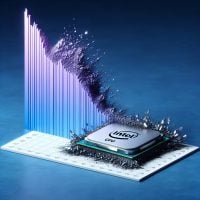
Since then, sentiment has cooled. The stock fell 29.07% over the past month to $86.96, though it is still up 135.66% year to date.
Analysts Expect Another Big Step Up
| Metric | Q3 2026 Consensus | YoY Growth | FY 2026 Consensus | YoY Growth |
|---|---|---|---|---|
| Normalized EPS | $0.3953 | 71.87% | $1.5297 | 273.10% |
| Revenue | $16.47 billion | 20.66% | $63.18 billion | 19.53% |
Estimates have risen fast. Over the past 30 days, analysts made 30 upward EPS revisions and zero downward ones. Management guided to $0.38 in EPS on revenue of $15.8 billion to $16.8 billion.

Gross Margin and Foundry Losses Will Decide the Reaction
I’ll be watching gross margin first. On the July call, CFO David Zinsner guided to a flat 42% non-GAAP gross margin. Reserve reversals help, but early Panther Lake and Granite Rapids products still sit below the corporate average. His stated goal: “to get gross margins comfortably into the 40s in every quarter.”
Intel Foundry carries more risk. Its operating loss narrowed by $348 million to $2.1 billion, and Intel 18A output ran about 25% above target. External foundry revenue was only $293 million, so you should look for named outside customers, especially for Intel 14A. Its 0.9 PDK was due in October. Intel also cut the cost of its main Panther Lake chip by about 50% this year.
Supply matters too. Zinsner said “server CPU demand continues to far outpace available supply,” and new capacity is weighted toward late Q3 and Q4. I want to see whether pricing holds while client revenue remains about flat and memory costs weigh on PC demand.
A 57x Multiple Demands Clean Execution
At $86.96, Intel trades near 57x full-year 2026 consensus EPS. That premium leaves little room for error. Capex will top $20 billion this year and rise significantly in 2027, so foundry losses must keep shrinking to protect cash flow. If margins hold in the 40s and outside customers appear, the turnaround gains real proof. Last month’s slide shows how quickly the market’s patience can fade.

Contact [email protected] for any questions or corrections.
After two decades of patrolling the dark corners of suburbia as a police officer, Rich Duprey hung up his badge and gun to begin writing full time about stocks and investing. For the past 20 years, he’s been cruising the markets looking for companies to lock up as long-term holdings in a portfolio while writing extensively on the broad sectors of consumer goods, technology, and industrials. Because his experience isn’t from the typical financial analyst track, Rich is able to break down complex topics into understandable and useful action points for the average investor. His writings have appeared on The Motley Fool, InvestorPlace, Yahoo! Finance, Money Morning, and, of course, 24/7 Wall St. He has been featured in both U.S. and international publications, including MarketWatch, Financial Times, Forbes, Fast Company, and USA Today.