Is Money for AI Data Centers Drying Up? Here’s Who Could Come Out on Top.
Elon Musk says debt markets have nearly shut off funding for AI data centers and predicts a wave of half-built facilities with nowhere to go. Whether that warning reflects reality or just one billionaire's opinion depends on what happens next…

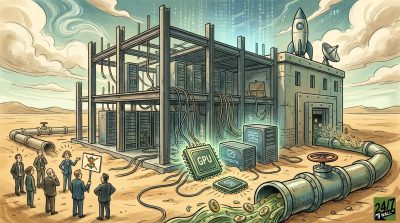
On October 25, 2026, Elon Musk wrote on X that “debt markets have almost entirely shut off access to money for any company that doesn’t have substantial revenue independent of AI data centers.” In another post on the same day, he warned: “I think we’re going to see a lot of stranded compute in partially complete data centers.” Musk said SpaceX closed $40 billion in debt financing for GPUs regardless. He credited that to being “investment grade” (a credit rating that tells lenders a borrower is low risk) and to having Starlink and launch revenue.
The data center builder on this list moved in premarket trading on October 26. Applied Digital (NASDAQ:APLD) slipped 1.6% to $17.95. Its suppliers held firm. Coherent (NYSE:COHR | COHR Price Prediction) edged up fractionally, and Arista Networks (NYSE:ANET) rose 1.3%. Much of the damage came earlier. Over the past month, Applied Digital fell 34.1% and Coherent 30.3%.
What Musk and Chamath Actually Said
On October 24, Social Capital founder Chamath Palihapitiya posted on X: “Power is the binding constraint. This is why prices continue to climb so ferociously.” Musk answered “Pretty much” and added the point about financing. “Stranded compute” means chips and capacity left sitting in half-built data centers after the money to finish them runs out. In a follow-up post, Musk wrote: “Delivering on projected cash flow is what matters.”
Only one hard fact came out of the exchange: Musk’s statement that SpaceX closed its GPU debt. He did not name the lenders, the interest rate, or the length of the loans.
Reality Check: No Names, No Data
So, Musk named no companies. He offered no data for “the past few weeks.” His claim about the debt markets is just his opinion. There is evidence against it, too.
I/O Fund founder Beth Kindig posted a report that Anthropic is offering a yield of more than 10% on a $9 billion junior debt tranche, the piece of a loan that gets repaid last. That report is unconfirmed. If it holds, money is still available, but at a steep price.
Applied Digital fits Musk’s description most closely. Its only revenue outside AI comes from crypto hosting, worth $37.8 million in the latest quarter. In its favor, its leases are signed: about $36 billion of contracted revenue over the initial 15-year terms. Against that, it carries $6.4 billion of debt versus $3.7 billion of cash, and most of its revenue depends on two tenants. That combination helps explain the sell-off in debt-funded AI builders and Ray Dalio’s debt-crisis warning.
Who Could Still Win
Comments from Nvidia (NASDAQ:NVDA) CEO Jensen Huang that circulated on X on October 24 point toward the parts suppliers: “Scale up is going to become optical” and “I’m fairly certain the number of switches we need is going to increase.” That is his view, not a confirmed forecast.
All that optical and switching gear has to come from somebody, which is the whole idea behind the suppliers worth watching here (we pulled together seven of them, from power to networking, in a free AI infrastructure report):
- Coherent: Data center sales make up 79% of its revenue, so it gains the most from optics. But $1.1 billion of capital spending has driven its free cash flow yield (the cash it generates relative to its market value) to −2.5%.
- Arista: The company guided to about $3.3 billion in third-quarter revenue. Its own filings flag heavy dependence on a few large customers.
- Marvell Technology (NASDAQ:MRVL): Customers commit to its chips before the data centers are built. Delays pushed revenue into later quarters rather than eliminating it. Its guide is $3.15 billion ±5%.
- Broadcom (NASDAQ:AVGO): On September 2, 2026, Hock Tan told analysts, “Even as we ship the chips, will they be deployed on a timely basis?” Its guidance still calls for $21.7 billion in AI revenue.
Is the AI Buildout Slowing or Just Consolidating?
The expansion is consolidating. Borrowers with investment-grade ratings and revenue outside AI keep getting funded. Builders that depend only on leases pay more for money or wait. For now, suppliers continue selling to the strongest buyers, and Applied Digital carries the most risk on this list.
Two things will show who is right. First, Arista’s and Marvell’s next earnings reports, measured against the $3.3 billion and $3.15 billion guides. Second, Applied Digital’s next debt deal. If it prices above the 7.000% coupon on its existing notes, the pressure Musk describes has reached builders with signed contracts.
Contact [email protected] for any questions or corrections.
Trey has been an editor and author at 24/7 Wall St. for more than a decade, where he has published thousands of articles analyzing corporate earnings, dividend stocks, short interest, insider buying, private equity, and market trends. His comprehensive coverage spans the full spectrum of financial markets, from blue-chip stalwarts to emerging growth companies.
Beyond 24/7 Wall St., Trey has created and edited financial content for Benzinga and AOL's BloggingStocks, contributing additional hundreds of articles to the investment community.
Trey's editorial expertise extends across multiple publishing environments. He served as production editor at Dearborn Financial Publishing and development editor at Kaplan, where he helped shape financial education materials. Earlier in his career, he worked as a writer-producer at SVE. His freelance editing portfolio includes work for prestigious clients such as Sage Publications, Rand McNally, the Institute for Supply Management, the American Library Association, Eggplant Literary Productions, and Spiegel.
Outside of financial journalism, Trey writes fiction and has been an active member of the writing community for years, moderating workshop sessions at regional conventions.