Cisco Is Up 47%, IBM Is Down 13%. Which Dividend Stock Is Better for Retirement?
Cisco and IBM have moved in opposite directions this year, and that gap reshapes which one actually puts more money in a retiree's pocket over time. The answer depends on which trade-off you can afford to make.

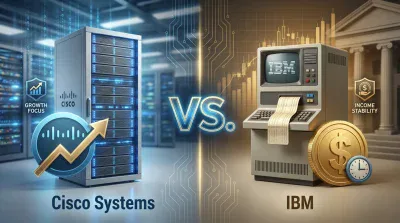
Cisco Systems (NASDAQ:CSCO | CSCO Price Prediction) or IBM (NYSE:IBM): which old-guard tech dividend holds up better for someone saving for retirement right now? This year, the two stocks have gone in opposite directions. Cisco is up 46.77% year to date at $111.03. IBM is down 13.13% at $252.18. That gap changes how much income a new buyer gets today.
We compared the two on three things that matter to anyone living off dividends: current income, payout safety and the balance sheet, and the business growth that pays for future raises.
Current Income: IBM Writes the Bigger Check
IBM yields 2.67%, compared with 1.56% for Cisco. Its forward annualized dividend is $6.76 per share. Cisco’s is $1.68. IBM has paid consecutive quarterly dividends every year since 1916, and its April 2026 raise was its 31st consecutive annual increase. Cisco’s run stands at 15 consecutive years.
IBM’s weak spot is how slowly the payout grows. Its quarterly dividend went from $1.66 in early 2024 to $1.69, a gain of about 1.8%. Over the same period, Cisco’s rose from $0.39 to $0.42, about 7.7%. Still, for retired people spending income now, IBM pays far more per dollar invested. Winner: IBM.
Payout Safety and Balance Sheet: Cisco Has More Cushion
Cisco paid $6.6 billion in dividends in fiscal 2026 out of $14.18 billion in operating cash flow, so the dividend used about 47% of operating cash. Its forward dividend works out to roughly 33% of the low end of fiscal 2027 non-GAAP EPS guidance, which is $5.05 to $5.11. Cisco closed the fiscal year with $15.9 billion in cash and investments. It also has $8.1 billion left on its buyback authorization.
IBM’s coverage is tighter. Over nine months, it paid $4.8 billion in dividends against about $8 billion of free cash flow, or 60%. Its forward dividend is about 58% of trailing EPS of $11.72. Debt stood at $63.8 billion, including $12.7 billion tied to its financing arm, against $11.1 billion in cash. That follows $11.4 billion in acquisitions this year. CFO Jim Kavanaugh described “a solid investment-grade balance sheet,” and he’s right, but Cisco has more room for error. Winner: Cisco.
Business Momentum: Cisco’s AI Networking Cycle Pulls Ahead
Cisco’s fiscal fourth-quarter revenue rose 17.6% to $17.25 billion. Non-GAAP EPS of $1.22 beat the $1.17 estimate, its fifth straight beat. Product orders rose 35%, and AI infrastructure orders reached $9.3 billion for the year. Chief Executive Chuck Robbins said, “We believe we are only at the beginning of this super cycle.” The weak spot is gross margin, which fell to 66.3% from 68.4% as AI hardware made up more of sales.

IBM’s third-quarter revenue grew 4.7% to $17.10 billion, with Red Hat up 11%. Consulting grew just 0.2%, and IBM Z revenue fell 20%. Full-year guidance calls for 4% to 5% constant-currency growth. That rate supports small, steady raises and little more. Cisco’s valuation premium is modest: 20 times forward earnings versus 17 for IBM. Winner: Cisco.

Verdict: Cisco Is the Stronger Retirement Dividend
Cisco takes two of the three categories. Its dividend is growing faster, uses a smaller share of earnings, and is backed by faster sales growth. Over 10 years, its shares returned 386.17%, compared with 162.51% for IBM. The trade-off is volatility: Cisco’s beta is 0.979, against 0.724 for IBM.


IBM fits one narrower profile: a retired people already drawing down savings who needs the highest yield today and values a payout record dating to 1916 more than growth (we ranked ten of the longest-running dividend payers by valuation in a free Dividend Kings report). For an income stream that has to beat inflation for the next decade or longer, Cisco’s profile is the closer match. In Cisco’s next earnings report, check gross margin against the 65%-66% guidance. At IBM, track debt as recent acquisitions are folded in.
Contact [email protected] for any questions or corrections.
Chris Lange is a financial and geopolitical writer with more than a decade of experience covering a myriad of topics. He has published thousands of articles for 24/7 Wall St., with past coverage focused heavily on stocks, IPOs, healthcare, defense, global affairs, and technology.
His work has been quoted, or referenced by a number of outlets including Business Insider, USA Today, Yahoo Finance, MSN, The Motley Fool, and many other publications. A graduate of Southwestern University, he studied business with a focus on investments and has previous experience in banking and startups.
When not reading or writing the news, he is following his passion for Lacrosse, playing chess, or building solar projects with his dad.