Seagate’s Most Important Opportunity May Be Sitting in Your Data Center
Seagate stock shed 30% in a single month even as revenue surged 48% and contracts locked in demand through 2028, leaving investors to decide whether the selloff is a warning or the setup of the year.


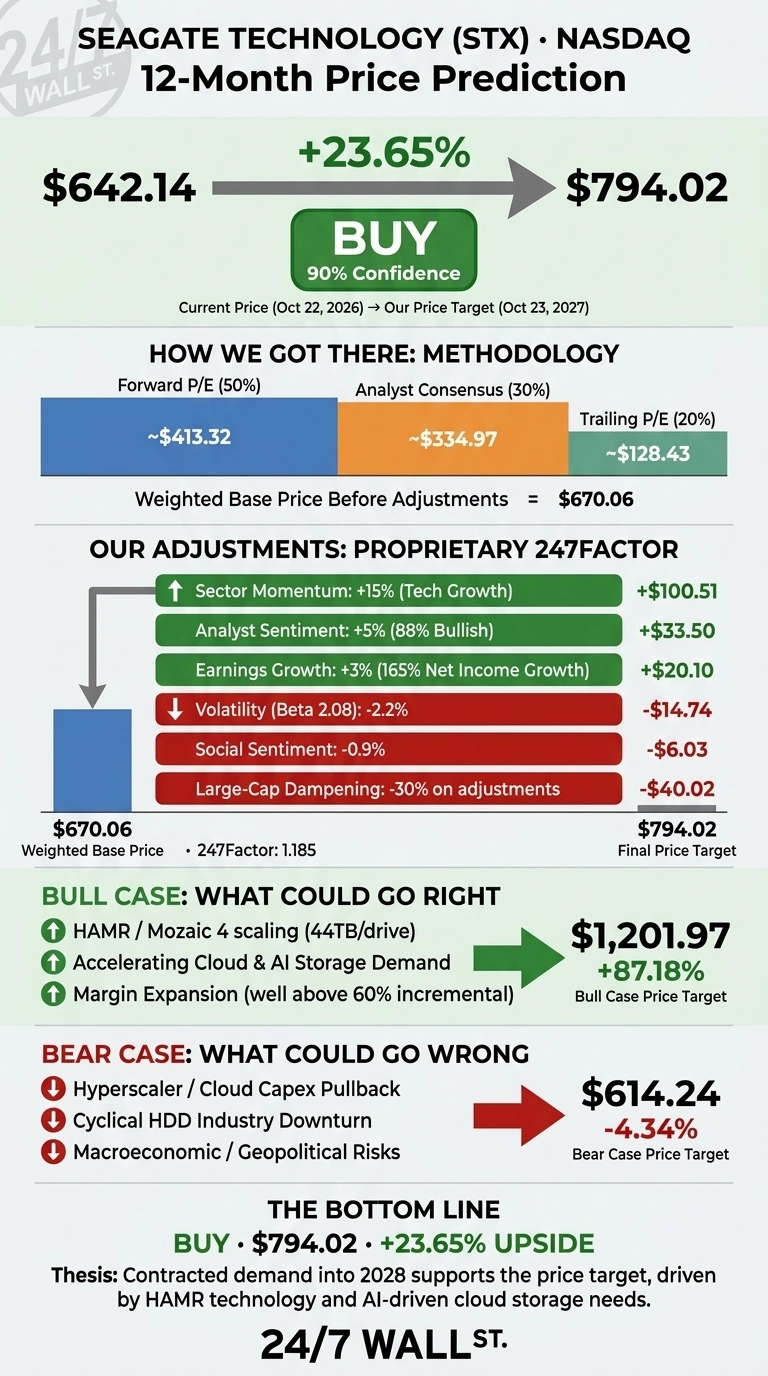
Seagate Technology (NASDAQ:STX | STX Price Prediction) closed at $642.14. The 24/7 Wall St. price target is $794.02, which means 23.65% upside over the next 12 months. The stock gets a buy rating with 90% confidence, which counts as high conviction.
24/7 Wall St. Price Target Summary
| Metric | Value |
|---|---|
| Current Price | $642.14 |
| 24/7 Wall St. Price Target | $794.02 |
| Upside/Downside | 23.65% |
| Recommendation | BUY |
| Confidence Level | 90% |

On the July call, CEO Dave Mosley said “data center demand now represents approximately 90% of our exabyte shipments” and that most nearline exabytes are “allocated into calendar 2028.” The selloff prices in a cycle peak that Seagate’s contracts don’t yet show.
Seagate Lost 30% in a Month Despite Record Results
Shares fell 7.86% on October 22, 7.05% over the week and 30.13% over the past month. They are still up 133.96% year to date. The stock sits 43.8% below its 52-week high of $1,143.27 and about 197% above its low of $216.39. This week, Morgan Stanley (NYSE:MS) made a bullish case for battered Seagate and Western Digital (NASDAQ:WDC) shares, according to Barron’s.
Fundamentals improved: fiscal Q4 revenue reached $3.63B, up 48.5% and ahead of the $3.49B consensus. Non-GAAP EPS came in at $5.71 against a $5.09 estimate, the fourth straight beat.
Non-GAAP gross margin expanded to 52.7% from 37.9%. For fiscal Q1, management guided to revenue of $4.10B ± $100M and EPS of $7.30 ± $0.20.
Why Bulls See $1,200 Ahead
HAMR technology is the growth engine. Exiting fiscal 2026, HAMR products made up about 40% of Seagate’s nearline exabyte run rate. Mozaic 4, which supports up to 44 terabytes per drive, is scaling up with the two largest cloud providers. Mozaic 5 is on track for qualification shipments in late calendar 2027.
Because each disk holds more data, profit grows without adding factory output. Management said incremental gross margin is “well above the 60% figure.” Agentic AI could add more demand as KV cache data spills onto hard drives, and so could physical AI, though Mosley called both “very early days.”

Wall Street mostly agrees: 4 Strong Buys, 18 Buys, 2 Holds and 1 Strong Sell. The bull case hits $1,201.97, an 87.18% gain.

Risks That Could Stall the Storage Upcycle
Hard drives have a long history of boom-and-bust cycles, and Seagate depends heavily on a small group of hyperscalers whose capex plans drive the whole order book (we profiled seven of the non-chip suppliers riding that same expansion, from power to cooling to storage, in a free report).
Other risks include dilution from the Exchangeable Senior Notes due 2028, tariffs, exposure to the Middle East conflict and settlement payments to the Commerce Department’s BIS. Still, contracts set product configuration and pricing for all of calendar 2027, and Seagate paid down $1.40B of debt. The bear case sits at $614.24, a decline of just 4.34%.
Seagate Trades Below Western Digital’s Multiple
Western Digital is the other half of the HDD duopoly. In fiscal Q1, its revenue grew 55.46% and non-GAAP gross margin hits 58.1%. It trades near 23x forward earnings, compared with our about 18x for Seagate.
Micron Technology (NASDAQ:MU) gives a memory-side contrast. At about 7x forward earnings, it shows how cheaply the market prices AI hardware it views as cyclical.
| Company | Forward P/E | TTM Operating Margin |
|---|---|---|
| Seagate | 18x | 43.1% |
| Western Digital | 23x | 43.6% |
| Micron | 7x | 80.7% |
Seagate’s margins are almost the same as Western Digital’s, yet it trades at a lower multiple. That makes the 24/7 Wall St. price target look reasonable, and arguably conservative.
Contracted Demand Supports a BUY
The 24/7 Wall St. price target of $794.02 carries a buy rating and 90% confidence. The critical factor is supply that is already allocated into 2028.
The thesis improved if fiscal Q1 results land near guidance and Mozaic 4 hits its milestones. It weakens if hyperscalers start shortening their planning horizons. Those are the signals to watch from here.
| Year | 24/7 Wall St. Price Target |
|---|---|
| 2026 | $794.02 |
| 2027 | $910.18 |
| 2028 | $1,050.87 |
| 2029 | $1,139.69 |
| 2030 | $1,207.07 |
The outlook depends on Seagate keeping its HAMR roadmap on track. A sharp cut in hyperscaler capex is the biggest downside risk, while demand from agentic and physical AI is the biggest source of upside.
Contact [email protected] for any questions or corrections.
Vandita Jadeja is a financial publisher with over a decade of experience writing about financial topics, including investment, savings, retirement, insurance and banking. Vandita is a Chartered Accountant who loves to debunk financial concepts for readers.
Her work has appeared on sites that include The Motley Fool, InvestorPlace, and Benzinga. She covers investing and focuses on stock picks and price prediction for 24/7 Wall St.
When not looking for the next stock investment opportunity, she can be found traveling, reading, chasing sunsets and enjoying her iced latte.