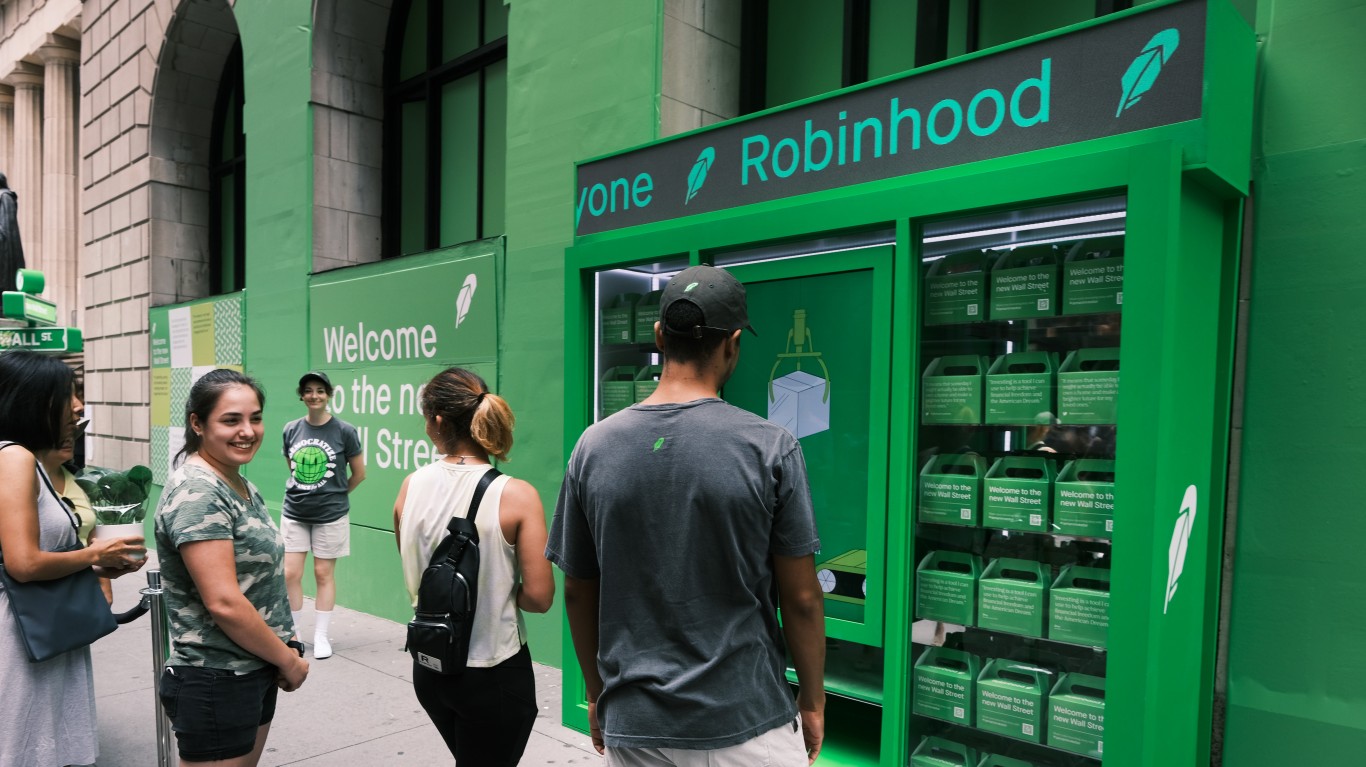
200,000 Robinhood Customers Now Let AI Trade for Them
Robinhood just launched AI agents that can trade on your behalf without asking permission, and customers are already moving real money in. But after-hours investors punished the stock anyway, and the reason tells you something important about where agentic trading…


Robinhood (NASDAQ:HOOD | HOOD Price Prediction) said about 200 thousand customers have opened accounts that let AI agents trade for them. The company disclosed the figure in its third-quarter 2026 results after the close on October 27, 2026.
About 150,000 customers had opened these accounts. They did so by the September 30 launch of Robinhood Agents, one of 17 new products announced at the company’s HOOD Summit in Houston. To date, the accounts have generated more than $1.6 billion in cumulative notional volume, the total dollar value of trades placed.
Shares closed that day at $94.56, up 1.85%. They then fell 7.63% to $87.34 after hours as of 7:59 PM ET, because a revenue miss counted more to investors than the AI milestone. Agentic trading has yet to prove it can become a meaningful revenue source alongside a $396 billion platform.

What Opened Accounts Really Tell You
Agents can trade only with money a customer moves into a separate agentic account, and every trade needs the customer’s approval unless the customer turns that setting off.
Chairman and CEO Vlad Tenev said on the call that customers have over $250 million in agentic accounts. “Remember, the accounts start at zero, so you have to make a choice to move money into them,” he added.
That balance is a fraction of the platform’s total assets, and Robinhood did not say how many customers have turned off approval and let an agent trade on its own.
How Robinhood Gets Paid When AI Trades
Robinhood offers models from Anthropic and OpenAI, and customers pay for that usage through Robinhood. The company did not disclose what it makes from that billing.
The larger return would come indirectly, because every order an agent places adds to transaction revenue. That line reached $867 million, up 19%. Options revenue rose 31% to $399 million, and event contracts revenue grew more than 6x to $173 million.
If agents make options strategies easier to run, the gains will show up in those lines and in Gold subscriptions, which reached a record 5.2 million.
Risks of Handing Trades to Software
Customers are responsible for their agents’ trades. If autonomous agents accumulate losses in a fast market, regulators would likely scrutinize that policy, and Robinhood’s reputation could suffer.
At the launch, Robinhood VP of product management Abhishek Fatehpuria said: “very few people are going to go and put a large portion of their net worth in their agentic account.” Crypto revenue fell 55% to $120 million. That shows how quickly a trading line can reverse.
Mixed Results Behind the AI Headline
Total net revenue hit a record $1.42 billion, up 12%. That still fell short of the Wall Street analyst consensus of roughly $1.43 billion, missing by about 2.1%. Adjusted EPS of $0.60 beat the Wall Street analyst consensus of $0.55, but GAAP diluted EPS fell 16% to $0.51.
Net interest revenue dropped 9%, and net income fell 14% to $476 million. Robinhood brought down the top of its 2026 range for adjusted operating expenses plus stock-based compensation to $2.75 billion.

CFO Shiv Verma shared the figures. He said October net deposits had exceeded $13 billion month-to-date, including a one-time $6 billion from the Dell family’s contribution to Trump Accounts.

What Investors Should Watch in HOOD Stock Next
The after-hours drop shifts focus to whether the core business can offset slower revenue growth. Agentic trading is too small to move the results yet, so treat it as a possible source of future trading volume.
The core business is still growing. Gold subscribers rose 34%, net deposits reached $15.7 billion, and ARPU (average revenue per user) hit $200. At $87.34, the shares sit far below their 52-week high of $150.47.
The main risk is that slower revenue growth and falling interest income keep pressure on earnings. Check the fourth-quarter report. The bullish case holds if agentic balances climb well above Vlad Tenev’s $250 million mark and deposits stay strong without the Dell money. It would break if shares close below the 52-week low of $63.52.
Contact [email protected] for any questions or corrections.
Omor Ibne Ehsan is a writer at 24/7 Wall St. He is a self-taught investor with a focus on growth, cyclical, and dividend equities that have strong fundamentals, value, and long-term potential. He also has an interest in high-risk, high-reward investments such as penny stocks.