OpenAI Now Makes Up 11% of Microsoft’s Revenue
Microsoft's latest quarterly filing reveals it partly owns one of its biggest customers, and the money flowing between them is growing faster than most investors realize.

Microsoft (NASDAQ:MSFT | MSFT Price Prediction) filed its quarterly report for the three months ended September 30 with the SEC on October 28, 2026. It shows $10.0 billion of revenue from OpenAI, out of total revenue of $92.279 billion at Microsoft. That is about 10.8%, which means Microsoft partly owns one of its largest customers.
The stock closed at $531.01, down 0.06%. After hours, it rose 2.90% to $546.39 as of about 7:59 p.m. ET. OpenAI revenue helps justify Microsoft’s data center expansion, but it also links more of the payback to one private customer that needs a lot of cash.

What Microsoft’s Filing Actually Discloses
The filing calls the figure “revenue from commercial arrangements with OpenAI, inclusive of revenue-sharing payments,” so it covers more than Azure cloud purchases. Microsoft reports it because OpenAI is an equity-method investee, meaning Microsoft owns enough of it to count its share of OpenAI’s results, and that makes OpenAI a related party.
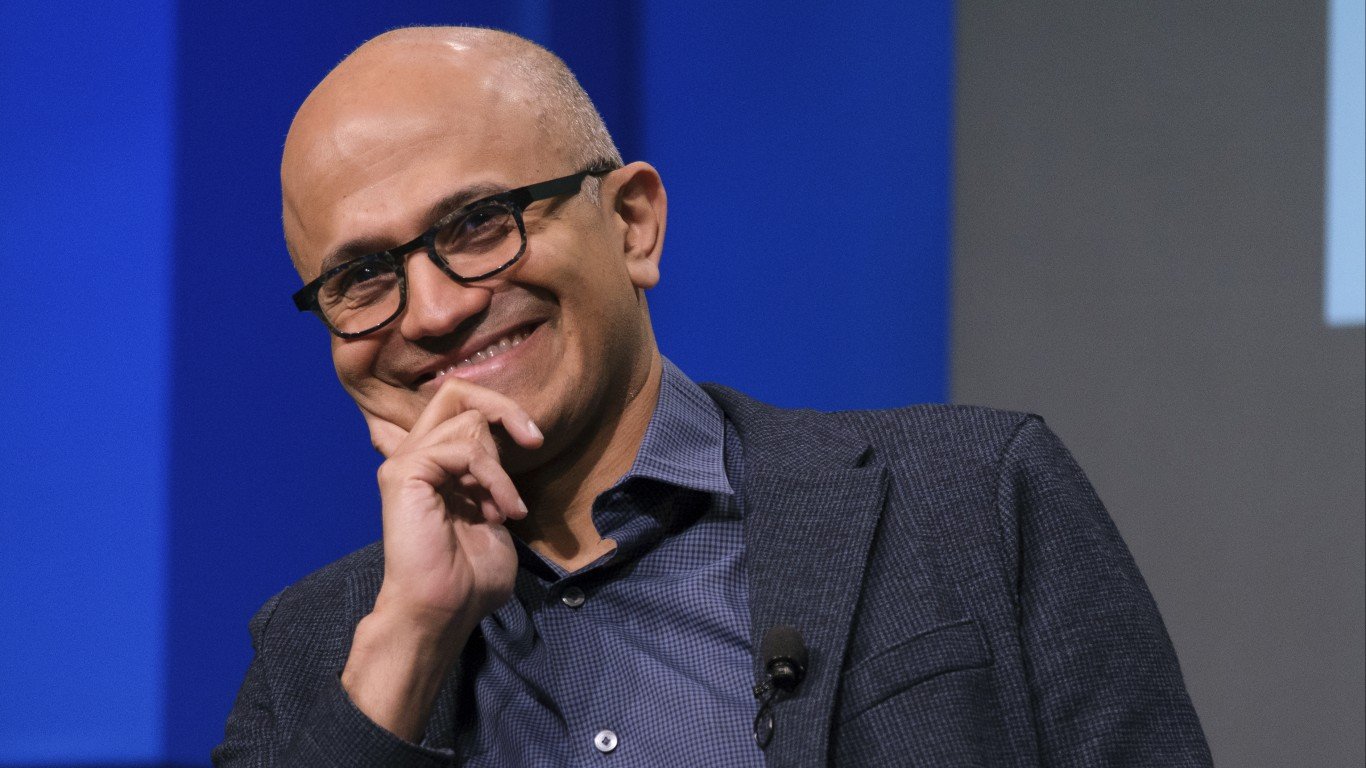
Goldman Sachs analyst Gabriela Borges rounded the share to 11% on the earnings call, telling CEO Satya Nadella, “you have OpenAI at 11% of revenue in the quarter.” Microsoft itself did not give that number.
In fiscal 2026, OpenAI was about 7.3% of revenue: $24.1 billion out of $331.839 billion. The September quarter alone produced roughly 41% of that full-year total.
Supplier, Investor and Creditor at Once
OpenAI owed Microsoft $7.2 billion at September 30, up from $6.0 billion at June 30. That is a 20% rise in three months. Receivables are bills sent but not yet paid, so this rise means Microsoft is giving more trade credit to a company it partly owns.
Microsoft holds “an approximate 24% interest on an as-converted basis,” down from about 25% at June 30. It has paid $12.0 billion of its $13.0 billion commitment.
Other income showed net profits of $272 million on OpenAI investments, compared with net losses of $4.1 billion a year earlier. As a result, GAAP EPS of $4.92 came close to non-GAAP EPS of $4.89, which excludes the OpenAI impact.
Growth Still Looks Strong Beyond One Customer
Revenue grew 19% to $92.3 billion from $77.673 billion. Net income rose 32% to $36.6 billion, and Azure grew 48%.
Growth this broad would likely still look strong without OpenAI. A rising share also gives OpenAI more leverage on price, because Microsoft needs its workloads to fill the new capacity it is building, and that capacity story goes well beyond the chipmakers (we covered seven suppliers of power, cooling, and networking behind the data-center boom here).


Microsoft’s Hedges and Its Spending Bill
Nadella said coding-agent users want “Anthropic and OpenAI, by the way, to compete for your workload, not like once a quarter, but for every task.” Microsoft says its own MAI models target “capabilities comparable to leading models within 3 to 6 months of their release at a fraction of the training cost.”
CFO Amy Hood said capital spending (capex) of $45.2 billion came in lower “as some third-party capacity deliveries we expected in Q1 were delayed.” Hood expects December-quarter capex of over $50 billion. Hood put calendar 2026 spending at approximately $170 billion, slightly below her July 29 guidance of about $175 billion. Free cash flow was $18.6 billion, and Hood expects it to stay positive through fiscal 2027.
What the OpenAI Concentration Means for Microsoft Investors
Microsoft’s fundamentals look solid. Net income is growing faster than revenue while capex continues to rise, and free cash flow remains positive.
The OpenAI concentration and the rising receivables are real risks. But Microsoft discloses them, and its MAI models give it a fallback if OpenAI gains more pricing power.
Alphabet (NASDAQ:GOOG, NASDAQ:GOOGL) fell 9.97% after hours to $292.50 from a $324.89 close. At that close, it was worth $3.97 trillion, compared with Microsoft at $3.94 trillion. At after-hours prices as of about 7:59 p.m. ET on October 28, Microsoft’s implied value of about $4.05 trillion was above Alphabet’s about $3.57 trillion. That is only an estimate until the October 29 close confirms it.
Microsoft’s next quarterly report is expected in late January 2027, although the company has not confirmed the date. If it shows OpenAI’s share still rising, receivables above $7.2 billion, and the stake below the approximate 24% level, concern about Microsoft’s dependence on OpenAI grows.
Contact [email protected] for any questions or corrections.
Omor Ibne Ehsan is a writer at 24/7 Wall St. He is a self-taught investor with a focus on growth, cyclical, and dividend equities that have strong fundamentals, value, and long-term potential. He also has an interest in high-risk, high-reward investments such as penny stocks.