Wendy’s Gets a Lifeline, but Kohl’s May Be the Smarter Buyout Bet
Trian Fund just threw a lifeline to a struggling fast-food chain, but the real buyout prize may be hiding in plain sight inside a completely different sector with cheaper valuations and over a billion dollars in free cash flow.

A group led by Nelson Peltz’s Trian Fund Management has offered to take Wendy’s (NASDAQ:WEN | WEN Price Prediction) private in an all-cash deal worth $1.4 billion, according to a regulatory filing reported by CNBC. The offer of $7.35 per share is a 20% premium to Wendy’s closing price on October 27. Trian and its affiliates already own 16.3% of the company, which makes them the largest shareholder. The rest of the buying group consists of BlueFive Capital, Sixth Street Partners, and Flynn Group, one of Wendy’s largest franchisees.
In premarket trading, the stock was at $7.08, up 12.6% for the week. CNBC noted that shares had fallen 65% over two years and that same-store sales have declined for six straight quarters. TD Cowen analyst Andrew Charles told CNBC: “In our view, a take private makes sense as Wendy’s turnaround is likely to be prolonged given the challenged state of the lower income consumer and soft state of the quick service burger category.” The bid is still only an offer.
What Makes a Company an Ideal Buyout Target
In a leveraged buyout, the buyer borrows heavily to purchase a company and then pays the loans back out of the target’s own cash. EBITDA (earnings before interest, taxes, depreciation, and amortization) is a rough measure of operating profit. Free cash flow is the cash left over after the company pays for equipment and buildings. Lenders favor targets with:
- Steady, predictable free cash flow
- Low capital spending needs
- Little existing debt, which leaves room to borrow
- A cheap valuation relative to EBITDA
- A mature, stable business with costs to cut
- Hard assets, such as real estate, that can secure loans
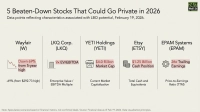
Below, four candidates are ranked against that checklist, counting down to the best fit.
4. DigitalOcean Is Growing Too Fast to Load With Debt
DigitalOcean (NYSE:DOCN) grew revenue 28.6% last quarter, and its AI customer annual recurring revenue (ARR) jumped 212% to $234 million. That growth is expensive to buy. The stock trades at 34x EV/EBITDA, and the market cap is $12.3 billion. Capital spending in 2025 was $268.5 million against operating cash flow of $309.6 million, which leaves little cash to repay a lender. Risk: shares fell 22.2% in a month, a sign of how quickly an AI premium can fade.
3. Etsy Throws Off Cash but Costs Too Much
Etsy (NASDAQ:ETSY) produced $693.4 million in operating cash flow in 2025 and spent just $54.7 million on capital projects. Its adjusted EBITDA margin was 30.4% last quarter. The Depop sale produced an $839.7 million gain, and Etsy bought back about $394.6 million of stock in the third quarter. Years of buybacks have pushed book value negative, to −$15.10 per share. With an $8.5 billion market cap and a 17x EV/EBITDA multiple, Etsy is the second-most expensive name on this list. Risk: CFO Lanny Baker leaves on March 1, 2027.
2. Dropbox Fits the Model but Has Already Borrowed
Dropbox (NASDAQ:DBX) generated $235.2 million in free cash flow last quarter. In 2025, capital spending was only $21.0 million against operating cash flow of $951.8 million. Revenue rose just 0.9%, the steady, slow profile buyout firms favor, and the stock trades at 13x EV/EBITDA. Dropbox has already used much of its borrowing room. Its term loan has grown to $2.6 billion, stockholders’ equity is negative $2.2 billion, and quarterly interest expense rose to $50.0 million from $18.6 million. Risk: the adjusted EBITDA margin slipped to 39.7% from 41.5%.
1. Kohl’s Checks the Most Boxes
Kohl’s (NYSE:KSS) trades at 6x EV/EBITDA and 0.7x book value, the lowest multiples in this group. It generated $1.0 billion in free cash flow in fiscal 2025. Cash rose to $821 million from $174 million, and the company had zero borrowings on its revolving credit line. Interest expense fell to $63 million from $78 million. Its real estate portfolio across more than 1,100 stores could back new loans. Private equity has bid for Kohl’s before, with suitors including Sycamore and Franchise Group. Management also raised its 2026 adjusted EPS outlook to $1.80 to $2.40. Risk: second-quarter results got a lift from about $150 million in tariff refunds that may not repeat, and net sales still fell 0.9%.
Kohl’s Fits the Wendy’s Playbook Best
Trian’s offer goes after a well-known brand whose stock has fallen, whose cash flow can carry debt, and whose turnaround works better out of public view. Kohl’s matches that description most closely. It has the cheapest valuation, more than $1 billion in annual free cash flow, an empty revolver, and real estate to borrow against, all for a $2.7 billion market cap that a buyout group can realistically finance.


Contact [email protected] for any questions or corrections.
Trey has been an editor and author at 24/7 Wall St. for more than a decade, where he has published thousands of articles analyzing corporate earnings, dividend stocks, short interest, insider buying, private equity, and market trends. His comprehensive coverage spans the full spectrum of financial markets, from blue-chip stalwarts to emerging growth companies.
Beyond 24/7 Wall St., Trey has created and edited financial content for Benzinga and AOL's BloggingStocks, contributing additional hundreds of articles to the investment community.
Trey's editorial expertise extends across multiple publishing environments. He served as production editor at Dearborn Financial Publishing and development editor at Kaplan, where he helped shape financial education materials. Earlier in his career, he worked as a writer-producer at SVE. His freelance editing portfolio includes work for prestigious clients such as Sage Publications, Rand McNally, the Institute for Supply Management, the American Library Association, Eggplant Literary Productions, and Spiegel.
Outside of financial journalism, Trey writes fiction and has been an active member of the writing community for years, moderating workshop sessions at regional conventions.