Out of 993 Million DoorDash Orders, AI Agents Only Placed a Few Hundred
DoorDash just revealed exactly how many dinner orders AI agents have placed through its platform, and the number exposes a striking gap between Wall Street's fears and what customers are actually doing.

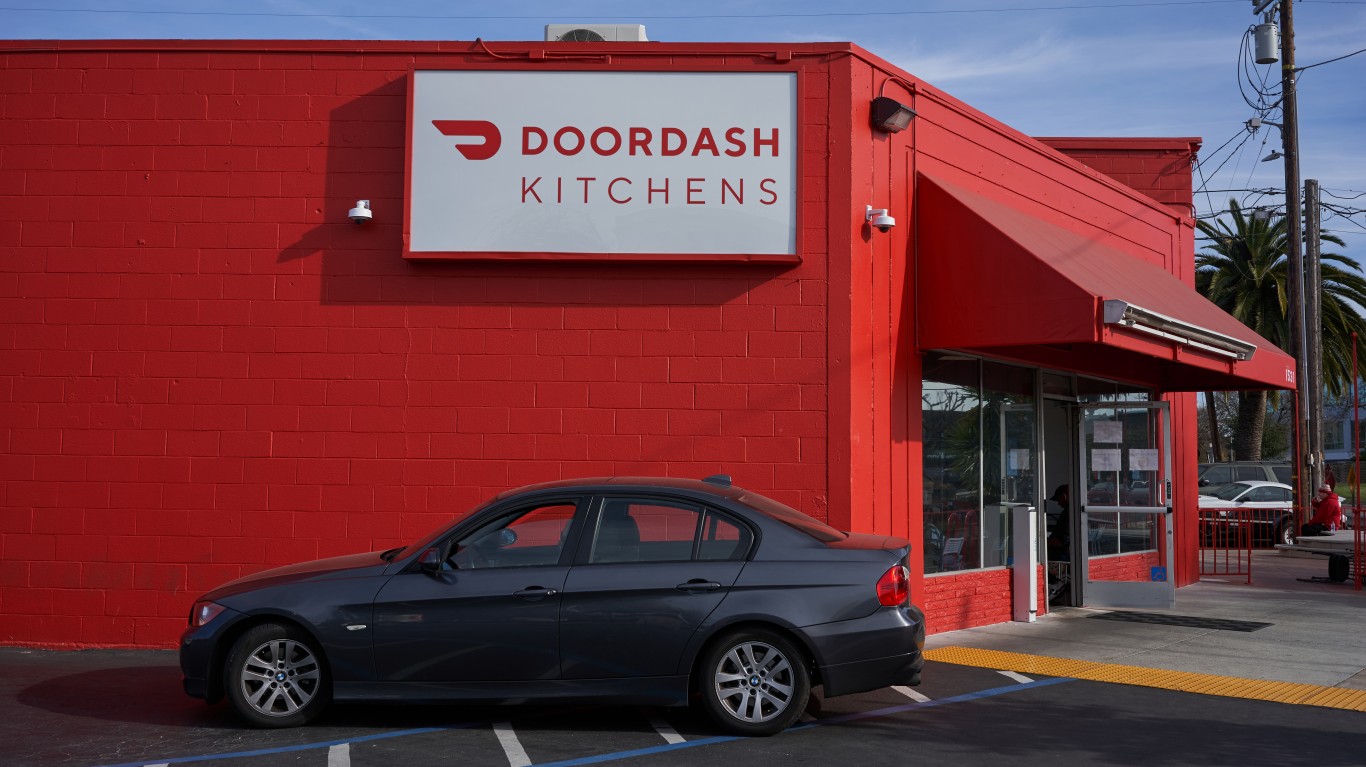
In a statement on October 29, 2026, DoorDash (NASDAQ:DASH | DASH Price Prediction) chief executive quantified the AI threat that has weighed on the stock, and it was small. He said third-party AI agents have generated “several hundred orders” since they went live. DoorDash handled 993 million orders in the third quarter alone.
The fear is that if an AI assistant orders dinner for you, DoorDash loses the customer relationship, the ad impressions and the chance to sell you a DashPass subscription. The call shows customers still order through the app, and DoorDash wants to be the delivery network that any agent has to use.
Shares closed at $179.00, up 5.61% or $9.51, for a market value of about $73.2 billion. They reached $181.26 after hours, up 1.26%. The stock was still down 20.96% year to date and 32.72% over one year.
What Tony Xu Said About AI Agents
Rothschild & Co Redburn analyst Dominic Ball asked how the business changes as consumers shop through AI agents. Tony Xu, speaking as co-founder and CEO, answered: “right now, AI agents are generating several hundred orders across the time that they’ve been up and running. So it’s been a fairly low use case.”
Earlier in the call, he told Cantor Fitzgerald’s Deepak Mathivanan, “The predominant use case of that is actually through our app.” In August, he described agentic partner volume as “quite low so far,” so the pattern has now held for two quarters.
The low count applies only to third-party agents. DoorDash shipped its own agents, Ask DoorDash and Text DoorDash, along with a Model Context Protocol (MCP) interface, which is a standard connection that lets outside AI agents place orders through DoorDash.
A Quarter Strong Enough to Shift the Debate
Revenue rose 34% to $4.6 billion. Marketplace gross order value (GOV), the total dollar value of orders placed, climbed 36% to $33.9 billion. Total orders grew 28%, but Deliveroo inflates that figure, and growth without it was 17%.
Profit grew faster than revenue. Net income attributable to common stockholders rose 91% to $466 million, or $1.06 per diluted share, and adjusted EBITDA increased 41% to $1.06 billion.
Fourth-quarter guidance calls for GOV of $35.4 billion to $36.4 billion and adjusted EBITDA of $900 million to $1.1 billion. The range is wide, which leaves room for changes in investment spending.

Why the Agent Risk Still Matters
Agent use is early, so low usage now tells you little about usage in a few years. By building MCP, DoorDash chose to supply agents instead of blocking them. That choice brings more order flow but gives the company less control over the customer.
DoorDash describes its defense as “winning the battle for atoms,” meaning its drivers, merchant density, routing and delivery speed. Software cannot easily copy that network, although it may do less to protect pricing once agents compare delivery apps on price for you.
Xu also said “there will be advertising opportunities even within some of these AI agents,” and added, “my take on all things technology is you never want to fight gravity.” DoorDash has not put a number on that advertising revenue.
What the Results Mean for DASH Stock Now
The results argue against the AI fear. Shares are priced for AI disruption that hasn’t shown up in the results, while the core business grew orders 17% without Deliveroo and profit outpaced revenue.
The larger risk is Instacart (NASDAQ:CART), a deal that ties up capital for years. DoorDash agreed to pay $65.00 per share, about $17 billion in equity value, at least 75% in cash, a 26% premium to Instacart’s October 22 close. Justifying that needs a multi-year push to $500 million or more in annual synergies, with closing expected by the end of 2027 or the first half of 2028.
This view can be tested against two signals. If fourth-quarter adjusted EBITDA lands within guidance and third-party agent orders remain minor, the market’s concern about agents may ease. A close below $167.40, the price when results were filed, would show the market still doubts the story.


Contact [email protected] for any questions or corrections.
Omor Ibne Ehsan is a writer at 24/7 Wall St. He is a self-taught investor with a focus on growth, cyclical, and dividend equities that have strong fundamentals, value, and long-term potential. He also has an interest in high-risk, high-reward investments such as penny stocks.